
 Español
 Türkçe
 Français
 عربي
عربي  dansk
dansk 한국어
한국어 Deutsch
 Việt Nam
 Italiano
 日本語
日本語 Português

The 15mm Tolerance Gap: Why Fragmented PEB Sourcing Fails
Consider a standard 15,000-square-meter industrial warehouse project in Southeast Asia. The shipping containers have cleared customs, and the crane is lifting the primary columns. However, during the initial erection phase, the bolt holes connecting the primary framing to the secondary purlins are misaligned by just 15 millimeters.
Furthermore, an inspection of the custom built-up sections reveals slight warping on the web plates, the direct result of a supplier rushing the welding process without proper thermal distortion control. The consequences are immediate: site operations grind to a halt, the erection schedule is delayed by weeks, and daily budget overruns accumulate through idle labor and heavy equipment rental costs.
This is a frequent reality in overseas engineering procurement. Many project managers and procurement officers fall into the trap of treating a Pre-Engineered Metal Building (PEMB) or Pre-Engineered Building (PEB) as a simple grocery list of isolated steel commodities. They buy heavy plates from one mill, purlins from a local roll-former, and cladding from another trading company, crossing their fingers that everything fits together seamlessly.
The reality is starkly different. A Pre-Engineered Building is exactly that-engineered. It is a highly integrated, zero-tolerance system where every millimeter of a steel flange and every micron of a painted surface must align perfectly.
Whether you are constructing a heavy industrial manufacturing plant, a multi-story commercial complex, or a sprawling logistics center, understanding the deep anatomy of these structures is your first line of defense against costly project delays. In this comprehensive, 360-degree guide, we will dissect the PEB system from the ground up. We will explore the raw materials, the critical fabrication components, the engineering standards, and the supply chain strategies required to ensure your next project is erected safely, on time, and within budget.
Structural Framing Steel: The Primary Skeleton
The primary framing is the load-bearing backbone of any steel structure. It absorbs and transfers all the massive forces of gravity, wind uplift, seismic activity, and dynamic operational loads (such as the movement of heavy overhead cranes). Compromising on the primary frame is compromising the structural integrity and lifespan of the entire building.

Structural Heavy Steel Plates: The Raw Foundation
Before a massive steel column takes its final shape, it starts its journey as a raw, flat steel plate. For large-span warehouses, multi-story public buildings, and heavy industrial facilities, standard pre-made profiles are often insufficient to carry the required loads. Instead, structural engineers rely on Structural Heavy Plates, typically ranging from 9mm to 50mm in thickness and sometimes exceeding 80mm for specialized columns.
The most critical decision at this stage is the selection of the steel grade. The grade dictates the yield strength, tensile strength, and, ultimately, the weight and cost of the building. Often, overseas architectural drawings will specify American or European standards. Understanding how to match these with equivalent high-quality Chinese grades can save a project millions of dollars in material costs.
| Common Structural Steel Grade Equivalency & Yield Strength | |||
| Standard | Steel Grade | Minimum Yield Strength (MPa) |
Primary Application Scenario |
| Chinese (GB) | Q235B / Q355B | 235 MPa / 355 MPa |
The global standard for PEB frames. Q355B offers the perfect balance of high strength, excellent weldability, and cost-efficiency. |
| American (ASTM) | A36 / A572 Gr50 | 250 MPa / 345 MPa |
Widely specified in North and South American engineering drawings. Fully interchangeable with Q235B and Q355B, respectively. |
| European (EN) | S235JR / S355JR | 235 MPa / 355 MPa |
Common in European, Middle Eastern, and African projects. |
| Bridge/Specialty | Q345q / Q355q | 345 MPa / 355 MPa |
Features superior fatigue resistance and impact toughness in sub-zero temperatures. Used in bridges and extreme dynamic load environments. |
Looking for a deeper technical analysis?
Read our detailed guide on [choosing steel grades for PEB primary frames: Q355 vs. S355 vs. A572].
Built-up Sections: The Art of Custom Steel Fabrication
When architectural designs call for clear, unsupported spans of 40 meters or heavy crane capacities exceeding 20 tons, standard rolled beams simply won't suffice. This is where heavy steel plates undergo rigorous fabrication to become Built-up Sections-specifically, custom welded H-beams, box columns, and cruciform columns.
This intricate fabrication process typically involves several critical stages:
- Precision CNC Cutting: Heavy plates are laser, plasma, or flame-cut into precise flanges (the horizontal top and bottom parts of the 'H') and webs (the vertical middle section). Accuracy here is non-negotiable; a deviation of a few millimeters will result in the erection nightmare described in our introduction.
- Stiffeners and Gusset Plates: To prevent the thin web from buckling under extreme compressive pressure, additional thick steel plates called "stiffeners" are welded at critical intervals along the beam. Gusset plates are also pre-welded to act as the connection nodes for bracing systems.
- Advanced Welding Standards (CJP vs. PJP): The connection between the flange and the web is the most vulnerable point of the beam. High-quality PEB systems rely on automated Submerged Arc Welding (SAW). Depending on the structural load, engineers will specify either PJP (Partial Joint Penetration) for standard loads or CJP (Complete Joint Penetration) for maximum strength. CJP requires the weld metal to fuse completely through the thickness of the joint, often verified by strict NDT (Non-Destructive Testing) like Ultrasonic Testing (UT) to ensure zero internal flaws.
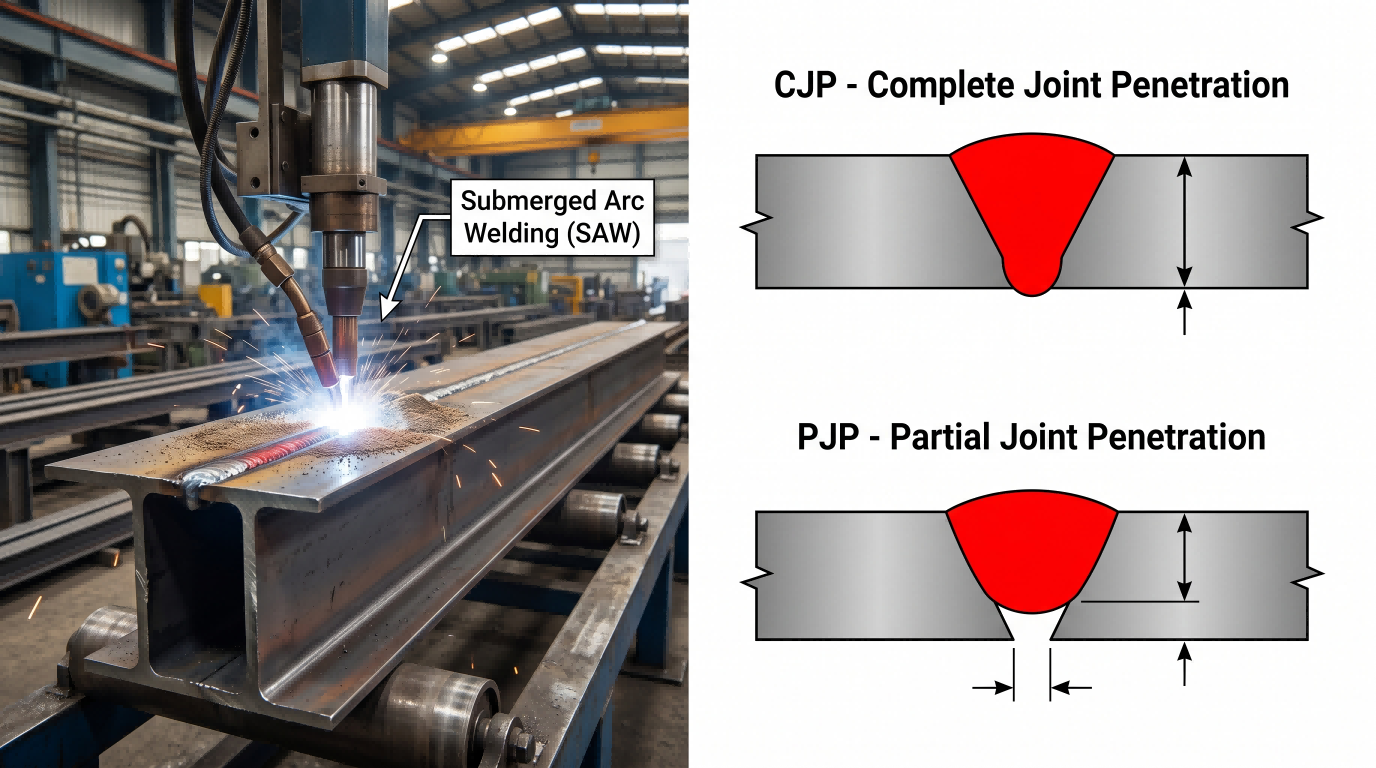
The Promisteel Supply Chain Advantage: Navigating the procurement of built-up sections can be overwhelming. As an international steel supply chain solution provider with our own dedicated processing capabilities, we bridge the gap between raw material sourcing and precision fabrication. We don't just supply the Q355B heavy plates; our facilities cut, drill, and weld them to your exact architectural drawings. We deliver ready-to-assemble components with full MTC (Mill Test Certificate) traceability, eliminating on-site guesswork and ensuring strict compliance with international welding codes.
Standard Rolled Profiles
For smaller structures, internal mezzanine floors, or less demanding primary supports, standard Rolled H-Beams and I-Beams offer a highly efficient alternative. Unlike built-up sections, these are hot-rolled directly at the steel mill into their final "H" or "I" shape. They offer a highly cost-effective solution with excellent structural integrity, provided the project requirements fit within standard, pre-manufactured dimensional parameters.
Secondary Structural Members: Support and Stability
If the primary framing acts as the skeleton, the secondary structural members are the ribcage. While they are lighter and thinner than heavy columns, they serve two absolutely vital purposes: they connect the massive primary frames together to provide longitudinal stability, and they create the structural grid onto which the exterior cladding (roof and walls) will be attached.
Purlins and Girts (The C and Z Profiles)
Purlins are the horizontal beams attached to the roof rafters, while girts are identical members attached horizontally to the wall columns. In modern PEB systems, these are almost exclusively manufactured from cold-formed galvanized steel coils. The cold-forming process significantly increases the yield strength of the steel, allowing for lighter, highly efficient support structures.
| C-Purlins vs. Z-Purlins Comparison | |||
| Profile Type | Shape Characteristics | Structural Advantage | Best Application |
| Z-Purlins | Shaped like the letter 'Z' with asymmetrical flanges. | Engineered to overlap at the joints over interior supports. This overlapping creates a continuous beam across multiple bays, doubling the strength at connection points. |
Highly recommended for large-span roofs and projects requiring maximum structural efficiency. |
| C-Purlins | Shaped like a 'C' with symmetrical flanges. | Excellent bending resistance on their own but cannot be easily overlapped at supports. |
Typically used for wall girts, single-span roofs, or around door and window openings where overlapping is not required. |
- The Importance of Galvanization: Because purlins are located directly under the roof cladding, they are susceptible to condensation. High-quality PEB projects mandate a zinc coating of at least Z120 to Z275 (grams per square meter) to ensure long-term rust prevention.
- Pre-Punched Precision: To accelerate construction, premier PEB suppliers will utilize CNC roll-forming machines to pre-punch all bolt holes in the purlins prior to shipping. This transforms site erection from a tedious measurement and drilling job into a fast, simple bolt-together assembly process.
Bracing Systems: Resisting the Elements
A steel building must do more than just stand up; it must resist extreme lateral forces-the sideways push of heavy gale-force winds, the sudden shock of seismic earthquakes, or the vibration of overhead cranes. Bracing systems are the unsung heroes of a PEB, keeping the structure plumb and secure.
- Rod and Cable Bracing: These are typically threaded steel rods that form an "X" shape between columns (wall bracing) or roof rafters (roof bracing). They act purely in tension. When wind pushes against the building, the cables pull the structure tight, preventing it from leaning or collapsing like a house of cards.
- Angle and Channel Steel: For heavier industrial applications, or where rod bracing might interfere with doors or equipment, robust angle steel or channel steel is used for portal bracing. Unlike cables, these rigid members offer resistance in both tension and compression, providing maximum rigidity to the frame.
Steel Cladding Systems: Roof and Wall Enclosures
If the primary and secondary framing forms the skeleton of your Pre-Engineered Building, the cladding system is the vital skin. It is the architectural envelope that dictates the building's visual appeal, its resistance to harsh elements, and its overall energy efficiency. Selecting the wrong cladding materials can lead to crippling HVAC (heating, ventilation, and air conditioning) energy bills, rapid corrosion, and catastrophic water leakage.
Insulated Sandwich Panels: The Core of Thermal Efficiency
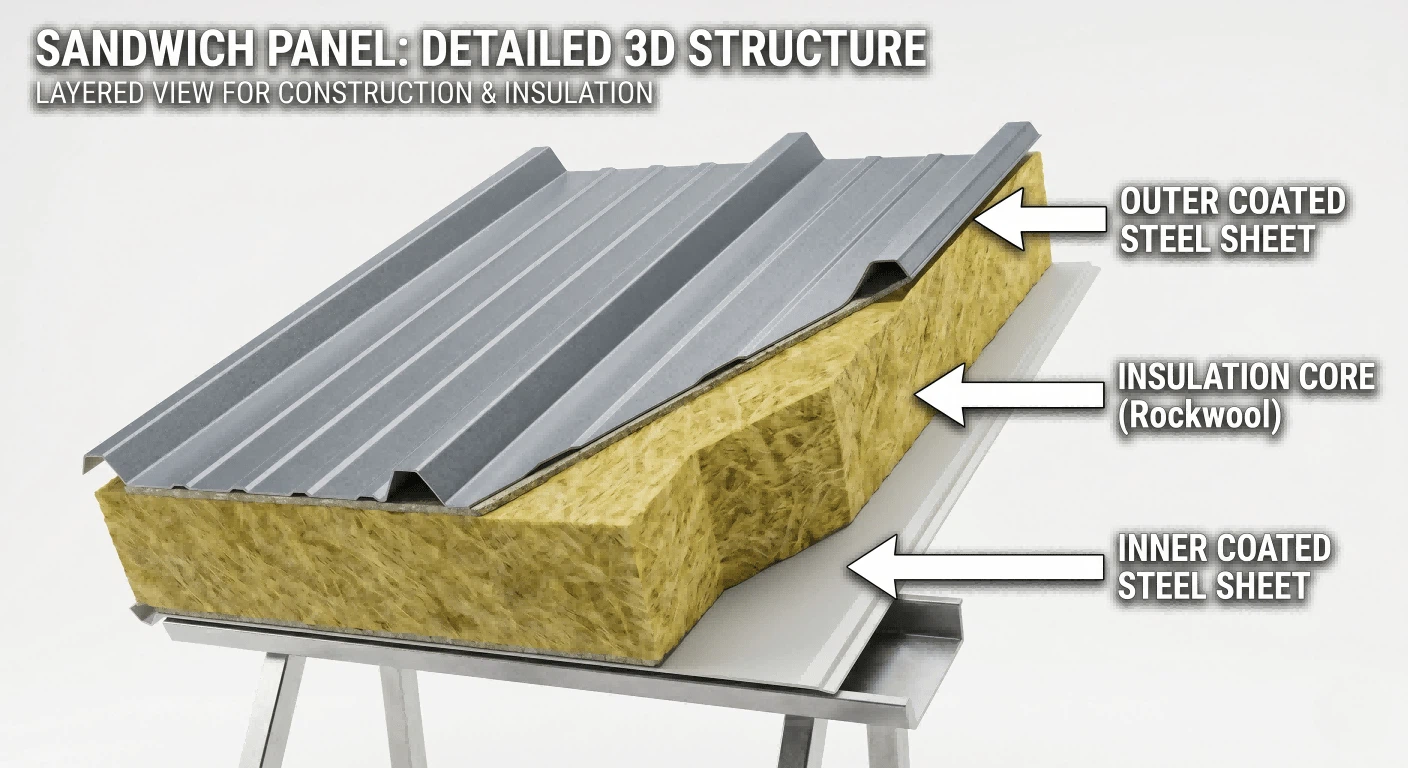
For facilities requiring strict temperature control-such as cold storage logistics, food processing plants, pharmaceutical facilities, or simply comfortable workshops in extreme climates-single-layer steel sheets are entirely inadequate. The industry standard solution is the Sandwich Panel, a composite structure consisting of two exterior prepainted steel sheets bonded to a central insulating core material.
Understanding the thermal and combustible properties of the core material is essential for correct project specification:
| Comparison of Sandwich Panel Core Materials | |||
| Core Material | Fire Rating & Safety | Thermal Insulation (R-Value) |
Best Application Scenario |
| Rockwool (Mineral Wool) | Exceptional (Non-combustible A-class). Won't melt or emit toxic smoke. | Good, but heavier and less moisture-resistant than PU. |
Facilities with strict fire safety codes, chemical plants, and environments requiring acoustic insulation (soundproofing). |
| Polyurethane (PU/PIR) | B-class (Fire-retardant). Advanced PIR offers better fire resistance. | Unmatched (lowest thermal conductivity). Lightweight and highly water-resistant. |
Cold storage warehouses, food processing facilities, and temperature-controlled clean rooms. |
| Glasswool | Non-combustible A-class. | Good basic insulation, lightweight, and highly cost-effective. |
Standard industrial workshops and commercial warehouses looking to balance budget and performance. |
The Promisteel Supply Chain Advantage:
We provide advanced industrial curtain wall panels (MRP-W) that go beyond basic functionality. Available in pure flat, small corrugation, embossed, and relief surface patterns, our composite panels offer excellent decorative qualities alongside outstanding fire resistance and insulation performance.
Single Skin Prepainted Sheets & Standing Seam Roofs
For standard warehouses, open-air shelters, or industrial hangars where strict thermal insulation is not the primary concern, Corrugated Prepainted Sheets provide a highly durable and cost-effective weather barrier.
The longevity of these single-skin systems relies entirely on the quality of their metallic coating and paint system. As part of our TIAN-COLOR® series, we supply prepainted coils categorized by their coating chemistry:
- PE (Ordinary Polyester): Offers good corrosion resistance for general indoor and outdoor coating, with a service life of 5-8 years.
- HDP (High Durable Polyester): Features excellent chemical corrosion and weather resistance, extending the service life to 12-15 years for industrial equipment and landmark buildings.
- PVDF (Fluorocarbon): A high-performance material with exceptional chemical stability against UV rays and humidity, offering a lifespan of up to 20 years. PVDF is highly recommended as a coating for seaside construction materials.
The Roof Leakage Solution: 360° Standing Seam Roof Systems
Traditional corrugated roofs installed with exposed screws are prone to a notorious problem: water leakage over time. As the long steel roof expands and contracts under the hot sun, the movement enlarges the screw holes, inevitably letting rain in.
To completely eradicate this issue, premium PEB projects utilize the 360° vertical standing seam metal roof.
- Zero Exposed Fasteners: The panels are joined together using a specialized seaming machine that folds the edges 360 degrees. It requires no overlapping, ensuring a seamless installation.
- Thermal Stress Elimination: This roof system boasts a high sliding capacity and excellent wind resistance, uniquely designed to fully address roof temperature stress issues by allowing the entire roof to "float" over its concealed clips without tearing.
PEB Connection Details and Accessories
In the world of structural engineering, the devil is always in the details. A massive 5-ton built-up column is useless without the precise bolts to anchor it, and a premium standing seam roof will still leak if the flashing is poorly manufactured. The true reliability of a PEB relies entirely on how well its massive components are joined and sealed together.
High-Strength Fasteners & Shear Studs
The era of welding every connection on the muddy job site is over. Modern PEB systems prioritize controlled factory fabrication and on-site bolted assembly. This approach guarantees speed, safety, and rigorous quality control.
- Structural Bolts: The vital connections between columns, rafters, and splice plates are secured using High-Strength bolts. We provide various specifications of fasteners required for steel structure assembly, including internationally recognized Grade 8.8(S), 10.9(S), and 12.9(S) bolts.
- Shear Studs: For multi-story PEBs utilizing mezzanine floors, shear studs are welded directly through the decking sheets onto the primary steel beams. Once concrete is poured, these studs mechanically lock the steel and concrete together, forcing them to act as a single, ultra-rigid composite structural element.
- Welding Consumables: For any necessary in-shop or on-site welding, pairing the right consumable with the steel grade is mandatory. We supply corresponding structural steel welding electrodes (e.g., E4303, E5015) and welding wire (e.g., ER49, ER50) to ensure weld integrity.
Drainage, Daylighting, and Flashing (The Finishing Touches)
A Pre-Engineered Building is not complete without the critical accessories that transform an open steel frame into a functional, watertight facility. Overlooking these items during the overseas procurement phase often leads to messy, expensive, ad-hoc solutions sourced locally at a premium.
- Flashing and Trims: These are custom-bent pieces of prepainted steel used to seal vulnerable areas like corners, ridge lines, gable ends, and window openings. They are essential for rigid waterproofing and providing a clean, finished architectural look.
- Drainage Systems: Efficiently managing rainwater is critical, especially for large-span industrial roofs. This requires correctly sized Gutters and robust Downpipes to channel heavy monsoon rains away from the foundation, preventing soil erosion and building settlement.
- Daylighting (FRP Skylights): To drastically reduce operational electricity costs, Translucent Fiberglass Reinforced Plastic (FRP) panels are seamlessly integrated into the roof cladding, allowing natural sunlight to illuminate the warehouse floor while filtering out harmful UV rays.
Optimizing Your Structural Steel Supply Chain: From Sourcing to Assembly
Understanding the technical anatomy of a Pre-Engineered Metal Building (PEMB) is only half the battle. The other half-often the more treacherous half-is physically navigating the global supply chain to get thousands of tons of disparate steel components onto your job site on time and within budget.
The Hidden Costs of Fragmented Procurement
Many overseas EPC (Engineering, Procurement, and Construction) contractors fall into the fragmented sourcing trap. Attempting to save a few dollars per ton, they might source heavy steel plates directly from a large steel mill, purchase cold-formed C/Z purlins from a specialized roll-forming workshop, and buy high-strength bolts from a standard fastener trading company.
This approach almost always leads to catastrophic hidden costs:
- Inconsistent Quality Control: A steel mill only guarantees the flat plate. If you hire a separate, unvetted third-party workshop to weld those plates into built-up box columns, you risk encountering poor CJP/PJP weld penetration and warped flanges.
- The "Blame Game": When the 360° standing seam roof clips don't fit the purlin profiles, the roof manufacturer blames the purlin supplier, and the purlin supplier blames the structural engineer. Meanwhile, your project is stalled.
- Logistical Nightmares: Coordinating shipping schedules across five different suppliers to consolidate materials into unified sea containers is a logistical nightmare that inevitably incurs severe port demurrage fees.
The Integrated Solution: Raw Materials Meeting Precision Fabrication
The most successful overseas structural steel projects rely on a unified supply chain model. Instead of dealing with isolated manufacturers or pure middlemen who simply push paper, modern procurement demands a hybrid partner: an expert who commands raw material resources but also controls the fabrication floor.
As an international steel supply chain solution provider, this is precisely the gap we bridge.
- Raw Material Authority: Through deep-rooted partnerships with state-owned steel mills, we bypass the chaotic spot market to secure consistent, high-grade materials (from standard Q355B plates to specialized Q345q bridge steel). We provide absolute traceability through original Mill Test Certificates (MTCs).
- In-House Fabrication Control: We do not simply trade raw plates. The heavy plates are routed directly into our own dedicated processing plant. Here, they undergo precision CNC laser and flame cutting, automated Submerged Arc Welding (SAW), and rigorous NDT (Non-Destructive Testing).
- The "Lego" Delivery Model: By controlling both the raw material and the processing, we deliver a true PEB package. The structural frames, the galvanized purlins, the building curtain wall composite panels (MRP-W), and every single Grade 10.9 bolt are engineered to fit together seamlessly. Your erection crew receives a ready-to-assemble kit, exactly like a giant industrial Lego set.

Global Logistics and Container Consolidation
Fabricating a 12-meter-long, 5-ton welded H-beam is an engineering achievement; shipping it across the ocean safely is a logistical art.
Structural steel components are bulky, heavy, and notoriously difficult to load. Improperly loaded containers lead to shifting cargo, severely damaged flanges during transit, and massive unloading hazards at the destination port.
- Strategic Loading Plans: Before any steel is cut, our logistics engineering team designs a 3D container loading plan. This dictates the maximum length of fabricated members to maximize the payload of standard 40HQ containers or specialized Open Top (OT) containers.
- Consolidation Hub: Located in Tianjin, one of the world's premier deep-water ports, we possess the warehousing capacity to consolidate your entire project. The primary steel, the fragile translucent FRP skylights, and the pallets of welding electrodes are meticulously packed and braced together, ensuring that when the container doors open on your site, everything is intact, accounted for, and ready for the crane.
Conclusion: Building with Confidence, Not Guesswork
A Pre-Engineered Building is a marvel of modern engineering-a perfect orchestration of high-strength heavy plates, precision-welded built-up sections, cold-formed secondary supports, and high-performance insulated cladding.
However, the structural integrity of the final building is only as strong as the supply chain that delivered it. Navigating international steel standards, deciphering CJP welding codes, and managing container consolidation should not be left to trial and error. By understanding the deep anatomy of these structures-from the core material of a sandwich panel to the yield strength of the primary framing-you empower your procurement team to make decisions based on value, not just the lowest initial price per ton.
When you partner with a unified supply chain expert, you eliminate the guesswork. You transition from managing disparate purchase orders to managing a smooth, predictable construction schedule.
Ready to optimize the procurement for your next large-scale industrial warehouse or multi-story PEB project? Stop dealing with fragmented suppliers. Contact the structural steel experts at Promisteel today to discuss your architectural drawings, material specifications, and fabrication requirements.
- Email: sales@promisteel.com
- Website: www.promisteel.com
- lobal Reach: Supporting major infrastructure and industrial projects across North America, the Middle East, Southeast Asia, and beyond.


