
 Español
 Türkçe
 Français
 عربي
عربي  dansk
dansk 한국어
한국어 Deutsch
 Việt Nam
 Italiano
 日本語
日本語 Português

What is Bolts
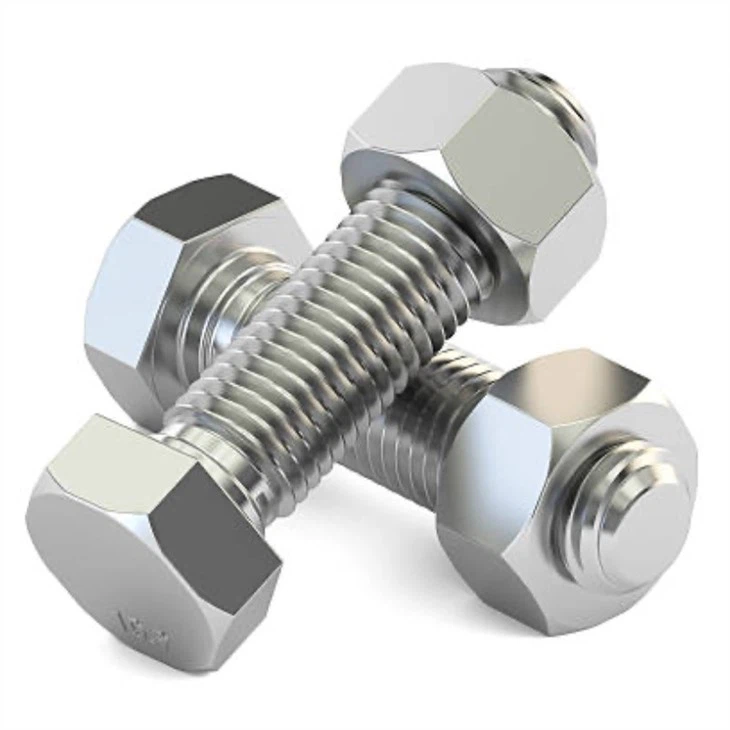
A bolt is a form of threaded fastener with an external male thread requiring a matching pre-formed female thread such as a nut. Bolts are very closely related to screws.
Benefits of Bolts
Bolted joints are easy to use
The bolted connection is an appealing method due to its ease of use. It combines a screw/stud with a threaded counterpart such as a nut or tapped hole and only requires a simple torque wrench to operate. This differentiates it from other technologies such as:
• Bonding: Relies on the operator's judgement to determine quality and correct application.
• Riveting: This assembly requires press tools that makes the process more complex.
• Welding: Requires a certified welder, advanced tooling and failure can remain undetected.
Bolted joints are flexible
A bolted joint is not a permanent assembly, it can be easily removed and reused using the same tools with which it was assembled. This is very helpful for maintenance, simple checks or replacement of parts. It is also useful when the product is at the end of its life cycle as parts made of different materials can be separated, sorted and recycled effectively.
Bolts come in many sizes and materials
Bolts are available in a range of sizes and materials depending on the demand of the application. They are commonly made of steel, which provides strong mechanical characteristics that are usually greater than the capacities of the assembled parts.
Bolts can clamp different materials together
Bolts can be used to join parts made of materials that are different than the bolt itself, such as plastics and composites. No special arrangement or design is required to make this assembly compatible.
Bolts can secure thick parts
The thickness of the assembled parts can be as large as they need to be to fit the manufacturer's needs. The thickness and the hole size can be produced with large tolerances. This usually implies economical and regular well-known machining processes.
Bolts can operate at a wide temperature range
Normalized steel bolts can sustain temperatures between -50°C and 200°C and for wider demands, stainless steel bolts can function between the ranges of -160°C and 500°C. Special designs using materials able to sustain high temperatures and alloys capable of functioning in an acidic environment can bring the connection to the right level of performance.
Why Choose Us
Quality Products
Promisteel is known for delivering high-quality steel products that are durable and reliable. Quality is assured through rigorous testing and quality control measures.
01
Experienced Team
Promisteel has an experienced team of professionals who have excellent knowledge of the industry's market trends and customer needs.
02
Customer Service
Promisteel is committed to providing customers with exceptional customer service. You can expect prompt and efficient service from their team of experts.
03
Competitive Pricing
Promisteel offers competitive pricing on their steel products without compromising quality. This makes them an affordable option for customers.
04
Expertise
Ensure the service provider has the necessary skills and knowledge to handle your specific needs.
05
Fastener Terminologies Related to Bolts
Shank diameter
The shank diameter is the diameter of the smooth or unthreaded portion of the bolt shaft. It is often referred to as the nominal diameter or body diameter.

Major diameter
The major diameter is the largest diameter of the bolt thread. It is the distance between two opposite crests or the topmost surface of the thread. The major diameter is often equal to the nominal diameter.

Minor diameter
The minor diameter (or root diameter) is the smallest distance of the bolt thread. It is the distance between two opposite roots or the bottommost surface of the thread.

Pitch diameter
The pitch diameter is the diameter halfway between the major and minor diameters.
Basic Dimensions of a Bolt Thread
Nominal Length
The nominal length is the total axial length of the bolt shaft, which is equal to the sum of the grip and thread lengths. The grip length is the length of the unthreaded portion, while the thread length is the length of the threaded portion measured from the first complete thread next to the shank to the end of the bolt shaft.
Thread Pitch
The thread pitch is the axial distance between two adjacent crests. This specification is used in metric fasteners and is normally expressed in millimeters.
Metric fasteners are manufactured in accordance with the ISO and DIN standards. How do you read metric bolt sizing?
If you encounter a bolt with M10-1.0 x 2.0 sizing:
• M designates that the bolt specifications are in the metric system
• 10 is the nominal diameter in mm
• 1.0 is the thread pitch in mm. Since the thread pitch is specified, this bolt has a fine thread.
• 20 is the bolt length in mm
Threads Per Inch (tpi)
The TPI is the number of threads per bolt thread inch. This specification is only used in imperial or US fasteners. How do you read imperial bolt sizing?
If you encounter a bolt with ¼"-20 x 2" sizing:
• ¼" means that the bolt is ¼ inch in diameter
• 20 means that the bolt has 20 TPI
• 2" means that the bolt is 2 inches long
Right-handed And Left-handed Threads
Right-handed threads are tightened when rotated in a clockwise direction. It is the most common thread configuration. Meanwhile, left-handed threads advance axially when turned in a counterclockwise direction. These threads are used when the application of pressure causes a right-handed thread to become loose. Left-handed threads are used in bicycle pedals, vehicle wheels, circular saw blades, and gas supply valves.
Chamfer And Chamfer Angle
A chamfer is a slightly beveled edge near the bolt tip. It is created by cutting a portion of the first thread near the bolt tip. Some bolts have a chamfered end in order to insert a nut and fit into holes easily. The chamfer angle is measured from the normal to the bolt axis.
Types of Bolts

Anchor Bolts
Anchor bolts are designed to join components into concrete surfaces. They are commonly used in the construction industry. They are usually found in the bases of steel poles. They are also used in attaching façade systems to reinforced concrete walls. There are two classifications of anchor bolts:
• Cast-in-place anchor bolts are installed by drilling a hole in the concrete slightly larger than the bolt, fixing the bolt in place, and pouring a concrete mixture into the remaining spaces in the hole. Once the concrete settles, the bolt will not dislodge easily.
• Drilled-in-place anchor bolts are installed without the use of wet concrete. They are installed directly into an ample-sized hole drilled into hardened concrete. Adhesives are applied on the bolt installation to stabilize the connection.
Arbor Bolts
Arbor bolts are pre-assembled bolts with a washer permanently attached to the head of the bolt. Their head has a sinker design with ridges around it. Arbor bolts have a dark or black finish and reverse threads that differentiate them from other bolts. The reverse thread is the most important feature of arbor bolts and is critical to their use. Unlike other types of bolts, arbor bolts are not commonly sold in home improvement stores or hardware stores. They have a single function and are not considered to be fasteners. Arbor bolts are used with electric saws to keep the blade of the saw secure and working properly and are a critical part of a saws operation.
Blind Bolts
Blind bolts are a specialty bolt that was developed for applications where hex bolts and rivets can't be used due to restricted access. They have good tensile strength and can handle loads that are slightly less than standard bolts. Blind bolts are used to join objects using a pre-drilled hole in one of the objects to be joined and where there is limited space due to adjacent components.The head of a blind bolt has a series of teeth that interlock with a nut, which provides extra strength and stability when secured. Blind bolts get their name due to their ability to access only one side of objects to be joined and the inability to see the other side. They have a pin, collar, and sleeve. The collar is designed to collapse as the blind bolt is tightened.
Carriage Bolts
Carriage bolts are partially threaded along their shank and have a round head with a square neck that keeps the bolt from turning when being fastened. They are referred to as plow or coach bolts and are mainly used in wood applications. Carriage bolts have tensile and shear strength, which varies according to the type of material from which they are manufactured. Carriage bolts made of stainless steel have a shear strength of 90,000 psi.A carriage bolt is secured using a nut with a washer that is attached to the threads on the flat end of the bolt. When determining the size of a carriage bolt, it is important to measure them from under the head to the end of the bolt. Measuring from under the square neck leads to inaccurate measurements. A pilot hole of the diameter of the flat end of a carriage bolt has to be drilled prior to inserting the bolt. It is important to use a washer with a nut when securing a carriage bolt to reduce potential surface damage.
Elevator Bolts
Elevator bolts get their name from their use in the construction of elevators. Their flat head allows them to secure components without interfering with the movement of the elevator. The distinct feature of elevator bolts is their flat round thin head that becomes flush with the surface to which they are attached when secured.Threads on an elevator bolt go part way up the shaft. Underneath the flat head is a square neck that is similar to that of carriage bolt, which provides for a tight secure connection and prevents the bolt from turning during installation. Elevator bolts are made from several types of materials and come in different diameters, lengths, and sizes.A common use for elevator bolts is in the construction of conveyors, which require a flat surface for smooth operation. Additionally, since elevator bolts form a highly secure connection, they prevent conveyors from vibrating or shifting. They are also an ideal fastener for soft materials such as softwoods, fabrics, and plastics.

Common Nuts Materials
Stainless steel
1
>>
Alloy steel
2
>>
Low carbon steel
3
>>
Medium carbon steel
4
>>
Titanium
5
>>
Polymers, such as nylon
6
Cap Nuts
The cap nut, also known as the acorn nut, gets its name from its shape. The nut has a domed top to prevent contact with the external thread.
Castle Nuts
Used with cotter pins to prevent loosening, a castellated nut, also called a castle or slotted nut, is a not with slots cut into the top. Used in low-torque applications such as holding a wheel bearing in place.
Coupling Nuts
A coupling nut is a threaded fastener used for joining two male threads, most commonly threaded rod. The outside of the fastener is a hex so it can be driven with a wrench.
Flange Serrated Nuts
A flange nut is a nut that has a wide flange at one end which acts as an integrated washer that does not move or spin. The serrated flange distributes the pressure of the nut over the part being secured and creates a locking action to prevent loosening.
Hex Finish Nuts
Hex finish nuts are used for fastening to a hex cap screw, socket cap screw or bolt. The most common nuts, hex finish nuts are hex shaped with internal threads and driven with a wrench.
Hex Jam Nuts
A jam nut is often used when a nut needs to be locked in place without clamping to another object. Hex jam nuts are hex shaped with internal threads, but they are thinner than hex finish nuts.
Heavy Hex Nuts
Larger, heavier, and thicker than a standard hex nut. Heavy hex nuts are hex shaped, internally threaded, and driven with a wrench. Often used with hex cap screws and carriage bolts.
Hex machine nuts
Lorem ipsum dolor sit amet,consectetur adipiscing elit. Ut elit tellus,luctus nec ullamcorper mattis,pulvinar dapibus leo.
Hex machine nuts small pattern
A machine nut is hex shaped with internal threads. Smaller than a hex jam or hex finish nut, they are used with machine screws under 1/4" diameter.
Keps-k lock nuts
Also known as a keps nut, a k-nut or a washer nut, a keps-k lock nut has an attached free spinning lock washer. Keps nuts are designed to make assembly more convenient.
Knurled thumb nuts
A knurled head thumb nut or thumb nut has a knurled outside surface rather than a hex, which facilitates tightening by hand. Often used in decorative finishes or applications.
Nylon hex jam nuts
A low-profile lock nut is hex shaped, internally threaded with a nylon insert. The nylon material prevents loosening from vibration and cross threads to stop the nut from backing off of the fastener.
Our Certificates


