
 Español
 Türkçe
 Français
 عربي
عربي  dansk
dansk 한국어
한국어 Deutsch
 Việt Nam
 Italiano
 日本語
日本語 Português


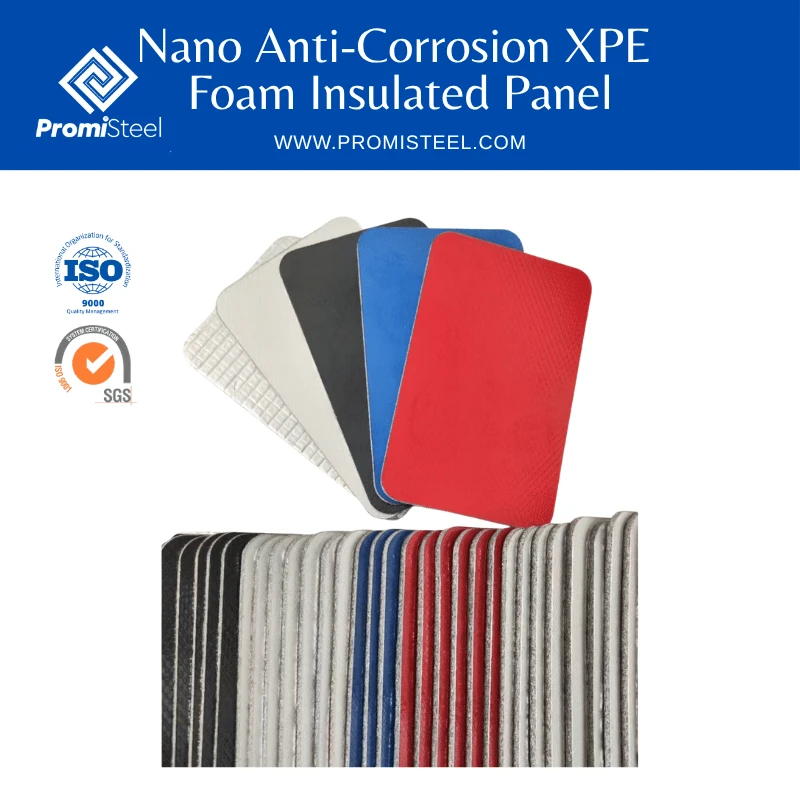

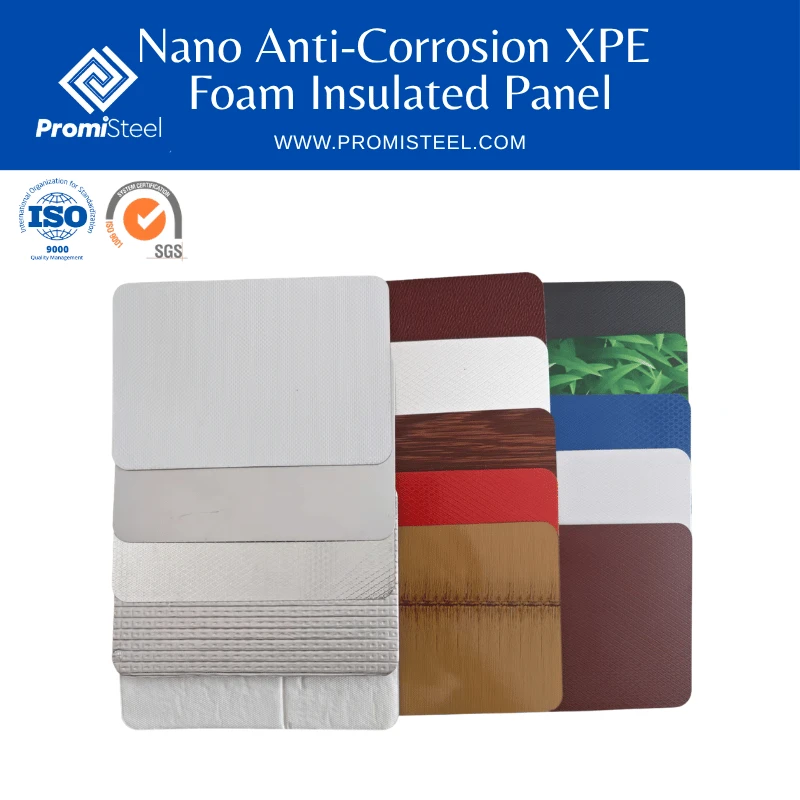
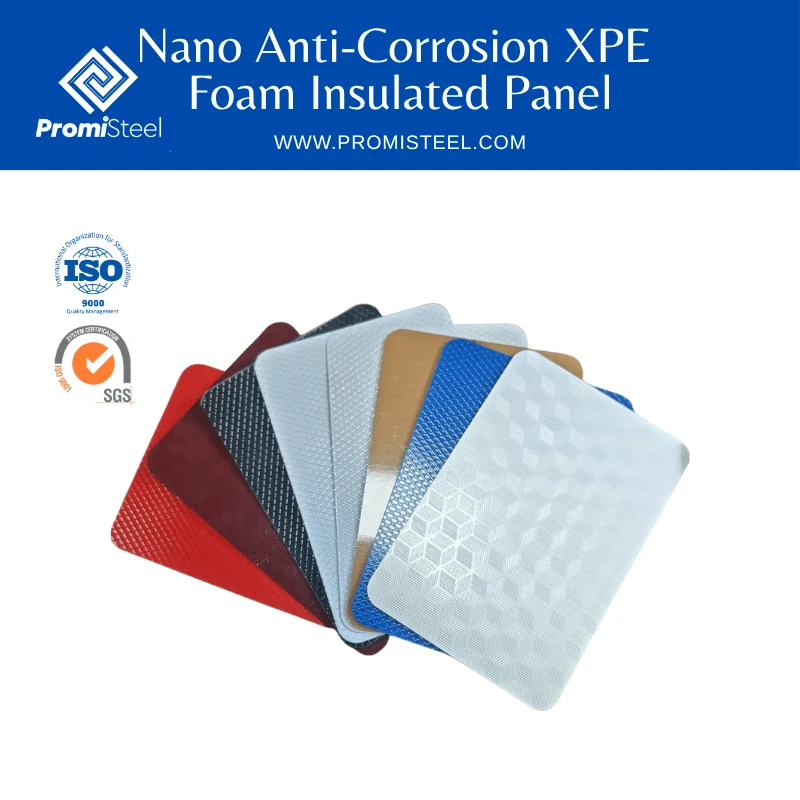
Nano Anti-Corrosion XPE Foam Insulated Panel
INSULATION: Closed-cell chemically cross-linked polyethylene foam (XPE / XLPE)
XPE THICKNESS: 2.5–3.0 mm nominal; confirm by order
SUBSTRATE: Galvanized, Al-Zn coated, or other agreed metal sheet
FACING: PET film and pure aluminum-foil laminate
SUPPLY FORM: Laminated coil or project-agreed profiled sheet
CUSTOMIZATION: Substrate, metal thickness, profile, width, length, finish, and export packing
Terminology note: “rubber-plastic foam” is a market name. The supplied backing is XPE polyethylene foam, not natural rubber, NBR, or EPDM.
XPE Foam-Backed Laminated Metal Panel for Roof and Wall Applications
The Nano Anti-Corrosion XPE Foam Insulated Panel is a laminated roofing and wall-cladding material that combines a protective reflective facing, a project-selected metal substrate and a 2.5–3.0 mm closed-cell XPE backing. It is intended for warehouses, workshops, agricultural buildings and other metal-envelope projects where buyers want a thin, lightweight build-up with added thermal and moisture-control support.
Unlike a conventional double-skin sandwich panel, this product is supplied as a laminated coil or as a project-agreed profiled sheet. Required thermal performance, fire classification, corrosion resistance, profile geometry and structural capacity must be confirmed against the final bill of materials and project design.
Panel Structure
This product is a laminated coil or sheet system rather than a conventional double-skin structural sandwich panel. The final layer order can be adjusted to the agreed substrate and facing specification.
The standard exposed-side build-up is PET film + polymer adhesive + pure aluminum foil + polymer adhesive + metal substrate. The backing side is metal substrate + XPE foam + pure aluminum foil + PET film. This construction combines a protective reflective surface, a metallic skin and a thin closed-cell foam backing in one profile-ready material.
Order-control note: available supplier documents use inconsistent units for facing thickness. State the confirmed value in both micrometres and millimetres on the quotation, approved layer drawing and technical data sheet.
PET protective film
Outer protective and handling surface.
Polymer adhesive
Bonds the surface laminate to the foil and substrate.
Reflective aluminum foil
Reflective facing; final thickness must be order-confirmed.
Polymer adhesive
Bonds the outer laminate to the metal substrate.
Metal substrate
Galvanized, aluminum-zinc coated or another agreed metal sheet.
Closed-cell XPE foam
Chemically cross-linked polyethylene foam, nominally 2.5–3.0 mm.
Inner pure aluminum foil
Protective reflective layer; order-confirm the thickness.
PET inner film
Protects the backing surface during handling and service.
Key Benefits for Roof and Wall Projects
The panel should be selected as a complete roof or wall system. Performance depends on the substrate, facing, profile, fasteners, joints, ventilation and installation quality.
Heat-transfer control
The reflective facing and thin closed-cell XPE layer can help reduce heat flow through metal roofs and walls. Project temperature or energy savings should be calculated, not assumed.
Moisture-conscious backing
Closed-cell cross-linked polyethylene foam is valued for low water absorption at material level. Correct overlaps, sealing and ventilation remain essential for controlling condensation.
Surface protection
The PET, foil and coated-metal construction provides multiple protective layers. Chemical, salt-spray or ammonia resistance must be matched to product-specific test data.
Lightweight build-up
A 2.5–3.0 mm backing adds insulation without the depth of a thick sandwich panel, supporting projects with handling, transport or retrofit constraints.
Profile flexibility
The laminated material may be supplied in roll form for profiling or as project-agreed sheets. Profile geometry and minimum bending radius must be confirmed before production.
Project customization
Substrate, thickness, profile, width, length, surface and packing can be aligned with drawings, destination climate and container-loading requirements.
Recommended Product Specifications
These reference values are quotation inputs, not a substitute for an approved technical data sheet, layer drawing or project calculation.
| Product name | Nano Anti-Corrosion XPE Foam Insulated Panel |
|---|---|
| Technical description | Nano anti-corrosion XPE foam insulated metal roof and wall panel |
| Insulation material | Chemically cross-linked polyethylene foam (XPE / XLPE), closed-cell |
| Nominal XPE thickness | 2.5–3.0 mm Confirm by order |
| Metal substrate options | Available options may include galvanized steel, aluminum-zinc coated steel, zinc-aluminum-magnesium coated steel, aluminum-magnesium-manganese sheet and aluminum sheet. Final grade, coating designation, coating mass and applicable standard must be stated. |
| Metal thickness | Customized according to profile, span, wind design and project requirement. |
| Outer construction | PET film + polymer adhesive + pure aluminum foil + polymer adhesive + metal substrate. |
| Inner construction | Metal substrate + XPE foam + pure aluminum foil + PET film. |
| Facing thickness | To be stated on the approved order documents. Confirm the value in both μm and mm before production. |
| Supply form | Laminated roll or profiled sheet, subject to manufacturing and project agreement. |
| Reference roll length | 300–400 m reference range; confirm the ordered coil length. Finished sheet length and loading plan must be confirmed separately. |
| Width and profile | Customized to available profiling equipment and approved drawing. |
| Color / finish | Subject to metal substrate and surface-laminate availability. |
| Installation | Mechanical fastening with project-selected screws, washers, sealants, overlaps and flashings. |
| Documentation | Confirm available mill certificate, coating data, dimensional report, adhesion check and any project-required third-party tests before order. |
market focus
Typical Applications in African Building Projects
The product is positioned for importers, roofing distributors, contractors, steel-building companies, agricultural project suppliers and industrial buyers across Sub-Saharan and Southern African markets.
Warehouses & logistics
Metal roofs where solar heat, indoor comfort and underside condensation require consideration.
Factories & workshops
Roof and wall cladding for light-industrial buildings, repair workshops and production sheds.
Poultry & livestock
Agricultural buildings with heat, humidity and cleaning exposure. Ammonia resistance requires specific verification.
Agro-processing
Produce storage, packing, milling and farm-service buildings that use lightweight metal envelopes.
Market & community sheds
Large-span shelter roofs where material handling and rapid installation are priorities.
Steel-structure buildings
Pre-engineered and light steel buildings requiring profiled roof and wall materials.
Coastal projects
Possible with an environment-matched substrate, fasteners and maintenance plan; not a universal coastal specification.
Roof refurbishment
Selected retrofit projects where a thin insulated backing is preferred to a deep sandwich-panel system.
How to Select the Right Panel
For African projects, product selection should begin with the destination and building use rather than a generic thickness. High solar exposure, seasonal rain, coastal salt, internal humidity, livestock gases, dust and available installation skills can change the correct specification.
Important performance boundaries
This panel is not automatically equivalent to a PIR, PUR, EPS or mineral-wool structural sandwich panel. Its 2.5–3.0 mm XPE layer is thin and lightweight; required U-value, fire rating, acoustic value and structural capacity must be assessed separately.
Do not specify from marketing claims alone. Ask for the final bill of materials, approved layer drawing, substrate certificate and applicable test reports. Claims such as "fireproof," "acid-proof," "20-year life" or a fixed indoor temperature reduction should not be used without product-specific evidence.
System Comparison
How This Panel Compares With Other Roofing Options | |||
|---|---|---|---|
| Decision factor | Nano anti-corrosion XPE-backed panel | Single-skin metal roofing | Thick sandwich panel |
| Construction | Metal skin with protective laminate and thin XPE backing | Profiled metal skin without bonded insulation | Two skins with a deep insulation core |
| Thermal function | Helps reduce heat transfer; project value depends on the complete roof | Limited without a separate insulation system | Higher insulation potential when correctly specified |
| Thickness and handling | Thin, lightweight laminated build-up | Lightest and simplest option | Thicker and more demanding to transport and handle |
| Condensation approach | Closed-cell backing can support condensation-control design | Often requires a separate membrane, felt or insulation | Joint and vapor-control design remain important |
| Best fit | Projects balancing insulation support, low build-up and transport efficiency | Basic roof and wall applications | Projects requiring a specified high-performance insulated envelope |
Export delivery
Quality Control, Packaging and Shipping
A B2B export order should define inspection and packing before production, especially when long profiled sheets are shipped to African ports.
1. Specification review
Confirm substrate, coating, thickness, layer build-up, profile, dimensions and required documents.
2. Production checks
Check surface condition, layer adhesion, foam thickness, profile dimensions and roll or sheet identification.
3. Export packing
Use moisture-resistant wrapping, edge protection, stable bundles or coil protection suited to container handling.
4. Loading plan
Coordinate bundle size, lifting method, container type, destination port and unloading equipment.
Long sheets may require special container or break-bulk planning. Confirm maximum sheet length, bundle weight and local unloading capacity before quotation.
FAQ
Q: What is the insulation material inside the panel?
A: The supplied construction uses chemically cross-linked polyethylene foam, known as XPE or XLPE foam. It is a closed-cell polymer foam. It is not natural rubber, NBR rubber, or EPDM rubber.
Q: Is 2.5–3.0 mm XPE enough for a complete insulated building?
A: Not necessarily. The thin backing can improve a metal roof or wall build-up, but it should not be treated as equivalent to a thick sandwich panel. Required U-value and indoor conditions must be checked against the complete envelope design.
Q: Can the substrate be galvanized or aluminum-zinc-coated steel?
A: Yes, both are listed in the supplied material. The final grade, coating designation, coating mass, thickness, and standard must be stated in the purchase specification.
Q: Is the panel suitable for Nigeria, Ghana, Kenya, or Southern Africa?
A: It can be supplied for projects in these markets, but the specification should reflect the project city, solar exposure, humidity, rainfall, coastal distance, building use, and local code. There is no single specification for all African climates.
Q: Can it be used for poultry houses and livestock buildings?
A: It may be considered for agricultural roofs and walls, but livestock buildings can expose metal to humidity, condensation, ammonia, and cleaning chemicals. Product-specific corrosion and cleaning resistance should be confirmed.
Q: Is the panel fireproof?
A: No fireproof claim should be made without a valid test for the complete product. Request the applicable fire-test report and check local building regulations before selection.
Q: Can dimensions and profiles be customized?
A: Metal thickness, width, profile, finished length, and supply form can be reviewed against available equipment and project quantity. Send a profile drawing or effective cover-width requirement with the inquiry.
Q: What information is needed for a quotation?
A: Provide the destination country and port, application, profile drawing, metal substrate, coating, thickness, XPE thickness, sheet or roll dimensions, quantity, packing requirements, and required certificates.
Hot Tags: nano anti-corrosion xpe foam insulated panel, China nano anti-corrosion xpe foam insulated panel manufacturers, suppliers, Coated Steel Roof Tiles, Galvanized Steel Sheet for Roofing, Roofing Sheets
Previous
No InformationNext
Decking SheetsYou Might Also Like



Send Inquiry