
 Español
 Türkçe
 Français
 عربي
عربي  dansk
dansk 한국어
한국어 Deutsch
 Việt Nam
 Italiano
 日本語
日本語 Português

The structure parts are critical components of a vehicle's body, designed to ensure safety, structural integrity, and performance all the time.
Categories of Body Structure Parts
Body Frame: The skeleton of the vehicle, providing structural integrity and supporting other body parts. Examples: uni-body or ladder frame.
Outer Panels: Visible exterior parts that form the vehicle's shape and appearance. Examples: doors, hood, trunk lid, roof panels, fenders.
Inner Panels: Interior support components located under the outer panels, often hidden from view. Examples: inner fenders, door inner panels.
Structural Components: These load-bearing parts can absorb energy in a collision situation. A-pillar, B-pillar, C-pillar, floor panels, and cross members are the main examples.
Crash Safety Parts: These Reinforced parts are designed to protect occupants when suffering a sudden accident. Side-impact beams, crumple zones, and bumper reinforcements are mainly examples.
Suspension Mounts: These areas where suspension components attach to the vehicle's body structure are quite important. Examples are shock absorber mounts and subframe attachments.
Roof and Pillar Structures: Parts that provide support for the roof and ensure rollover protection. Examples: roof bows, and pillars (A, B, C, D).
Floor and Underbody: Components that form the base of the vehicle, housing systems like fuel tanks and exhausts. Examples: floor pans, and underbody crossmembers.
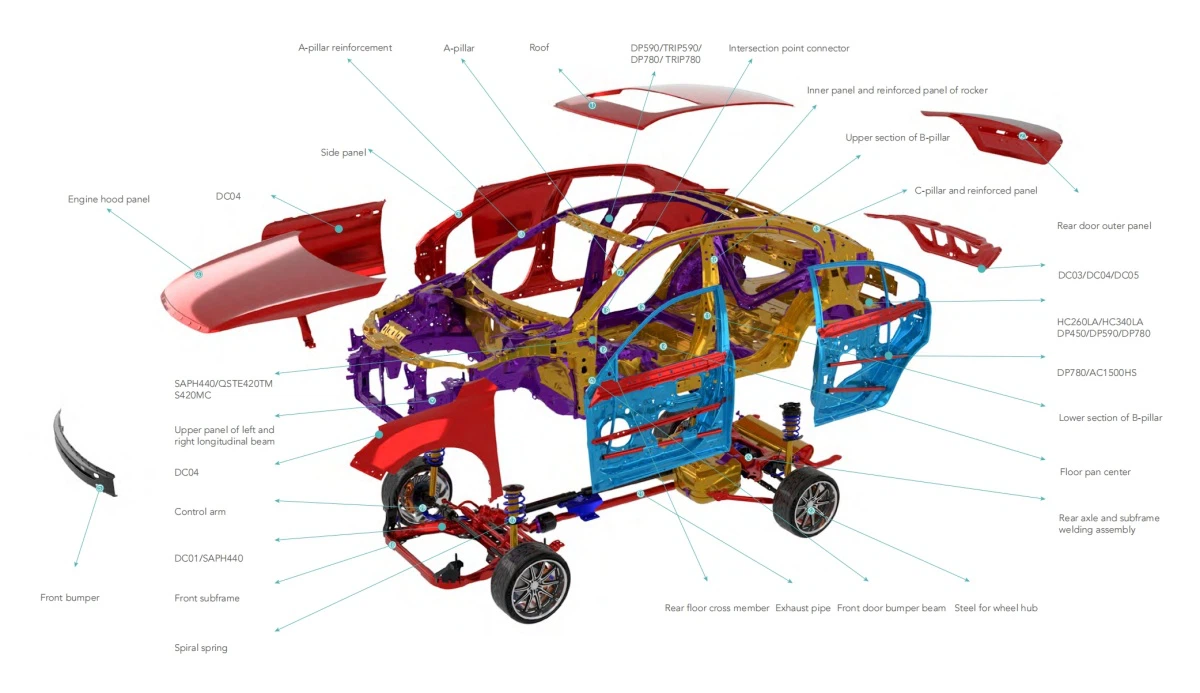
Key Body Structure Parts
A-Pillar
This one is the vertical support structure in an automobile located on either side of the windshield. It is one of the primary pillars in the car's body structure, typically connecting the roof to the body or chassis at the front of the vehicle. Vertical support on either side of the windshield. They are critical for structural integrity and rollover protection.
Key Features of the A-Pillar
Located in the Position between the windshield and the front side windows and forms the front edge of the vehicle's roof.
Functionality:
It provides Structural Support to the roof and overall body of the vehicle.
Also plays a Crash Protection role in absorbing and redistributing forces during a collision, especially in rollovers.
Installation location: often houses parts like side mirrors, airbags, and wiring for advanced systems (e.g., cameras, sensors).
Windshield Support: Anchors the windshield securely to the vehicle frame.
Safety Role: During a rollover accident, the A-pillar helps prevent the roof from collapsing, safeguarding occupants, and works with the rest of the body structure to provide crashworthiness in frontal impacts.
B-Pillar
Located between the front and rear doors, providing support for the roof and strength in side impacts.
C-Pillar
Vertical support toward the rear of the vehicle, often connecting the roof to the trunk or rear hatch.
The B-Pillar and C-Pillar are additional vertical support structures in an automobile, exactly serving specific roles in the vehicle's design, safety, and functionality.
Comparison list of A-, B-, and C-Pillars
|
Pillar |
Location |
Primary Role |
Key Features |
|
A-Pillar |
Beside the windshield |
Windshield support, roof support, crash safety |
Houses side mirrors, airbags, wiring for sensors |
|
B-Pillar |
Between front and rear doors |
Structural rigidity, side-impact protection |
Seatbelt mounting, side airbags, crash safety |
|
C-Pillar |
Behind the rear doors |
Rear structural support, crash safety |
Defines rear design, house wiring, or vents |
Floor Pan
Floor Pan is a large, flat structural component serving the base of a vehicle's passenger compartment. It is quite an essential part of the chassis or unibody design, providing a foundation for the car's interior and structural integrity all the time. Such as Electric Vehicles and Off-Road Vehicles.
Rocker Panels
are the other structural sections located along the sides of a vehicle, below the doors, and between the front and rear wheel arches. They play a quite important role in the vehicle's design, safety, and structural integrity. They play an important role in reinforcing the side of the vehicle and connecting the front and rear portions of the body structure.
Crossmembers
are structural components in a vehicle's chassis or frame that run laterally (side-to-side) across its width. They are vital for maintaining the vehicle's structural integrity, distributing loads, and contributing to crash safety. They are found in multiple locations, such as Under the engine bay, Midsection of the chassis, or Rear of the vehicle.
Side Rails
some clients also called side members, longitudinal rails, or frame rails, are the major structural components running along each side of the vehicle's chassis or frame. They act as the backbone of a car's structural integrity and are decisive for maintaining the vehicle's shape, which provides support for various components. In both body-on-frame and unibody designs, side rails play a very important role. These are commonly made of thicker or more durable materials to withstand many harsh conditions.
Firewall
The firewall is an important structural and safety component that separates an automobile's engine compartment from the passenger cabin. It is designed to protect residents from heat, smoke, flames, and fumes when the sudden event of an engine fire happens, in addition to providing structural integrity and acoustic insulation, also separates the engine area from the passenger cabin and provides a good barrier against heat and noise.
Crumple Zones
are designed to absorb energy that happens during a collision and minimize the impact force delivered to the occupants. Crumple zones are essential safety elements in contemporary automobiles all the time. Its controlled deformation of these areas helps to absorb energy, slow down the vehicle's descent, and ultimately protect passengers by reducing injuries in the event of an accident. They are used to absorb energy and shield occupants by deforming in a controlled way during a collision.
Bumper Beams
Reinforces the bumpers, absorbing and distributing impact energy in a collision.
Materials Used in Body Structure Parts
---Strength: Must withstand high forces without deforming under normal and crash conditions.
---Toughness: Ability to absorb energy without fracturing, especially in crash zones.
---Corrosion Resistance: Durability to resist environmental factors like moisture and salt.
---Lightweight: Reduces overall vehicle weight for improved fuel efficiency and performance.
---Crashworthiness: A ability to protect occupants by absorbing and redistributing impact energy.
---Manufacturability: Ease of fabrication and assembly, including welding, stamping, or bonding processes.
Body structure Parts of a vehicle's body are essential to its performance, longevity, safety, and efficiency. Each component-from the floor pan to the pillars-contributes to the vehicle's overall performance, handling, and environmental effect in addition to playing a key role in preserving the vehicle's integrity in an accident. Automobile manufacturers may create safer, more efficient vehicles and enhance the driving experience by taking into account the effects of these components.
Explanation: This article is from PROMISTEEL Steel Market Research Department


