
 Español
 Türkçe
 Français
 عربي
عربي  dansk
dansk 한국어
한국어 Deutsch
 Việt Nam
 Italiano
 日本語
日本語 Português

Executive Summary
For applications operating at approximately 500 HBW, selecting the right wear-resistant steel involves more than comparing hardness values. At this hardness level, small differences in toughness, manufacturing consistency, and fabrication performance can significantly influence equipment reliability and maintenance costs.
Both NM500 and Hardox® 500 belong to the high-hardness abrasion-resistant steel category and are widely used in mining, quarrying, cement production, recycling, and bulk material handling equipment. While Hardox® 500 is manufactured exclusively by SSAB under a proprietary production system, NM500 is produced by multiple qualified Chinese steel mills in accordance with GB/T 24186.
For many sliding-abrasion applications, qualified NM500 can provide an attractive balance between wear resistance and procurement cost. In contrast, applications involving severe impact loading, demanding fabrication requirements, or strict project specifications may benefit from the documented consistency and technical support associated with Hardox® 500.
This guide compares the two materials from both engineering and procurement perspectives, helping buyers evaluate wear performance, fabrication characteristics, supplier qualification, and total lifecycle value.
Introduction
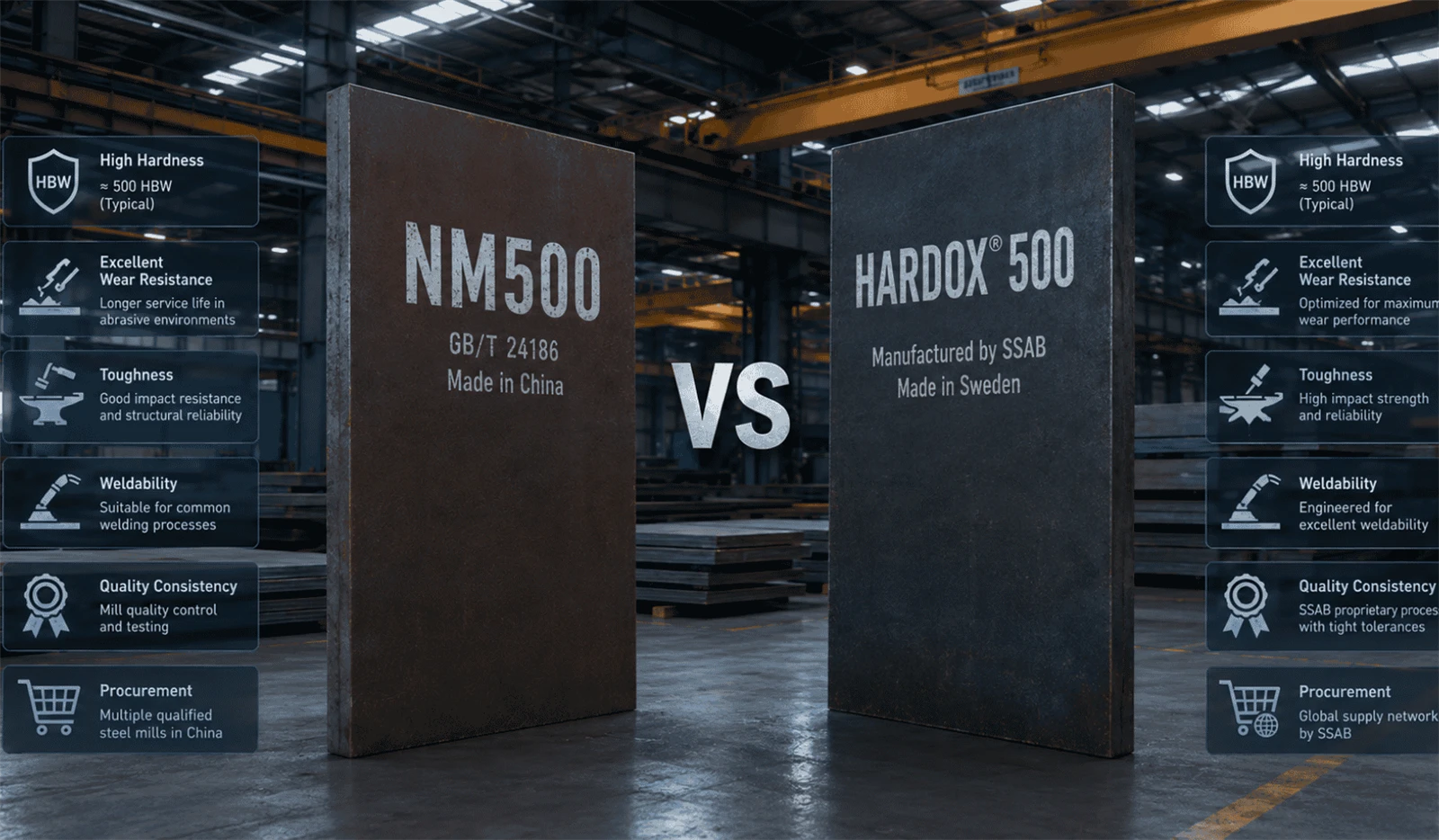
When abrasion-resistant steel reaches the 500 HBW hardness class, the engineering challenge changes.
Compared with the 400 HBW category, steels at approximately 500 HBW provide significantly higher resistance to abrasive wear. However, increasing hardness also reduces the margin for error during manufacturing and fabrication. Toughness, weldability, heat treatment consistency, and microstructural control become increasingly important as hardness increases.
For procurement teams, this means material selection is no longer simply a comparison of hardness or purchase price. Selecting an inappropriate material-or sourcing from an inadequately qualified supplier-can increase maintenance frequency, shorten equipment life, or introduce unnecessary fabrication challenges.
Both NM500 and Hardox® 500 are designed for demanding wear environments, but they originate from different manufacturing systems.
NM500 is produced under China's GB/T 24186 standard by multiple qualified steel manufacturers.
Hardox® 500 is a proprietary product manufactured exclusively by SSAB, supported by published fabrication guidance and globally recognized technical documentation.
Although the two materials often serve similar applications, they should not automatically be regarded as interchangeable. The suitability of either material depends on the wear mechanism, impact severity, operating temperature, fabrication requirements, supplier capability, and overall procurement objectives. Buyers should also verify the Mill Test Certificate (MTC) before approving any shipment.
This article compares NM500 and Hardox® 500 across the areas that matter most to industrial buyers:
- Material standards and manufacturing philosophy
- Chemical composition and alloy design
- Mechanical properties and toughness
- Wear performance
- Welding and fabrication
- Procurement considerations
- Total cost of ownership
- Recommended applications
Rather than identifying a universal "winner," the objective is to help buyers determine which material offers the most appropriate balance between engineering performance, commercial value, and long-term operational reliability.
Why the 500 HBW Class Deserves Special Attention
The difference between 400 HBW and 500 HBW wear-resistant steel is not simply an additional 100 points of hardness.
As hardness increases, steel generally becomes more resistant to abrasive wear, but it also becomes more sensitive to metallurgical quality, fabrication practices, and impact loading. Maintaining an appropriate balance between hardness and toughness is therefore considerably more challenging for manufacturers producing 500 HBW grades.
This has several practical implications:
- Manufacturing consistency becomes increasingly important.
- Welding procedures require greater attention to carbon equivalent and heat input.
- Material certification should be reviewed more carefully before fabrication.
- Supplier qualification becomes a critical part of procurement.
For this reason, buyers evaluating NM500 as an alternative to Hardox® 500 should compare more than nominal hardness. Buyers comparing NM400 and Hardox 400 often follow the same evaluation process before moving to the higher 500 HBW class. Material documentation, production consistency, mechanical properties, and supplier quality assurance often have a greater influence on long-term performance than the grade designation itself.
The following sections examine these factors in detail to provide a practical framework for evaluating both materials in demanding industrial applications.
Wear Performance Comparison
Wear resistance is the primary reason engineers choose a 500 HBW abrasion-resistant steel. However, wear performance is determined by more than hardness alone. Abrasive material type, impact loading, operating environment, plate thickness, and manufacturing consistency all influence the actual service life of a wear component.
Although both NM500 and Hardox® 500 belong to the same hardness class, their performance should be evaluated in the context of the specific wear mechanism rather than by hardness alone.
Understanding Wear Mechanisms
Different industries expose wear plates to different types of wear.
The most common wear mechanisms include:
- Sliding abrasion
- Gouging abrasion
- High-stress grinding abrasion
- Impact abrasion
- Mixed wear conditions
For example, chute liners handling dry iron ore are dominated by sliding abrasion, while crusher liners and excavator bucket lips experience a combination of abrasion and repeated impact loading.
Understanding the wear mechanism is often more important than selecting a specific material grade.
Performance in Sliding Abrasion
Sliding abrasion is the most common wear condition found in:
- Chutes
- Hoppers
- Conveyor transfer points
- Cement equipment
- Bulk material handling systems
Under these conditions, both NM500 and Hardox® 500 provide significantly higher wear resistance than 400 HBW grades.
When supplied by qualified manufacturers and correctly selected for the application, NM500 can deliver excellent service performance for many sliding-abrasion applications. Hardox® 500 offers the additional benefit of highly consistent hardness and metallurgical control, which can contribute to more predictable wear behavior across different production batches.
Performance Under Impact Loading
Impact loading introduces another engineering consideration.
As hardness increases, maintaining adequate toughness becomes increasingly important. Components subjected to repeated impact must resist both abrasive wear and crack initiation.
Typical examples include the following:
- Crusher wear parts
- Quarry equipment
- Mining buckets
- Grizzly bars
- Heavy-duty recycling machinery
Hardox® 500 is designed to combine approximately 500 HBW nominal hardness with good toughness and processability, allowing it to perform reliably in many severe wear environments.
Qualified NM500 products can also achieve excellent field performance, but buyers should verify impact test data, heat treatment quality, and supplier capability whenever impact loading is a critical design requirement.
Manufacturing Consistency
One of the most significant differences between the two materials is manufacturing consistency rather than nominal hardness.
Hardox® 500 is produced exclusively within SSAB's controlled production system. The company publishes comprehensive technical documentation covering hardness, dimensions, fabrication recommendations, and typical mechanical properties. This consistency helps engineers predict fabrication behavior and wear performance with greater confidence.
NM500, by contrast, is manufactured by multiple qualified Chinese steel mills under GB/T 24186. While this provides buyers with greater sourcing flexibility, consistency depends on the individual producer's steelmaking, quenching, tempering, and quality management processes.
For international procurement, evaluating the manufacturer is therefore just as important as selecting the material grade.
Factors That Influence Service Life
No manufacturer can accurately predict service life using hardness alone.
Actual wear life depends on the combination of
- Material hardness
- Toughness
- Wear mechanism
- Material flow velocity
- Particle size
- Operating temperature
- Component design
- Fabrication quality
- Maintenance practices
For this reason, procurement decisions should avoid relying on generalized claims such as "30% longer wear life" unless supported by application-specific testing conducted under comparable operating conditions.
Instead, buyers should compare certified material properties, documented manufacturing quality, and previous project experience when selecting a wear-resistant steel.
Fabrication Comparison
For wear-resistant steel in the 500 HBW class, fabrication quality is just as important as wear performance.
As hardness increases, steel generally becomes more demanding to weld, bend, machine, and cut. A successful fabrication process, therefore, depends not only on the material itself but also on appropriate workshop procedures, qualified personnel, and verified material certification.
Both NM500 and Hardox® 500 are designed for industrial fabrication. However, their workshop performance should always be evaluated using the actual material certification and fabrication recommendations rather than relying solely on the nominal grade designation.
Welding
Both NM500 and Hardox® 500 can be welded using conventional arc welding processes when suitable procedures are applied.
The primary factors affecting weld quality include:
- Plate thickness
- Carbon equivalent (CE or CET)
- Heat input
- Diffusible hydrogen level
- Preheating and interpass temperature
According to SSAB, Hardox® 500 is designed to be weldable using conventional welding methods, with welding recommendations covering consumable selection, preheating, heat input, and hydrogen control.
Qualified NM500 can also achieve reliable welding performance, but because it is manufactured by multiple producers, the required welding procedure should always be based on the actual Mill Test Certificate (MTC) and the applicable Welding Procedure Specification (WPS).
For critical structures, establishing welding parameters according to certified material properties is more reliable than applying identical procedures to every NM500 plate.
Thermal Cutting
Both materials are compatible with the cutting methods commonly used in heavy fabrication workshops.
|
Cutting Method |
NM500 |
Hardox® 500 |
|---|---|---|
|
Laser Cutting |
Excellent |
Excellent |
|
Plasma Cutting |
Excellent |
Excellent |
|
Waterjet Cutting |
Excellent |
Excellent |
|
Oxy-fuel Cutting |
Suitable for thicker sections |
Suitable for thicker sections |
Laser and plasma cutting are generally preferred where dimensional accuracy and minimal heat-affected zones are required.
For thicker plates processed by oxy-fuel cutting, proper edge preparation before welding helps maintain joint quality and reduces the risk of fabrication defects.
Bending and Forming
Forming becomes increasingly challenging as hardness increases.
Although both materials belong to the 500 HBW class, they remain suitable for many cold-forming applications when recommended bending radii are respected.
Hardox® 500 is supported by published bending recommendations and guaranteed dimensional consistency, allowing fabricators to predict forming performance with greater confidence.
Qualified NM500 can also be successfully formed into components such as:
- Bucket liners
- Side walls
- Wear boxes
- Chute liners
- Transfer components
For complex bends or thick plates, trial forming is recommended before full-scale production, particularly when sourcing from a new supplier.
Machining
Despite their high hardness, both materials can be machined using modern carbide tooling and appropriate cutting parameters.
Typical workshop operations include the following:
- Drilling
- Milling
- Counterboring
- Countersinking
- Thread machining
Tool life depends primarily on the following:
- Cutting speed
- Feed rate
- Tool material
- Cooling conditions
- Plate hardness
Because Hardox® 500 is manufactured under a tightly controlled production system, machining behavior is generally more predictable between production batches. Qualified NM500 can also provide consistent machining performance when supplied by experienced mills with stable heat treatment processes.
Practical Fabrication Recommendations
From a fabrication perspective, selecting wear-resistant steel should never be based solely on hardness.
Before production begins, fabricators should confirm:
- Material certification
- Carbon equivalent
- Welding procedure
- Cutting method
- Forming radius
- Plate thickness
- Workshop capability
- Supplier technical support
For OEMs and fabrication shops processing wear-resistant steel on a regular basis, developing standardized procedures for approved suppliers often delivers greater long-term value than focusing on small differences between nominal material grades.
Cost Comparison
The purchase price of a wear plate is only one component of its overall economic value. For high-hardness abrasion-resistant steels such as NM500 and Hardox® 500, procurement decisions should consider the complete lifecycle of the component rather than the initial material cost alone.
Factors such as fabrication efficiency, maintenance intervals, replacement frequency, equipment downtime, and supplier reliability often have a greater influence on the total cost of ownership than the difference in purchase price.
While qualified NM500 generally offers a lower initial procurement cost, Hardox® 500 commands a premium based on its proprietary production system, documented consistency, and global technical support. Whether that premium is justified depends entirely on the operating environment and project requirements.
Initial Purchase Cost
Because NM500 is manufactured by multiple qualified Chinese steel mills, buyers typically benefit from:
- Greater supplier competition
- Flexible production scheduling
- Shorter manufacturing lead times
- Competitive export pricing
Hardox® 500 is manufactured exclusively by SSAB and distributed through an established global network. Its pricing reflects not only the material itself but also the associated technical documentation, fabrication guidance, engineering support, and consistent production quality.
For projects where the specification requires a 500 HBW wear-resistant steel rather than a specific proprietary brand, qualified NM500 can often provide an attractive balance between technical performance and procurement costs.
Total Cost of Ownership (TCO)
Experienced procurement teams rarely evaluate wear-resistant steel on purchase price alone.
A comprehensive Total Cost of Ownership (TCO) assessment should consider:
- Material purchase cost
- Fabrication and welding costs
- Transportation and logistics
- Installation labor
- Maintenance frequency
- Replacement intervals
- Equipment downtime
- Spare parts inventory
- Production interruption costs
In applications dominated by sliding abrasion, the lower acquisition cost of qualified NM500 may result in excellent overall value.
Conversely, where equipment operates under severe impact loading, continuous production schedules, or highly demanding service conditions, the additional consistency and technical support associated with Hardox® 500 may reduce operational risk and contribute to lower lifecycle costs.
Supply Chain Considerations
Availability and delivery reliability are practical factors that directly influence project schedules.
NM500 benefits from production by multiple Chinese manufacturers, giving buyers greater flexibility in:
- Production capacity
- Plate dimensions
- Delivery schedules
- Export logistics
Hardox® 500 is supplied through SSAB's international distribution network, providing standardized technical documentation and established regional support. Depending on the required dimensions and destination market, lead times may vary, making early procurement planning advisable for specification-driven projects.
Procurement Checklist
Regardless of which material is selected, buyers should verify the following before placing an order:
- Applicable material standard
- Mill Test Certificate (MTC)
- Heat number traceability
- Mechanical property certification
- Hardness test results
- Plate dimensions and tolerances
- Delivery condition
- Third-party inspection requirements (if applicable)
For NM500 in particular, supplier qualification is often as important as the material grade itself. Evaluating the manufacturer's production capability, export experience, and quality management system helps reduce procurement risk and improves consistency across future orders.
Application Recommendations
Although NM500 and Hardox® 500 belong to the same nominal hardness class, the most suitable material depends on the service environment rather than the grade designation alone.
Wear mechanism, impact severity, fabrication requirements, operating temperature, maintenance strategy, and procurement objectives should all be considered before material selection.
The following recommendations provide general guidance for common industrial applications.
|
Application |
Recommended Material |
Primary Consideration |
|---|---|---|
|
Chute liners |
NM500 |
High sliding abrasion with strong cost-performance balance |
|
Hopper liners |
NM500 |
Bulk material handling and wear resistance |
|
Dump truck liners |
NM500 or Hardox® 500 |
Selection depends on impact severity and project specification |
|
Crusher liners |
Hardox® 500 |
Heavy impact and demanding wear conditions |
|
Grizzly bars |
Hardox® 500 |
High toughness under repeated impact loading |
|
Recycling equipment |
Either |
Depends on operating conditions and fabrication requirements |
|
Cement plant wear parts |
NM500 |
Continuous sliding abrasion with cost efficiency |
|
Quarry and mining wear components |
Either |
Selection should be based on actual wear mechanism and lifecycle requirements |
These recommendations are intended as general guidance. Final material selection should always be verified against the operating conditions, engineering calculations, and project specifications.
When NM500 Is the Better Choice
NM500 is often an excellent solution when the project requires the following:
- High abrasion resistance with competitive procurement cost
- Large production volumes
- Flexible supply from multiple qualified manufacturers
- Reliable performance verified through complete material certification
- Cost-effective replacement of conventional wear plates
For many mining, cement, recycling, and bulk material handling applications, qualified NM500 provides an excellent balance between wear resistance, fabrication capability, and commercial value.
When Hardox® 500 Is the Better Choice
Hardox® 500 may be the preferred option when projects require:
- Documented and highly consistent material properties
- Published fabrication guidance and engineering support
- Severe impact loading
- Low-temperature service
- Proprietary material specifications
- Global technical support throughout the equipment lifecycle
For OEMs whose customers explicitly specify Hardox®, maintaining the original material specification may also simplify quality assurance and contractual compliance.
Final Procurement Recommendation
Choosing between NM500 and Hardox® 500 is not about determining which material is universally "better." It is about selecting the material that best aligns with the technical requirements, fabrication capabilities, procurement strategy, and long-term operating objectives of the project.
For many standard industrial wear applications, qualified NM500 offers a compelling combination of wear resistance, availability, and cost efficiency. When sourced from an experienced manufacturer with complete documentation and consistent quality control, it can provide excellent performance across a wide range of mining, quarrying, cement, and material handling equipment.
Hardox® 500 offers additional value where documented consistency, proprietary manufacturing, published fabrication guidance, and engineering support are key project requirements. These advantages may justify the premium in applications where downtime, impact loading, or contractual material specifications significantly influence lifecycle cost.
Rather than focusing solely on hardness or brand, procurement teams should evaluate the following:
- Material certification
- Manufacturing consistency
- Supplier capability
- Fabrication requirements
- Operating environment
- Total cost of ownership
This approach leads to more informed purchasing decisions and reduces technical and commercial risk throughout the equipment lifecycle.
Supplier Qualification Checklist
Before approving an NM500 supplier, verify that the manufacturer can provide:
□ Compliance with GB/T 24186
□ Mill Test Certificate (EN 10204 3.1 or equivalent)
□ Heat number traceability
□ Mechanical property certification
□ Hardness inspection records
□ Third-party inspection (if required)
□ Stable production capability
□ Export experience
□ Technical support for fabrication and documentation
FAQ
Q: Is NM500 equivalent to AR500?
A: Both belong to the same general hardness class and are intended for severe abrasive wear applications. However, they are produced under different standards and manufacturing systems. Before substitution, buyers should compare the actual certified mechanical properties and material documentation rather than relying solely on the grade designation.
Q: Can NM500 replace Hardox® 500?
A: In many sliding-abrasion applications, yes.
Qualified NM500 can provide comparable wear resistance when supplied by an experienced manufacturer with complete certification. For applications involving severe impact loading, low-temperature service, or customer specifications that explicitly require Hardox®, the original material may remain the preferred choice.
Q: What documentation should buyers request?
A: A complete procurement package should include:
* Mill Test Certificate (MTC)
* Chemical composition
* Mechanical property test results
* Hardness inspection report
* Heat number traceability
* Third-party inspection report (when specified)
Q: Is higher hardness always better?
A: Not necessarily.
Increasing hardness generally improves abrasion resistance, but material selection should also consider toughness, weldability, fabrication requirements, and the actual wear mechanism. A balanced combination of properties often provides better long-term performance than hardness alone.
Q:
A: How should buyers choose between NM500 and Hardox® 500?
Q: The decision should be based on:
A: * Wear conditions
* Impact loading
* Fabrication requirements
* Supplier capability
* Project specifications
* Total lifecycle cost
Selecting the appropriate supplier is often just as important as selecting the material grade.
Conclusion
NM500 and Hardox® 500 are both proven solutions for demanding wear applications. Each offers distinct advantages depending on the engineering requirements and procurement priorities of the project.
Qualified NM500 provides an effective balance of wear resistance, manufacturing flexibility, and commercial competitiveness. Hardox® 500 remains an industry benchmark for consistent quality, documented performance, and comprehensive technical support, particularly in applications where reliability under demanding conditions is critical.
Ultimately, successful material selection depends on understanding the wear mechanism, verifying certified material properties, evaluating supplier capability, and considering total lifecycle value rather than purchase price alone.
By following a structured procurement process and working with qualified suppliers, buyers can select the wear-resistant steel that best supports long-term equipment performance and operational efficiency.
Call to Action
If you are evaluating NM500 as an alternative to Hardox® 500, Promisteel can support your project with:
- Qualified NM500 wear plate supply
- Mill Test Certificate (MTC) verification
- Third-party inspection coordination
- Custom dimensions and processing
- International export documentation
- Technical support for material selection
Whether your project involves mining, cement, recycling, quarrying, or bulk material handling, our team can help you identify the most appropriate wear-resistant steel solution based on your application and procurement requirements.


