
 Español
 Türkçe
 Français
 عربي
عربي  dansk
dansk 한국어
한국어 Deutsch
 Việt Nam
 Italiano
 日本語
日本語 Português

Talk to any procurement manager who's dealt with a dump truck body that failed at month seven, or a crusher liner that wore through ahead of schedule, and you'll hear the same thing: the cost of getting wear plate wrong isn't in the invoice - it's in everything that follows. Unplanned shutdowns. Emergency sourcing. Replacement fabrication. The original price difference looks small by then.
Wear resistant steel is one of those categories where doing your homework on suppliers genuinely matters. Not every mill that claims to produce NM500 actually produces consistent NM500. Not every brand name guarantees performance in your specific application. And the cheapest quote on paper can be the most expensive decision over a full project lifecycle.
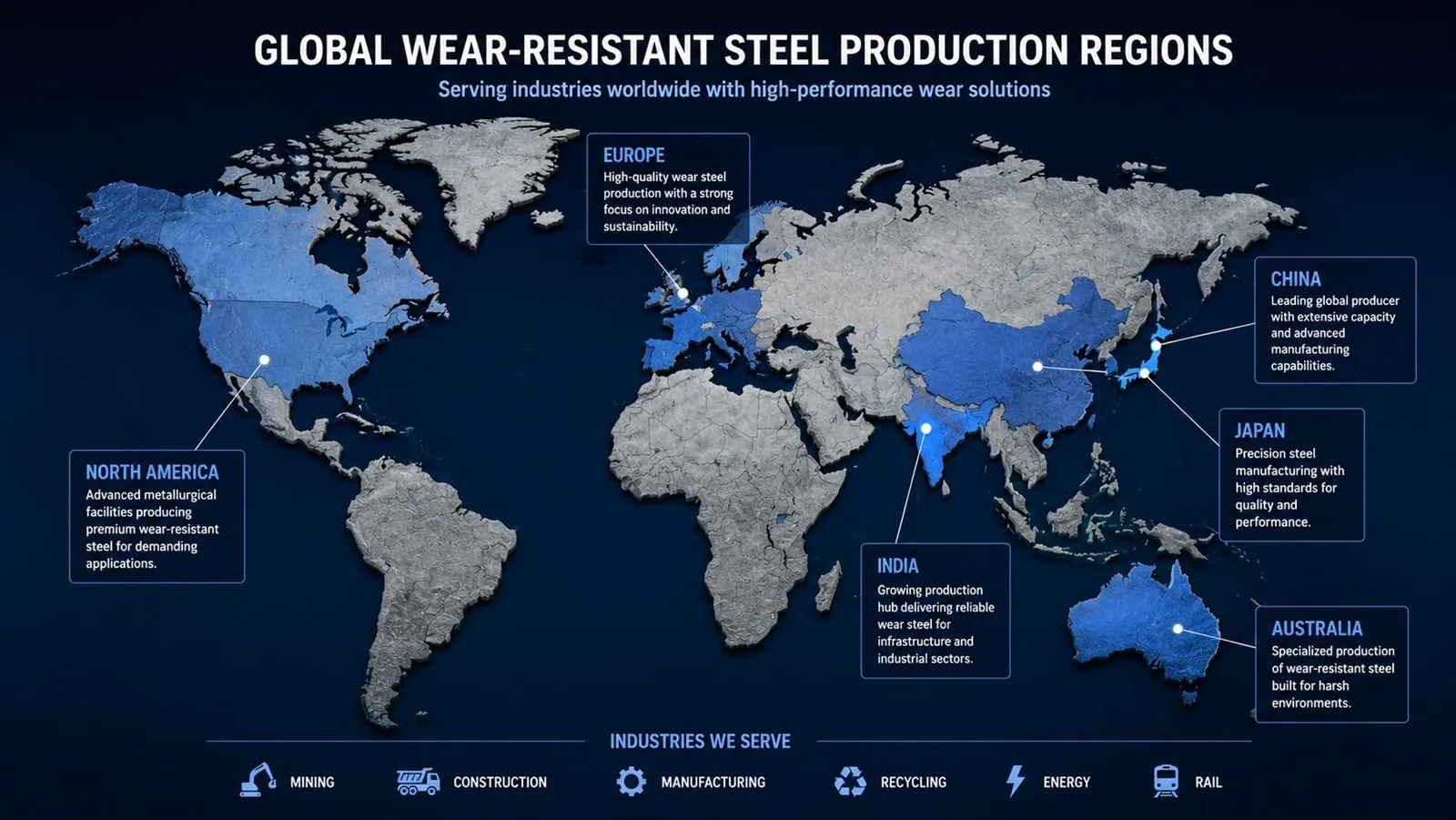
This guide maps out the world's major wear resistant steel manufacturers - European, North American, Chinese, Japanese, Indian, and Australian - with the technical and commercial data that actually helps procurement teams make the call. We've also tried to answer the question that keeps coming up among international buyers in 2026: are Chinese mills a credible alternative to European brands, and under what conditions does that switch actually make sense?
What Is Wear Resistant Steel? A Technical Overview
Wear resistant steel - you'll also see it called abrasion resistant (AR) steel, hard plate, or simply wear plate - is engineered to hold up against the kind of surface destruction that standard structural steel simply can't handle. Friction, impact, sliding abrasion: the environments that consume it fastest include mining excavation, ore crushing, cement grinding, aggregate conveying, and bulk material handling.
What makes it different from ordinary structural steel is heat treatment. Most commercial wear grades go through quenching and tempering (Q&T), a process that produces a hardened martensitic microstructure throughout the plate. The result is surface hardness measured on the Brinell scale (HB) - anywhere from 300 HB for lighter-duty applications up to 600 HB for the most extreme operating environments.
The grade naming conventions differ by region and manufacturer, which creates unnecessary confusion for international buyers. European mills market their grades under proprietary names: Hardox (SSAB), DILLIDUR (Dillinger), CREUSABRO (ArcelorMittal), RAEX. Chinese mills use the NM designation - NM300 through NM600 - under GB/T 24186 national standards. North American products often carry the AR prefix. Functionally, grades sitting at the same HB level are broadly comparable, though alloy composition and heat treatment specifics do affect performance when abrasion and impact occur together.
| Grade Designation | Hardness Range |
Typical Applications |
| NM/AR 300-360 | 300-360 HB |
Structural wear parts, chutes, hoppers |
| NM/AR 400 | 370-430 HB |
Mining buckets, dump truck bodies, crushers |
| NM/AR 450 | 420-480 HB |
Conveyor liners, cement mill internals |
| NM/AR 500 | 470-540 HB |
High-abrasion mining equipment, dredging |
| NM/AR 550-600 | 530-640 HB |
Extreme wear environments, cutting edges |
What to Establish Before You Evaluate Any Supplier
Most sourcing problems with wear plate happen because buyers jump to price comparison before locking down their requirements. Six things worth settling first:
Hardness and thickness range.
Not every mill covers the full 300–600 HB spectrum at every plate thickness. An NM600 at 80 mm is a very different production challenge than NM400 at 12 mm - and plenty of mills only do the latter well. Confirm both the grade and thickness are within a manufacturer's standard production range before spending time on an RFQ.
Certifications that actually apply to your project.
Marine applications need class certification - CCS, LR, DNV, BV. Rail freight requires AAR. Pipeline projects want API 5L. Military specs need GJB or equivalent. Many mills are ISO 9001 certified and stop there. Match what you need to what they actually hold.
Dimensional tolerances.
This rarely comes up until it causes a fabrication problem. High-precision work - tight-fitting liner panels, precision-machined wear parts - requires thickness tolerances in the ±0.1 mm range. Not all mills can hold that. Fewer will admit it upfront.
Lead time vs. project schedule.
European premium grades, if they're not sitting in distribution stock, often run 8–16 weeks mill-to-port. Chinese mills on standard grades typically ship in 30–45 days. If you have a hard mobilization date, this isn't a secondary consideration.
Processing before shipment.
Cut-to-size panels, beveled edges, drilled holes, shot blasting, painting - if your fabrication team needs finished components rather than raw plate, find out early whether the mill or its distribution partner can handle this. Doing it at the destination adds cost and time.
Minimum order quantities.
MOQ thresholds on specialty grades can make mixed orders impractical when sourcing direct from a mill. Understanding this upfront determines whether direct sourcing or a consolidation approach makes more commercial sense.
Top European Wear Resistant Steel Manufacturers
Europe built the global benchmark for wear resistant steel, and for good reason - the major mills have decades of metallurgical R&D behind them, process control systems that produce tight heat-to-heat consistency, and distribution networks that put stock close to fabricators across multiple continents. The premium over Chinese grades is real and significant. Whether it's justified depends entirely on what your specification actually requires.
SSAB (Sweden)
When most people in the industry say "wear plate," what they're actually picturing is Hardox. SSAB's brand has become effectively synonymous with the product category in engineering circles - and in many OEM supply chains, it's specified by name rather than by performance parameter, which means substitution isn't on the table regardless of what else is available.
The Hardox range runs from 400 to 600 HB: Hardox 400, 450, 500, 550, and 600. SSAB's patented quenching process produces consistent hardness through the full plate thickness - not just at the surface - which matters in heavy impact applications where sub-surface crack initiation is the failure mode. Beyond wear plate, their STRENX ultra-high-strength structural steel (tensile strength up to 1500 MPa class) serves crane boom, truck body, and structural fabrication applications where yield strength, not hardness, is the design driver.
SSAB's primary commercial territory is European and North American high-end construction machinery, where major OEMs like Caterpillar, Volvo CE, and Liebherr have built Hardox into their approved materials lists.
ArcelorMittal
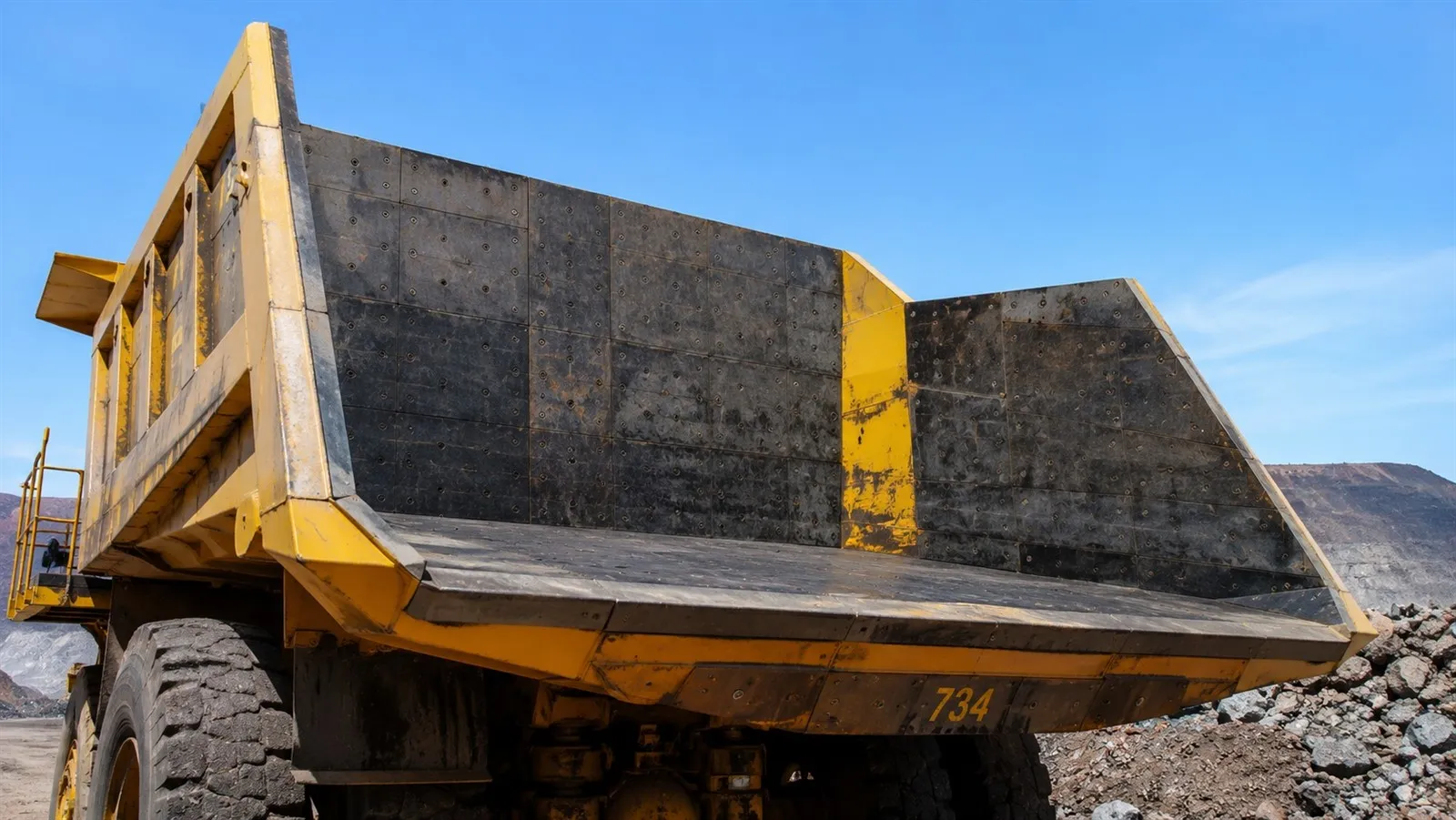
The world's second-largest steel producer by volume, ArcelorMittal brings the broadest geographic manufacturing footprint of any company on this list - and in wear plate, that translates to supply reliability for customers who need consistent stock across multiple project locations. Their CREUSABRO series (CREUSABRO 4800, 6400, and 8000) covers the 400–600 HB spectrum with grades optimized for different balances of hardness and toughness. Global wear-resistant steel production reached roughly 5.6 million metric tons in 2024.
For buyers with global operations who need a single approved supplier across regions, ArcelorMittal's distribution network is genuinely difficult to replicate.
DILLINGER (Dillinger Hütte, Germany)
DILLINGER is one of those mills that doesn't get mentioned as often as SSAB in general conversation but carries serious credibility in heavy-duty mining and quarrying applications. Their DILLIDUR series - 400 through 600 HB - covers the standard wear plate grades, and their vibrating screen plates deserve specific mention: these are engineered specifically for the high-cycle fatigue loading that standard wear plate grades weren't designed for and handle poorly. The DILLIMAX structural steel line hits 1300 MPa tensile strength for engineering machinery applications.
Six global production facilities, approximately 1.8 million metric tons annual capacity (2022 annual report), certified to EN 10025 and ASTM A514. That dual certification is useful for projects where specifications were written to either European or North American standards.
ThyssenKrupp (Germany)
ThyssenKrupp's approach is different from most others here. Alongside primary wear plate, they produce Duroxite - a wear-resistant cladding material for rebuilding and restoring worn components - and their PERDUR high-manganese steel deserves attention from anyone sourcing for crusher or rail applications. Manganese steel works differently from martensitic grades: instead of starting hard and staying hard, it work-hardens progressively under impact loading. In applications with severe repeated impact - jaw crushers, hammer mills, railroad switch components - that behavior makes it more appropriate than a high-hardness martensitic plate that would crack under the same loading.
voestalpine (Austria)
voestalpine's ALFORM plates (360–500 HB) are produced via Thermomechanical Controlled Processing (TMCP) rather than the conventional quench-and-temper route. The grain refinement from TMCP produces excellent toughness characteristics without needing a separate tempering cycle, and the resulting plates have corrosion resistance properties that make them appropriate for maritime and offshore environments where standard wear grades would need additional protection. Their DOMEX structural grades (600–1200 MPa tensile strength) pair well with ALFORM in fabricated structure applications.
Other Notable European Producers
- ACRONI (Italy): Their FORA wear plates run from 400 all the way to 700 HB - one of the wider ranges from a single European producer - alongside ARMOX armor plate that serves both ballistic protection and wear resistance requirements. Primarily military and high-hazard industrial applications.
- ILSENBURGER GROBBLECH (Germany): Specialists in extreme operating conditions, with BORON boron-alloyed plates at 500–600 HB and TBL microalloyed grades with welding performance as the design priority. Their customer base leans toward European energy and chemical plant applications.
- RAEX STEEL (Finland): The RAEX range goes up to 700 HB - among the highest of any commercial wear plate line - with powder metallurgy production methods producing material uniformity that's particularly valued in fatigue-critical cement and metallurgy applications.
- SWEBOR (Poland): Machinability is the design focus here. SWEBOR Wear Plates (400–600 HB) cut cleanly, drill without cracking, and weld reliably - priorities for fabricators working in Central European infrastructure and construction where downstream processing is as important as the wear performance itself.
- MIILUX (Finland): Operating primarily in Eastern European and CIS markets, MIILUX produces 400–600 HB wear plates with an estimated annual capacity around 500,000 metric tons. Their positioning is straightforward: accessible pricing without compromising technical standards.
Top North American Wear Resistant Steel Manufacturers
The North American wear plate market is genuinely complicated to characterize. Domestic mills exist, but a significant portion of the market is actually served by service center distribution networks for SSAB (which runs its own North American mills), ArcelorMittal, and DILLINGER - so the line between "domestically produced" and "imported brand held locally in stock" blurs considerably. The most distinctive domestic player is:
International Steel Group (ISG, USA)
ISG's Durashield 500 is produced via electric arc furnace at a claimed 20% production cost reduction over conventional blast furnace routes - a cost structure difference that matters at scale. Their Impacto series was developed specifically for shale gas extraction environments, where the abrasive and corrosive conditions created by fracking operations demand something more specialized than general-purpose wear plate. Eight U.S. production facilities, approximately 1.5 million metric tons combined annual capacity, API 5L certified.
Top Chinese Wear Resistant Steel Manufacturers
The gap between how Chinese wear plate is perceived and what it actually delivers has narrowed dramatically over the past decade. Chinese NM-grade plates from the major mills are now mechanically competitive with European equivalents - same GB/T 24186 standards, similar alloy compositions, comparable heat treatment processes. The hardness, tensile strength, yield strength, and Charpy impact values on certified mill test reports hold up to scrutiny.
The cost differential runs typically 25–40% below equivalent European grades on an FOB basis. That's not a rounding error. On a 500-ton project order, it's the difference between being competitive and losing the bid.
China Baowu Steel Group
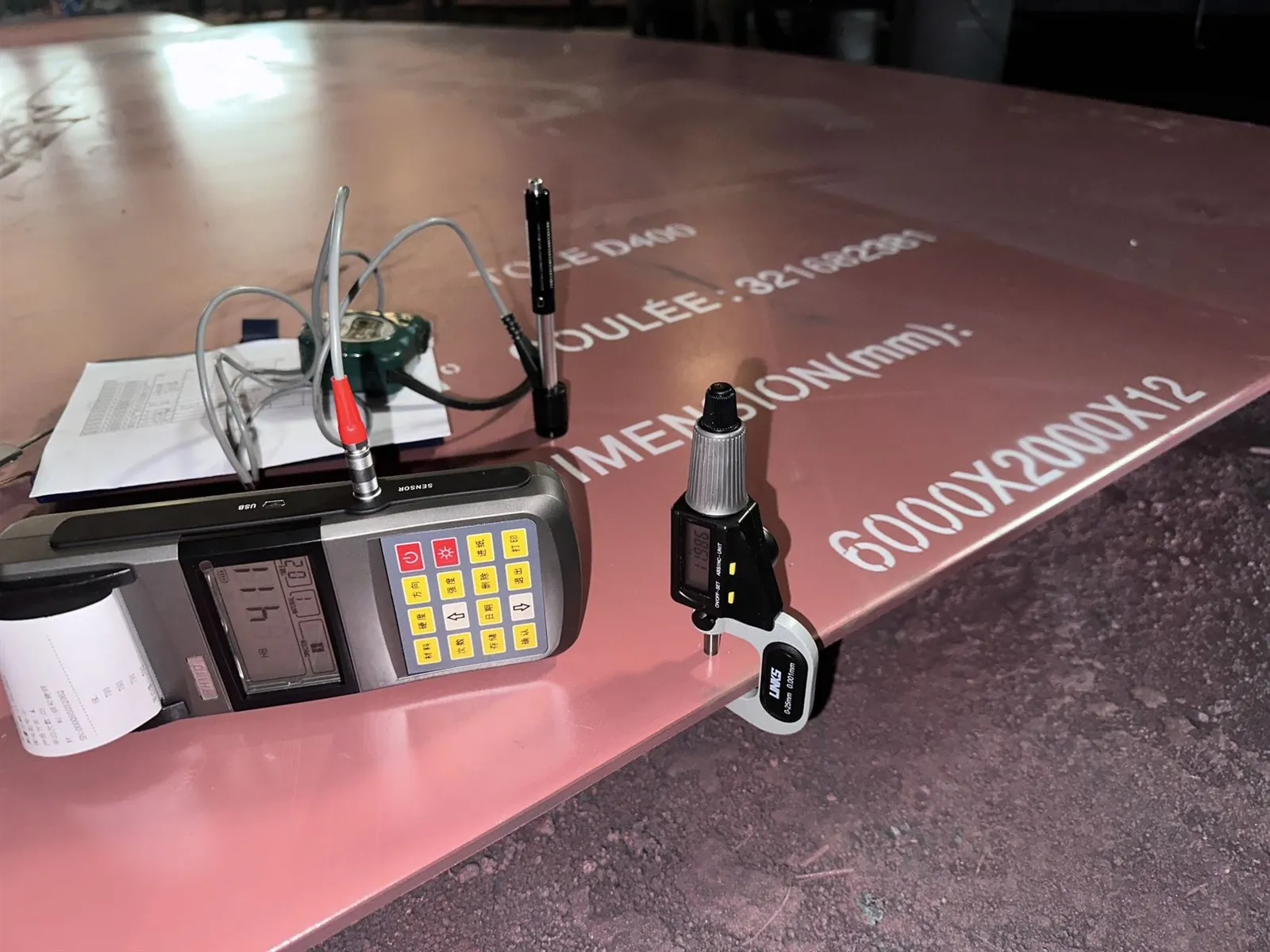
The largest steel producer in the world by volume, and the largest single manufacturer of wear resistant steel globally - roughly 6 million metric tons per year of wear-resistant capacity. Baowu's B24S and B36S mining series are available in thicknesses from 8 to 200 mm; that upper end of the thickness range is something most mills simply don't offer. Their Rex series railway freight car plates carry AAR certification, which demonstrates real export-market compliance capability rather than just domestic standards compliance. API 5L and IRIS certifications round out a certification portfolio that most Chinese mills don't come close to matching.
Wuhan Iron and Steel - WISCO (Baowu subsidiary)
WISCO operates out of production bases in Wuhan, Hubei and Fangchenggang, Guangxi. The NM series - NM300 through NM600 - is their core wear plate offering, fully compliant with GB/T 24186. Total WISCO steel output was around 40 million tons in 2024, with wear-resistant grades accounting for roughly 7% - approximately 2.8 million tons. The WH construction machinery steel series focuses on impact resistance for excavator, loader, and dump truck body applications, where the repeated shock loading places different demands on the material than pure sliding abrasion.
Wuyang Iron & Steel
Wuyang occupies an unusual position in the Chinese market: they hold GJB military standard certification, which is rare among commercial mills and signals a level of process control that goes beyond what standard ISO 9001 requires. Their NM500 and NM600 grades achieve tensile strengths at or above 1500 MPa. The WYJ construction machinery plate series has documented performance data showing three times the service life of loader bucket teeth compared to standard structural steel - the kind of application-specific testing data that procurement engineers actually need. Annual capacity at the Henan facility runs approximately 800,000 tons. For buyers sourcing at the hard end of the wear spectrum, Wuyang is one of the more capable options in China.
Angang Steel
Dual production bases at Bayuquan and Chaoyang give Angang approximately 1.2 million metric tons combined annual wear-resistant steel capacity. Their AR360F grade is specifically engineered for extreme cold - rated to -40°C low-temperature toughness, which rules out most competitors for projects in northern Mongolia, high-altitude Andean mining, or arctic infrastructure work. The AS series marine wear plates carry CCS certification. ISO 9001 certified. For buyers who need cold-climate or marine-grade Chinese supply, Angang is a serious option.
Lianyuan Steel
Lianyuan is a focused producer rather than a volume generalist. Their ML series mining wear plates for ball mill liners have documented service life data exceeding industry averages under GB/T certification - relevant because ball mill liner failure is a high-visibility maintenance problem at most mineral processing plants. Less commonly known: their LM series wear-resistant elbows are designed specifically for power plant fly ash conveyance pipelines, where standard pipe bends fail regularly. That kind of application-specific product development is a differentiator. Loudi, Hunan facility, approximately 600,000 tons annual capacity.
Shenglong Metallurgy
In December 2023, Shenglong's 1780 production line set a global record for single-line monthly output at 465,000 metric tons. Production efficiency at that scale translates directly to commercial pricing on standard grades. Their NM400 to NM550 range is ISO 9001 and CE certified - the CE certification opening access to European market project specifications. With approximately 500,000 tons annual capacity, Shenglong is particularly competitive for high-volume orders on standard grades where delivery speed and unit cost matter more than niche certifications.
Top Japanese Wear Resistant Steel Manufacturers
JFE Steel Corporation
Japan's second-largest steel producer brings precision manufacturing discipline to wear plate that tends to show up in tighter dimensional tolerances and more consistent heat-to-heat properties. Their JFE-EH360 delivers -40°C low-temperature toughness, putting it in the same cold-climate category as Angang's AR360F. The JFE-SP series was built for automotive die applications - achieving a 40% improvement in chipping resistance over standard die steels - which reflects JFE's orientation toward precision tooling rather than bulk wear applications. Five Japanese facilities plus a Vietnamese production base, approximately 2.5 million metric tons annual capacity, JIS G3125 certified.
India and Oceania: Emerging and Niche Players
Tata Steel (India)
Tata's multinational footprint - India, Netherlands, UK - means they're not purely an emerging market play; they have European production capability and OEM approval records with Caterpillar and Komatsu among others. Their Tata Weltaf wear-resistant plates sit in the 400–500 HB range. Global crude steel output was around 30 million tons in 2024, with wear-resistant grades at roughly 6% of that. For procurement targeting Indian infrastructure or mining projects, Tata's domestic logistics position is hard to compete with.
CHAMPAK GROUP (India)
CHAMPAK's FOR series (400–700 HB) competes on price in South Asian and Middle Eastern markets. Capacity data isn't publicly available. They serve both industrial and defense applications through their ARMOR protective plate line. A reasonable option where cost matters more than brand recognition and projects don't carry demanding certification requirements.
Bisalloy Steels (Australia)
BisPlate 400 and 500 series products claim over 70% coverage in Australian mining equipment - a figure that makes more sense when you consider the company's long-term relationships with the major Australian mining operators and their proximity to the market. Bisalloy isn't primarily competing on price; they compete on technical support, local service, and application knowledge built over decades in Australian mining conditions. Their BisTuf wear-resistant cladding - metallurgical bond strength of 800 MPa - is used for worn component restoration rather than new plate installation. Kwinana, Western Australia facility plus a South African joint venture, approximately 800,000 tons annual capacity, ISO 15649 certified.
| Manufacturer | Country | Key Product Lines | Hardness Range | Annual Capacity |
Key Certifications |
| SSAB | Sweden | Hardox 400-600, STRENX | 400-600 HB | N/A (global) | ISO, CE |
| ArcelorMittal | Luxembourg | CREUSABRO 4800/6400/8000 | 400-600 HB | ~5.6M t/yr (WR) | ISO, multiple |
| DILLINGER | Germany | DILLIDUR 400-600, DILLIMAX | 400-600 HB | ~1.8M t/yr |
EN 10025, ASTM A514 |
| ThyssenKrupp | Germany | Duroxite, PERDUR | 300-600 HB | Undisclosed | ISO, DIN |
| voestalpine | Austria | ALFORM, DOMEX | 360-500 HB | N/A | EN, ISO |
| RAEX STEEL | Finland | RAEX 500-700, TOOLOX | 500-700 HB | N/A | ISO |
| SWEBOR | Poland | SWEBOR Wear, ARMOR | 400-600 HB | N/A | CE |
| ISG | USA | Durashield 500, Impacto | 400-500 HB | ~1.5M t/yr | API 5L |
| China Baowu | China | B24S, B36S, Rex | 300-600 HB | ~6M t/yr |
API 5L, IRIS, AAR |
| WISCO (Baowu) | China | NM300-NM600, WH series | 300-600 HB | ~2.8M t/yr | GB/T 24186 |
| Wuyang Iron & Steel | China | NM500, NM600, WYJ | 500-600 HB | ~800K t/yr | GJB military |
| Angang Steel | China | AR360F, AS series | 360-500 HB | ~1.2M t/yr | ISO 9001, CCS |
| Lianyuan Steel | China | ML series, LM series | 300-500 HB | ~600K t/yr | GB/T |
| Shenglong Metallurgy | China | NM400–NM550 | 400–550 HB | ~500K t/yr | ISO 9001, CE |
| JFE Steel | Japan | JFE-EH360, JFE-SP | 360–500 HB | ~2.5M t/yr | JIS G3125 |
| Tata Steel | India | Tata Weltaf | 400–500 HB | ~1.8M t/yr (WR est.) | ISO |
| Bisalloy Steels | Australia | BisPlate 400/500, BisTuf | 400–500 HB | ~800K t/yr | ISO 15649 |
Wear Resistant Steel Grade Reference Guide
When an end-client specification says "Hardox 400" and your job is to price a competitive alternative, you need to know what you're actually substituting. The table below maps the major commercial brands to their Chinese NM equivalents and typical applications.
| HB Grade | SSAB (Hardox) | ArcelorMittal | DILLINGER | Chinese NM Grade |
Typical Applications |
| ~400 HB | Hardox 400 | CREUSABRO 4800 | DILLIDUR 400 | NM400 |
Dump truck bodies, chutes, hoppers, crusher liners |
| ~450 HB | Hardox 450 | CREUSABRO 6400 | DILLIDUR 450 | NM450 |
Excavator buckets, conveyor liners, cement mill parts |
| ~500 HB | Hardox 500 | CREUSABRO 8000 | DILLIDUR 500 | NM500 |
High-abrasion mining, dredge parts, grader blades |
| ~550 HB | Hardox 550 | - | DILLIDUR 550 | NM550 |
Extreme wear tools, bucket cutting edges |
| ~600 HB | Hardox 600 | - | DILLIDUR 600 | NM600 |
Ultra-high wear applications, specialized tooling |
Grade equivalency here is approximate. Two plates at 400 HB from different mills can have meaningfully different toughness, fatigue behavior, and weldability depending on alloy design and heat treatment. Always pull the mechanical property datasheet and verify against your application's actual loading conditions before finalizing a substitution decision.
Choosing the Right Supplier: A Practical Decision Framework
The honest answer is that "best manufacturer" is meaningless without context. Here's how experienced procurement teams actually think through this:
OEM-specified or Western-market projects:
If the specification says Hardox, it says Hardox. The commercial conversation ends there - source from authorized SSAB distributors and move on. The same applies to any project where brand compliance is a contractual requirement.
Performance-spec projects with cost optimization:
This is where Chinese mills make their case. Baowu, WISCO, Wuyang, and Angang produce plates that hit the same tensile strength, yield strength, and Charpy impact numbers as their European equivalents. Most experienced procurement managers sourcing for Middle East, Africa, Southeast Asia, or South American projects have already made this shift. The challenge is reliable access, consistent quality verification, and logistics - not the steel itself.
Cold-climate applications:
At -40°C and below, the shortlist gets short fast. JFE-EH360, Angang AR360F, and SSAB Hardox with certified low-temperature Charpy results. Ask for the actual test certificates - not every mill tests low-temperature toughness as standard, and "suitable for cold environments" in a brochure means nothing without test data behind it.
Upper hardness range (NM550–NM600):
Options thin out significantly above NM500. Wuyang is one of the more reliable Chinese sources at this end of the spectrum. SSAB Hardox 550/600 and RAEX 700 are the primary European options. Be realistic about lead times and MOQs - these aren't shelf items anywhere.
Marine and ship-class applications:
Class certification isn't optional. CCS, LR, DNV, or BV - get the certificates, verify the scope, and confirm they cover your specific grade and thickness range. Angang's AS series and SSAB's class-certified grades are among the qualified options in China and Europe respectively.
Large-volume mixed-grade orders:
Sourcing NM400, NM500, and NM550 from three different Chinese mills, combining into one shipment, coordinating quality inspection, and managing export documentation is operationally complex. It can be done - and the cost savings on large orders justify it - but it requires someone who knows how to manage multi-supplier Chinese steel sourcing, or you end up with logistics problems that eat the savings.
How Promisteel Simplifies Wear Resistant Steel Sourcing from China
Getting NM-grade wear plate out of China isn't complicated in theory. In practice, international buyers run into the same obstacles repeatedly: figuring out which mill actually has the credentials they need, getting a straight answer on dimensional tolerances, arranging third-party inspection before the material ships, dealing with export documentation, and - if the order involves multiple grades or thicknesses - managing consolidation across more than one supplier.
Promisteel was set up to handle exactly these steps. We're not a mill - we're a sourcing and supply chain partner that works with qualified Chinese manufacturers across the NM grade spectrum, and our job is to make sure the material your procurement team signs off on is the material that actually arrives.
What that covers in practice:
- Supplier selection and verification against your technical spec and destination market requirements - not just whoever can promise the fastest delivery
- Quality control and third-party inspection coordination before anything leaves the factory
- Value-added processing - cut to size, beveled edges, drilled holes, shot blasting, painting - so fabrication teams get components ready to use, not raw plate that needs more work
- Multi-supplier consolidation when your order spans multiple grades, thicknesses, or product categories
- Export packaging and logistics management to your destination port
- Technical consultation on grade selection, standard equivalencies, and certification requirements
If you're currently buying European brands for projects in the Middle East, Africa, or Southeast Asia and want to understand whether Chinese NM equivalents would hold up for your specific application, we can walk through that assessment alongside a comparative costing. No obligation.
Request a Wear Resistant Steel Quote
Send your specification, thickness range, and destination. We'll come back to you within 24 hours with sourcing options and indicative pricing.
FAQ
Q: What's the actual difference between wear resistant steel and regular structural steel?
A: Standard structural grades like A36, S355, or Q345 are designed around yield strength and ductility - they're built to take load without catastrophic failure, not to resist surface wear. Typical surface hardness sits around 120–180 HB. Wear resistant steel goes through quenching and tempering to produce hardness in the 300–600 HB range. The tradeoff is some ductility, but in abrasive environments, that hardness difference translates directly to service life. Using structural steel as a substitute in a high-abrasion application isn't a cost-saving measure - it's a recurring replacement cost.
Q: Is Chinese NM-grade wear plate actually equivalent to Hardox?
A: For most commercial applications, yes - mechanically. NM grades from the major Chinese mills (Baowu, WISCO, Angang) comply with GB/T 24186 standards and produce tensile strength, yield strength, elongation, and Charpy impact values that are comparable to SSAB's published Hardox specifications at the same HB level. Where it gets complicated: Hardox has decades of OEM approval records, batch consistency documentation, and distribution support infrastructure that Chinese mills generally haven't replicated. If your spec says Hardox, use Hardox. If your spec says "400 HB wear plate, impact tested to -20°C," certified Chinese NM400 is a legitimate option - and a cheaper one.
Q: Which wear resistant steel grades are most common in mining applications?
A: NM400 (equivalent to Hardox 400) does most of the work - dump truck bodies, bucket liners, chute liners, hopper walls. NM450 and NM500 come into play for higher-abrasion zones: conveyor system components, crusher feed liners, and grader blades. At the cutting edges and high-impact tool end, NM550 and NM600 are specified. One thing worth knowing: for actual crusher jaw and jaw plate applications, high-manganese steel (Hadfield manganese) usually outperforms martensitic grades because it work-hardens under impact - a behavior that martensite can't replicate and that prevents premature cracking.
Q: What are realistic lead times for wear plate sourced from China?
A: Standard NM400 and NM450 in common thicknesses (6–50 mm) - 30 to 45 days from order confirmation to vessel loading. Thicker material (80 mm and above), higher hardness grades (NM550–NM600), or non-standard dimensions push that to 45–70 days. Processing services - cutting, drilling, beveling - add roughly 5–10 working days. European mills on non-stocked specialty grades typically run 8–16 weeks. That lead time gap matters on projects with tight construction schedules.
Q: What certifications do I actually need to ask for?
A: ISO 9001 and full material test reports are the baseline minimum - chemical composition, mechanical properties (yield strength, tensile strength, elongation), Brinell hardness test results. From there, it depends on your application: marine and offshore require class certification (CCS, LR, DNV, BV); pipeline and energy sector projects want API standards; cold-climate applications need Charpy impact certificates at the relevant temperature; some destination markets have their own import certification requirements. Get the actual certificates, not just assurances - and check that the grade and thickness you're ordering falls within the certification scope, not just the mill.
Q: Can wear resistant steel be cut and processed before shipping from China?
A: Yes, and doing it before export almost always saves money and time versus processing at the destination. Promisteel coordinates plasma cutting, flame cutting, laser cutting, waterjet cutting, beveling, drilling, and shot blasting at source - plates get re-inspected, dimension-verified, and documented before packing. For fabricators working to tight fit-up tolerances, getting pre-cut panels rather than raw plate removes a significant step from their production process.
Q: How much cheaper is Chinese NM wear plate versus European brands?
A: On an FOB basis, typically 25–45% lower than SSAB Hardox, DILLIDUR, or CREUSABRO equivalents. At CIF to Middle Eastern, African, or Southeast Asian ports, the gap narrows slightly depending on the shipping lane, but Chinese origin holds the cost advantage in most cases. On a 300-ton wear plate order, that differential is material. On a 1,000-ton mining equipment fabrication package, it's the difference between a competitive bid and an uncompetitive one.
Ready to Source Wear Resistant Steel for Your Next Project?
Promisteel works with qualified Chinese mills across the full NM300–NM600 range - general-purpose chute liners through ultra-high hardness mining tooling. We handle supplier selection, quality control, third-party inspection, processing, and export logistics.
Technical data in this article is sourced from manufacturer publications, annual reports, industry standards, and publicly available mill documentation. Specifications are subject to change - always verify current product data directly with your supplier before finalising procurement decisions.


