
 Español
 Türkçe
 Français
 عربي
عربي  dansk
dansk 한국어
한국어 Deutsch
 Việt Nam
 Italiano
 日本語
日本語 Português

Price disclaimer: All figures in this guide are budgetary market-planning ranges in USD per metric ton, not a firm offer. Wear-plate pricing changes with grade, plate source, mill availability, thickness, width, length, test requirements, processing, Incoterm, destination, duty, freight, and currency movement. A purchase decision should use a dated written quotation for the exact specification.
What Does Abrasion Resistant Steel Cost in 2026?
Buyers searching for an "AR steel plate price" often receive a number that cannot be compared directly with another supplier's offer. One quote may refer to stock NM400 plate delivered ex-works; another may include CNC cutting, MTC, export packing, inspection, sea freight, or import duty. The only useful comparison is the delivered, specification-matched cost of a plate that will actually meet the wear and fabrication requirement.
In the current export market, publicly visible supplier offers for 500 HBW-class wear plate span a wide band, including roughly USD 700-1,000 per metric ton for NM500-type plate and higher small-lot indications around USD 960 per ton. These references are useful only as a budget signal; they are not proof that a particular plate is available at that number, meets a named mill standard, or can be shipped to every destination on the same terms.
|
Budgetary 2026 planning range - FOB China, USD / metric ton |
Common stock / buying condition |
Why the range moves |
|
NM400, approx. 6-20 mm |
USD 650-850 / t |
Standard dimensions, 20-50 t consolidated orders, ordinary MTC, and available stock typically sit nearer the lower end. |
|
NM400, thick / wide / custom-cut |
USD 720-950 / t |
Thicker sections, non-standard widths, strict flatness, cutting, drilling, and short lead times add cost. |
|
NM500, approx. 6-20 mm |
USD 700-1,000 / t |
Current public export listings show a broad spread; mill, hardness guarantee, source documentation, and order size matter. |
|
NM500, thick / wide / low-volume |
USD 820-1,100+ / t |
Higher hardenability, thicker plate, yield loss, processing, and low MOQ commonly move the price upward. |
|
Premium branded 400/450/500 HBW plate |
Quote-based, normally premium-priced |
Value may include traceability, performance guarantees, technical support, local stock, and lower fabrication risk rather than only a lower plate price. |
These are intentionally broad ranges. A 10 mm x 2,000 mm x 6,000 mm NM500 plate with full MTC is not comparable to a 50 mm, ultra-wide, cut-to-shape plate that requires third-party inspection and immediate container loading. Quote comparison should normalize grade, source, hardness, dimensions, tolerance, MTC, inspection, processing, packaging, payment term, Incoterm, and delivery period before selecting a supplier.
NM400, NM500, and Hardox: Why "Same Hardness" Does Not Mean Same Cost
|
Material family |
Typical buyer position |
Cost logic |
|
NM400 / AR400-class plate |
General abrasion service where toughness, forming, and welding remain important. |
Usually the most economical choice when the abrasion rate does not justify a 500 HBW upgrade. |
|
NM500 / AR500-class plate |
Higher sliding abrasion, quarry, mining, recycling, chutes, bucket liners, and high-silica materials. |
Higher material price can be justified when it reduces replacement frequency, machine downtime, and field-repair labor. |
|
Hardox or other premium branded wear plate |
Projects requiring known performance, consistent fabrication guidance, documentation, or local technical support. |
Evaluate lifetime cost, not only USD/t. A higher purchase price can be offset by lower scrap, longer life, and reduced risk. |
Procurement rule: Do not buy based on grade name alone. Ask for the MTC, hardness range, thickness tolerance, test standard, plate source, and delivery condition. "NM500 equivalent" is not a sufficient technical specification for a critical wear part.
The Five Biggest Factors Behind Wear Plate Price
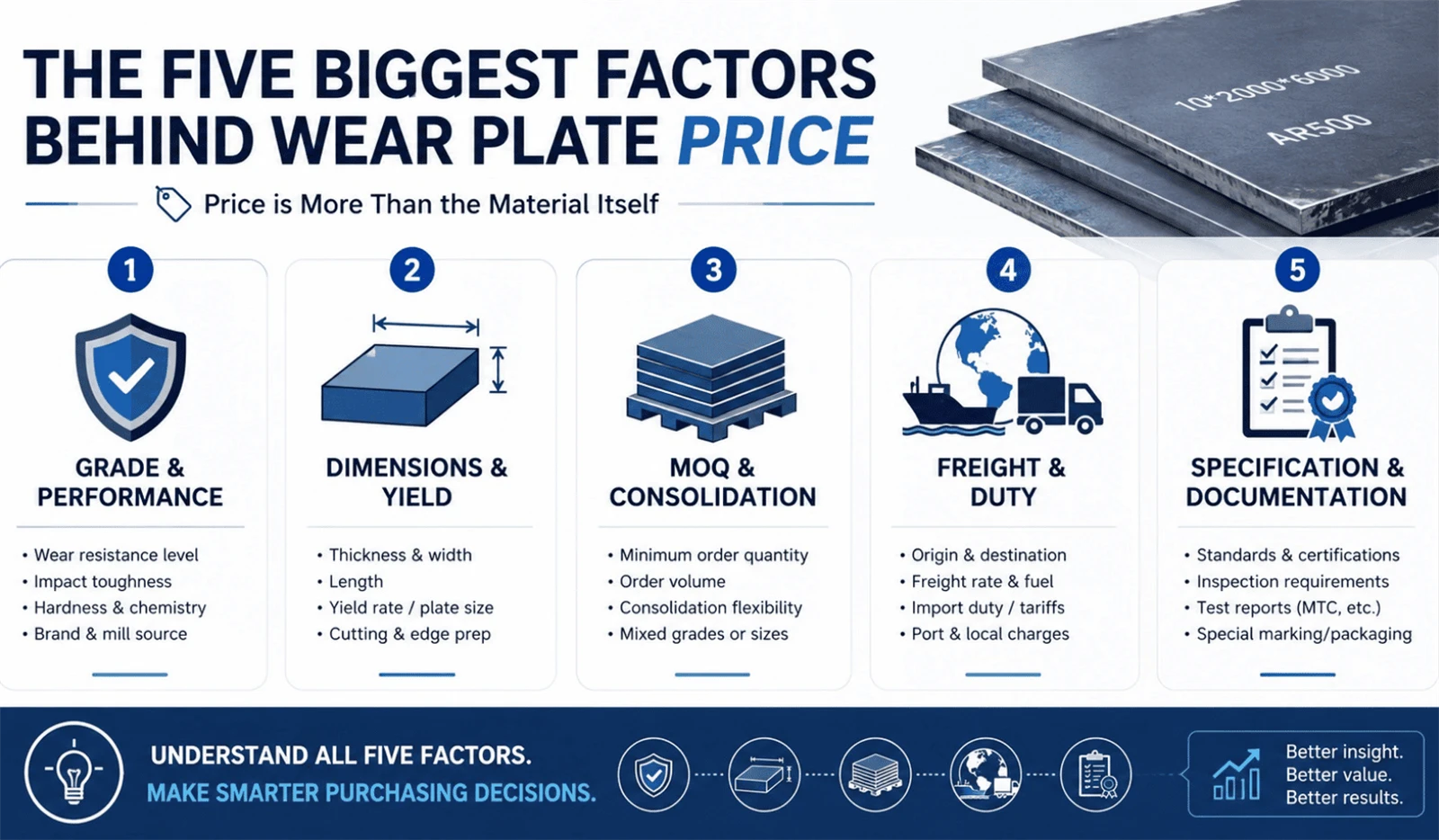
1. Grade and Guaranteed Performance
Wear plate is not priced only by the nominal 400 or 500 HBW label. A supplier may price higher for restricted chemistry, tighter hardness limits, guaranteed impact performance, through-thickness quality, branded mill origin, or full traceability. These features can be commercially worthwhile when a failed liner causes costly downtime.
2. Thickness, Width, Length, and Yield Loss
Standard plate dimensions are normally the most cost-efficient. Thin wear plate can carry a premium because it is harder to produce flat and may be in strong demand for liners. Heavy plate can also cost more because of rolling capacity, heat treatment, handling, freight weight, and lower availability. Extra-wide or extra-long plates may create a substantial price jump even when the tonnage is unchanged.
|
Dimension factor |
Typical commercial effect |
How to reduce the impact |
|
Very thin plate |
Premium for flatness, heat treatment control, and handling. |
Use the thinnest standard size that still meets wear life; compare nesting across standard sheet sizes. |
|
Heavy plate |
Premium for heat-treatment capacity, yield, handling, and transport. |
Confirm whether a thinner higher-grade liner or replaceable wear strip can meet the life target. |
|
Non-standard width / length |
May require special rolling, trimming, or low-yield cutting. |
Design parts around available stock widths and lengths where possible. |
|
CNC cut, holes, bevels, bends |
Adds labor, machine time, programming, and scrap loss. |
Send optimized drawings and nesting plans; bundle similar parts. |
3. MOQ and Order Consolidation
MOQ directly affects the price per ton. Some current supplier listings show MOQ levels from 1 ton for small-lot offers to 5 tons or more for typical export supply. Small orders usually carry higher material price, handling, packing, documentation, and freight cost per ton. Larger consolidated orders can access better mill allocation, but only when the buyer can use the material without creating excess inventory.
A practical approach is to combine wear plate with compatible grades, sizes, or processing services in one purchase order. For example, a buyer may consolidate NM400 liner plate, NM500 high-wear strips, cut parts, and mild-steel backing components where the supplier has the capability to manage the package. The savings should be measured against the cost of tying up inventory and the risk of buying a grade that is too hard for the intended fabrication.
4. Freight, Packaging, Duty, and Destination Charges
Freight can change the purchase decision dramatically because wear plate is dense. Ocean freight, inland trucking, export packing, insurance, port handling, customs clearance, duty, VAT/GST, and local delivery should be built into the purchase model at the start. Container utilization matters: a heavy plate order may reach the container weight limit before it fills the available volume.
|
Landed-cost item |
How to calculate / verify |
|
Material value |
Quoted unit price x net shipment weight under the agreed Incoterm. |
|
Export-side charges |
Confirm whether export packing, inland transport, port handling, documents, and inspection are included in FOB / CFR / CIF terms. |
|
Ocean freight and insurance |
Use current forwarder quote for the exact port pair, container type, cargo weight, and sailing window. |
|
Duty and taxes |
Apply the destination-country HS classification, customs value rules, preferential origin status, and current tariff schedule. |
|
Destination charges |
Include terminal fees, customs broker, inspection, demurrage risk, unloading, and final-mile transport. |
|
Processing and quality cost |
CNC cutting, beveling, drilling, MTC, third-party inspection, protective packing, and damage allowance. |
Landed-cost formula: Landed cost per ton = material price + export-side cost + freight + insurance + import duty / tax + destination handling + local delivery + financing + inspection / processing allowance. Compare suppliers only after each item is mapped to the same Incoterm and destination.
5. Specification, Documentation, and Quality Risk
The lowest quote may omit the information needed to verify performance. A price comparison should show whether each offer includes EN 10204 3.1 MTC, hardness verification, plate traceability, dimensional tolerance, third-party inspection, cutting quality, and export-grade packing. A low-cost plate that cannot be identified after cutting or does not meet hardness can become the most expensive purchase on the project.
Five Ways to Reduce Wear Plate Cost Without Reducing Service Life
1. Specify abrasion by zone, not by habit. Use NM500 only in high-wear hot spots, while using NM400 or structural steel where toughness or cost control matters more.
2. Design around standard plate formats. Standard thicknesses, widths, and lengths reduce mill premium and cutting scrap.
3. Buy the correct usable package. Consolidate grades and services to improve MOQ economics, but avoid buying excessive inventory solely to hit a price break.
4. Optimize cut nesting and part geometry. Shared cut lines, repeatable parts, fewer unnecessary holes, and reduced offcut can lower delivered cost materially.
5. Compare lifecycle cost. Include service life, replacement labor, planned shutdowns, machine availability, and risk of failure - not only the plate price per ton.
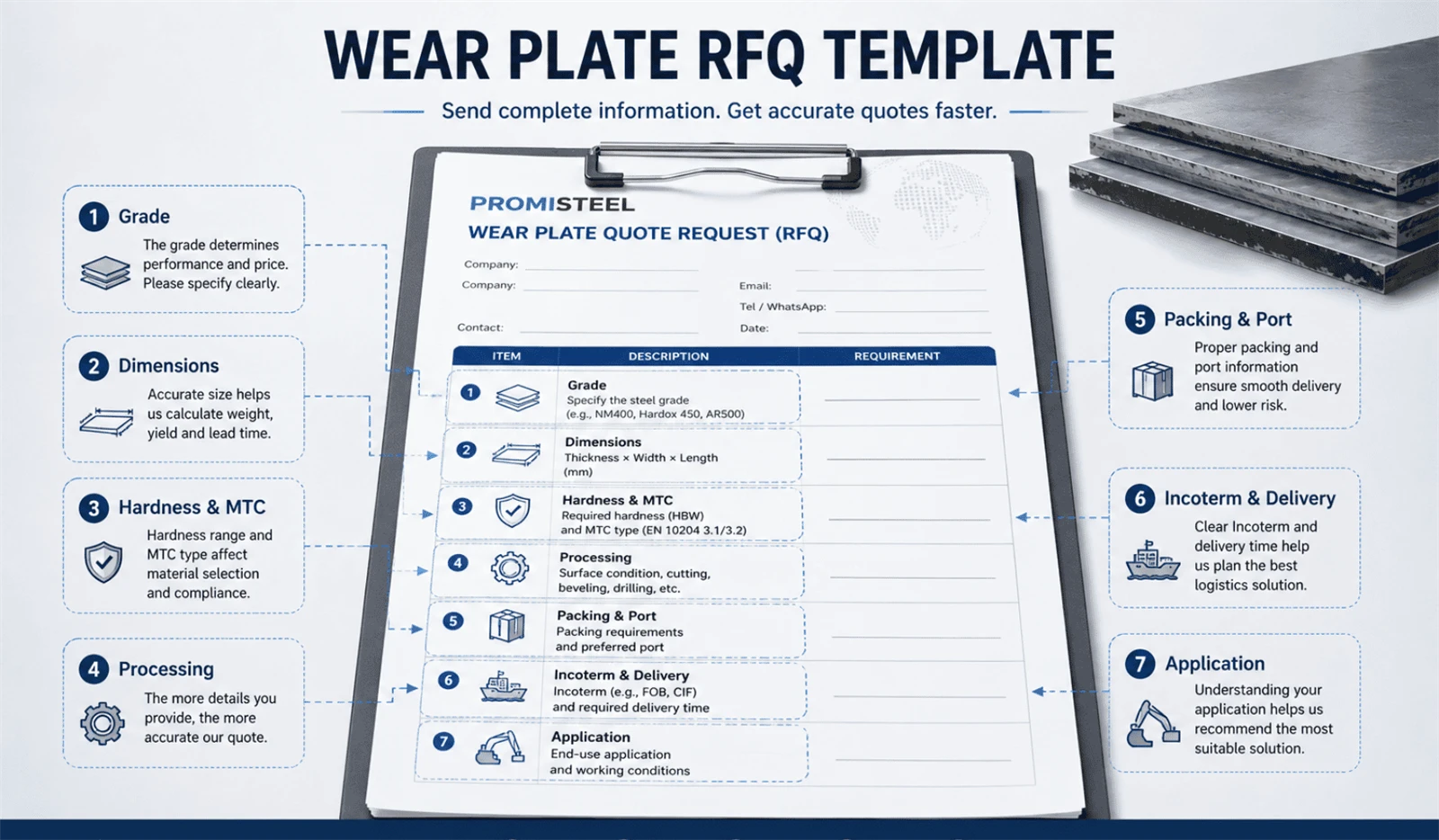
Quote Request Template: What to Send a Wear Plate Supplier
- Grade and acceptable alternatives: e.g., NM400 / NM500 or approved branded equivalent.
- Thickness, width, length, plate count, tolerance, and estimated total quantity.
- Required hardness range and test condition; MTC requirement and any impact / ultrasonic / third-party inspection need.
- Processing: cut-to-size, CNC profile, holes, bevel, bend, weld preparation, marking, or hardfacing.
- Packing requirement and destination port / delivery address.
- Required Incoterm, currency, payment term, delivery window, and quote validity.
- Application: bucket liner, chute, mixer, crusher, recycling, cement, or another service environment so the supplier can challenge an over- or under-specification.
Ready to Request a Wear Plate Quote?
Use the template above to send Promisteel your specification. We supply NM400 and NM500 wear resistant steel plate with full documentation, third-party inspection options, and competitive FOB pricing to the Middle East, Africa, Southeast Asia, and South America.
Request a Dated Quote →
FAQ
Q: What is the typical NM500 price per ton in 2026?
A: For budget planning, current public export offers place NM500-type plates broadly around USD 700-1,000 per metric ton FOB China, with small-lot or custom offers potentially higher. The only dependable number is a dated quote for exact plate dimensions, source, processing, Incoterm, and destination.
Q: Is NM400 always cheaper than NM500?
A: Normally yes on a unit-price basis, but NM500 can be cheaper over the equipment life when its added wear resistance extends liner replacement intervals or reduces downtime. Evaluate cost per operating hour or per tonne of material handled.
Q: Why does thin AR plate sometimes cost more per ton?
A: Thin, heat-treated wear plate may carry a premium for flatness, heat treatment control, handling, and availability. Plate price is driven by manufacturing difficulty and demand, not only steel weight.
Q: How do I calculate import duty on wear plates?
A: Duty is destination-specific. Confirm the correct HS code, customs valuation method, country of origin, trade remedies, and applicable preferential rules with a customs broker or local trade adviser before ordering.


