
 Español
 Türkçe
 Français
 عربي
عربي  dansk
dansk 한국어
한국어 Deutsch
 Việt Nam
 Italiano
 日本語
日本語 Português

When developing a market, aluminized steel and aluminium are often confused by buyers-especially in industries like construction, automotive, and manufacturing.
While some customers want to buy aluminized steel, as the product name suggests, some non-professional suppliers may misunderstand this product as aluminum steel.
However, these two materials are fundamentally distinct in chemical composition, mechanical strength, and usage. As a professional steel specialist, I'm here to elaborate on their core differences, unique advantages, and ideal applications to help you make the right purchasing decisions.
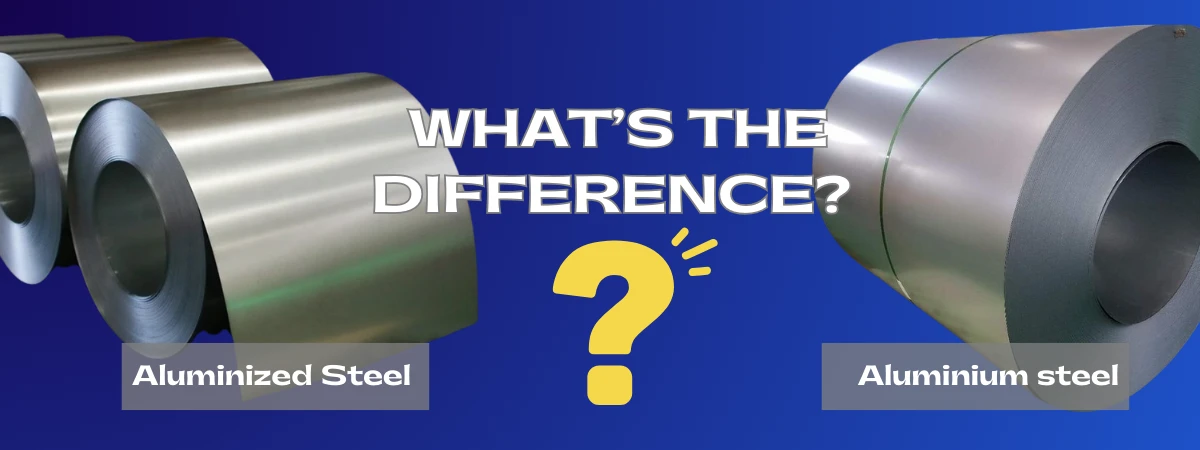
What Are They(Aluminized Steel and Aluminium steel)?
Aluminized Steel
It is a carbon steel substrate (base material) coated with a thin, uniform layer of aluminium or aluminium-silicon alloy via the hot-dip galvanizing process (hot-dip aluminizing).
The coating forms a dense aluminum oxide (Al₂O₃) film when exposed to air, providing exceptional corrosion resistance, while the steel core retains high tensile strength and structural integrity. It is a hybrid metallic material designed to combine the mechanical performance of steel with the anti-corrosion and heat-resistant properties of aluminium.
It is a pure metallic element (atomic number 13) with a natural oxide layer that offers inherent corrosion resistance. It's lightweight, malleable, and available in various forms (sheets, coils, extrusions) for diverse industrial uses. Unlike aluminized steel, it has no steel core-its properties come entirely from the aluminium itself.
The above are the definitional differences between aluminized steel and aluminium. To help you easily make the comparison, please refer to the table below.
|
Feature |
Aluminized Steel |
Aluminium |
|
Composition |
Carbon steel core + aluminium/aluminium-silicon coating |
Pure aluminium (99%+ purity, or alloyed with other metals like magnesium) |
|
Density |
Higher (≈7.8 g/cm³) – heavier than aluminium |
Lower (≈2.7 g/cm³) – 1/3 the weight of steel |
|
Strength |
Higher tensile strength (depends on steel core) – ideal for load-bearing applications |
Lower inherent strength (can be enhanced via alloying or heat treatment) |
|
Corrosion Resistance |
Protected by aluminium coating (forms Al₂O₃ layer) – excellent for high-temperature or outdoor environments |
Natural oxide layer (Al₂O₃) – good corrosion resistance, but less durable than aluminized steel in extreme conditions (e.g., high humidity, chemicals) |
|
Heat Resistance |
Superior (withstands temperatures up to 650°C) – suitable for high-heat applications |
Poor heat resistance (softens above 200°C) – not ideal for extreme heat |
|
Cost |
More cost-effective for large-scale structural projects (balances performance and price) |
Higher cost per unit weight – premium material for weight-sensitive uses |
Advantages & Ideal Applications
Aluminized Steel: Strength/Corrosion Resistance
Advantages
High-Temperature Resistance
Aluminized steel excels in handling high heat-benefiting from the iron-aluminum alloy layer that forms on its surface.
At 450°C, it still maintains strong heat reflectivity, and even when heated to 650°C, the protective layer that prevents the steel from rusting (oxidizing) remains completely intact.
01
Thermal Reflectivity
When it's exposed to 480°C high temperatures, aluminized steel can bounce back 80% of the heat that hits it! That's why it's perfect for making efficient heat shields or heat reflectors in situations where things get really hot.
02
Mechanical Strength
At room temperature, aluminized steel is just as strong as its base steel. But when it's heated to 480°C, it's 10 times stronger than aluminum plates! This means you can make the steel at least 30% thinner without losing any strength-saves material while still getting reliable performance.
03
Corrosion Resistance
During the hot-dipping process, the molten aluminum reacts right away with oxygen in the air. This forms a protective layer of Al₂O₃ (aluminum oxide) on the steel's surface, making it super stable. The layer doesn't dissolve in water, and even if the steel gets scratched, it can "self-heal" to keep protecting the steel from rust!
04
Applications

Automotive
Exhaust manifolds, mufflers, and underbody components.

Construction
Roofing panels, wall cladding, and structural supports in coastal or high-humidity areas.

Industrial
Heat exchangers, boiler parts, and agricultural equipment (e.g., grain silos
It is widely used in the automotive industry, such as exhaust systems, heat-insulating parts; in home appliances, such as ovens, microwave ovens; and in construction, such as building cover plates, walls, etc.

Aluminium: Lightweight/Versatility
Advantages
- Lightweight but Tough: It's light enough to carry easily (hello, portable camping cookware!) but strong enough to build airplanes. This means less hassle for transport (saves money on shipping!) and easier installation-no need for heavy machinery just to move a piece of aluminum.
- Rust-Proof & Low-Maintenance: Unlike steel, aluminum doesn't rust or corrode, even when it's outside in rain, snow, or humidity. That protective layer we talked about? It's like a built-in shield. So things made of aluminum last longer with almost no upkeep.
- Super Flexible to Work With: You can bend it, cut it, stamp it into shapes, roll it into thin sheets (like kitchen foil), or even melt it and cast it into new forms. Manufacturers love it because it's easy to turn into almost anything-from tiny phone parts to giant building panels.
- Eco-Friendly & Recyclable: Aluminum is 100% recyclable, and recycling it uses way less energy than making new aluminum (about 95% less!). That's great for businesses wanting to go green, and it means aluminum can be reused over and over without losing quality.
- Great at Conducting Heat & Electricity: It's a top-notch conductor-so it's perfect for things like cookware (heats up evenly!), electrical wires, and car radiators (cools down engines efficiently).
Applications
- Everyday Items: Soda cans, water bottles, kitchen foil, food containers, and even some cutlery. It's safe for food, keeps things fresh, and is easy to recycle.
- Construction: Window frames, door frames, roofing sheets, gutters, and skyscraper cladding. It's light for easy installation, rust-proof for outdoor use, and comes in lots of colors.
- Automotive & Aerospace: Car bodies, engine parts, radiators, and airplane wings. Using aluminum makes vehicles lighter, which saves fuel and reduces emissions (win for the planet!).
- Electronics: Phone cases, laptop bodies, tablet frames, and electrical wires. It's strong enough to protect devices, light enough to carry, and conducts electricity well.
- Sports & Outdoor Gear: Bike frames, camping cookware, hiking poles, and even surfboards. Its light weight and strength make it perfect for active lifestyles.
- Industrial Uses: Pipes, heat exchangers, and machinery parts. Its corrosion resistance and durability stand up to tough factory conditions.
The two products mentioned above are vastly different. Therefore, ordering the wrong product due to similar names can result in significant losses for customers.
Choosing aluminium for a high-heat or load-bearing project may result in premature failure.
Opting for aluminized steel in a weight-sensitive application (e.g., EV parts) could increase fuel consumption or installation difficulty.
That's why choosing a professional supplier matters so much!
PROMISTEEL doesn't just supply steel products-we're problem solvers you can rely on.
At PROMISTEEL, we customize the products based on your specific needs. It seems like a patient to see the traditional Chinese medicine, we make a prescription based on different patient situations. Not only in aluminized steel and aluminum differences, but Promisteel's professionalism also excels in every detail, products themselves, logistics, documents, and after-sales service.


