
 Español
 Türkçe
 Français
 عربي
عربي  dansk
dansk 한국어
한국어 Deutsch
 Việt Nam
 Italiano
 日本語
日本語 Português

China's automotive industry is growing rapidly in the 21st century. The country has built a complete system for producing auto parts, with a high level of industry concentration. Product technology has improved significantly, and China's position in the global car market has been rising. We Promisteel supply automotive metal for the automotive industry.

Materials are a basic and supporting industry for the development of the auto industry. As China's car industry grows, the materials industry has also found new opportunities. Today, auto materials need to meet high-performance standards, such as high strength, fatigue resistance, creep resistance, high-temperature resistance, solvent resistance, size stability, and excellent electrical performance.
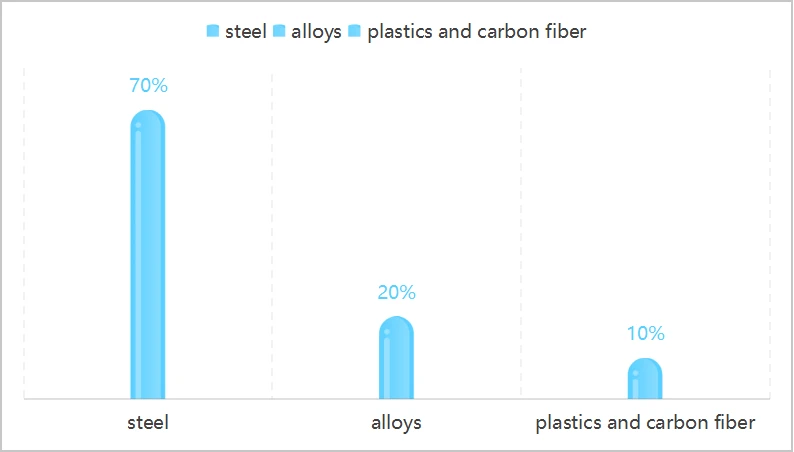
In car bodies, metal materials make up about 90%, with steel accounting for 70% and alloys like aluminum and magnesium around 20%. Other materials like engineering plastics and carbon fiber make up about 10%. When you consider cost, safety, and weight reduction, steel is still the best choice for car bodies for a long time.
Car steel can be divided into three main categories:
1. Low-carbon steel
Low carbon steel mainly refers to low carbon aluminum killed steel or interstitial free steel (IF steel), which has low yield strength and high elongation after fracture. It has excellent plastic processing properties and is very suitable for the production of complex parts. It can be used for stamping deep and ultra-deep drawing products such as door inner panels, spare tire wells, and wheel covers. In particular, interstitial-free steel is made by adding appropriate amounts of titanium and/or niobium to ultra-low carbon steel. The interstitial atoms (carbon and nitrogen) in the steel exist in the form of carbides and nitrites, which reduces the interstitial solid solution atoms in the steel and makes it have better formability.
2. Regular high-strength steels
This category includes different kinds:
- Phosphorus-added high-strength steel: refers to the addition of no more than 0.12% of phosphorus and other solid solution-strengthening elements to ultra-low carbon steel (based on interstitial-free steel) or low carbon steel (based on low carbon aluminum-killed steel) to improve the strength of the steel. This steel has high strength and good cold-forming properties, as well as good impact resistance and fatigue resistance, and is usually used to manufacture automotive panels or structural parts.
- High-strength IF steel: Steel's plastic strain ratio (r-value) and strain hardening index (n-value) can be enhanced by regulating its chemical composition. The presence of interstitial atoms and the solid solution strengthening effect of alloy elements in steel give this steel its exceptional cold-forming qualities and high strength, making it ideal for complex pieces that need deep stamping
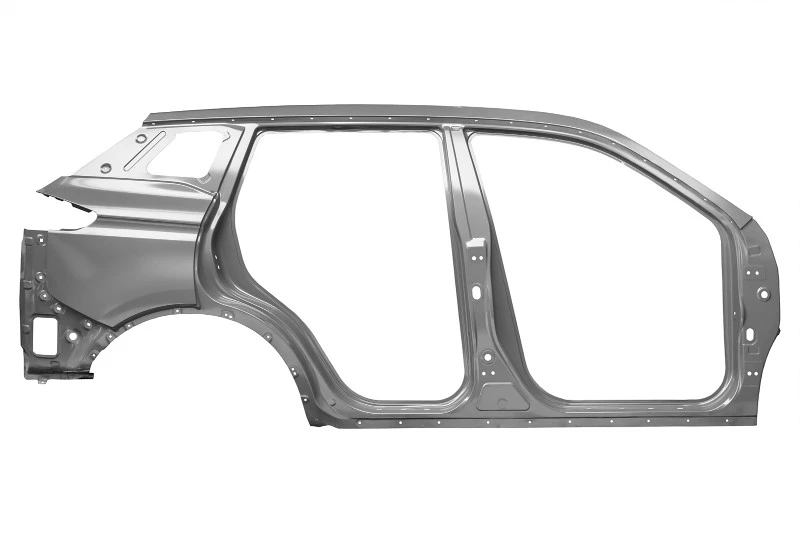
- Bake hardening steels: Steel retains some dissolved carbon and nitrogen atoms, and reinforcing metals like manganese and phosphorus can be added to increase the steel's strength. The steel is typically utilized in car exterior panels that need strong bake hardening performance since aging hardening greatly increases the steel's yield strength after it has been treated, shaped, and baked at a specific temperature.
- Low alloy high strength steel: It is a process of strengthening low carbon steel by adding microalloying elements such as niobium, titanium, vanadium, etc. alone or in combination to form carbonitride particles that precipitate and at the same time obtain higher strength through the grain refinement effect of microalloying elements. It is mainly used for structural parts and reinforcements with high requirements for flanging forming.
3. Advanced High-Strength Steels (AHSS)
These steels help reduce car weight while maintaining safety. Examples include:
- Dual phase steel (DP steel): 1. Dual-phase steel (DP steel) has a low yield strength ratio, strong work hardening performance, good uniform elongation, and bake hardening performance. Its structure is mostly made up of ferrite and martensite. Dual-phase steel is stronger than low alloy high-strength steel, does not age at room temperature, and has good formability at the same yield strength level. Dual-phase steel now has a strength level of 450–1310 MPa and is mostly utilized for reinforcement and structural components.
- Dual-phase steel with Improved Formability (DH steel): This is mainly composed of ferrite and martensite with a small amount of bainite or retained austerity. Compared with dual-phase steels with the same tensile strength, it has a higher elongation and work hardening index. Therefore, this steel is suitable for parts with higher drawing requirements.
- Transformation-induced Plasticity steel (TR steel): The primary components of transformation-induced plasticity steel (TR steel) are ferrite, bainite, and retained austenite, with at least 5% of retained austenite present. The steel has a greater work hardening rate, consistent elongation, and tensile strength because the residual austenite can change into martensite during the forming process. It has more elongation than dual-phase steel with the same tensile strength.
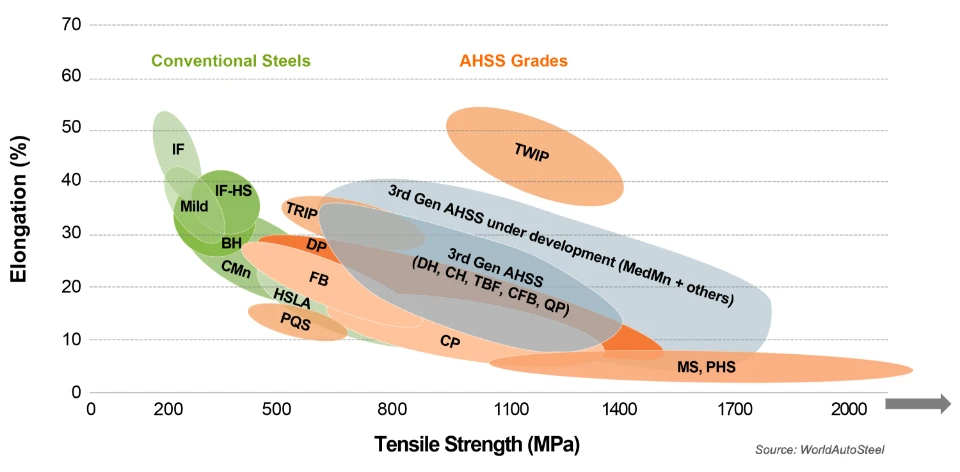
(Global formability chart comparing strength and elongation of existing and emerging steel grades)
 Complex phase steels with Improved Formability (CH steel): is mainly a small amount of martensite, residual austenite, or pearlite distributed on a ferrite or bainite matrix, and it is strengthened by micro-alloying elements through fine grain strengthening or precipitation strengthening. Compared with duplex steels of the same tensile strength, it has higher yield strength and good bending properties and is mainly used for bending and flanging parts.
- Quenching and partitioning steel (QP steel): It is a high-formability ultra-high-strength steel produced by the quenching-partitioning process. The microstructure of the steel is composed of multiple phases such as martensite + ferrite + retained austerity. It uses the ultra-high strength brought by martensite and the transformation-induced plasticity (TRIP) effect of retained austerity to obtain a better-forming performance than traditional ultra-high-strength steel. It has a medium yield-strength ratio and high work-hardening performance. It is suitable for body frame parts and safety parts with relatively complex shapes and high strength requirements.
- Martensitic steel (MS steel): Almost entirely composed of martensite, martensitic steel (MS steel) is mostly used for safety and anti-collision parts that require a high strength ratio. It typically has a high tensile strength and yield strength ratio.
- Hot stamping steel (HS steel): The high-strength parts are precisely stamped and formed, and the ultra-high-strength steel plate is easy to crack during cold stamping. The rebound is severe, complex parts are hard to form, and mold loss is significant. Hot stamping steel (HS steel) is a steel plate that is heated above the austenitizing temperature and stamped in the mold. The forming and quenching processes are finished simultaneously, transforming the austenite into a full martensite structure. Issues. Currently, hot stamping steel has a strength range of 1300 to 2000 MPa and is primarily utilized for safety and structural components like anti-collision beams and B-pillars.
Steel is one of the metal structural materials with the most adjustable strength and plasticity, and it can be utilized in a number of procedures, including casting, forging, and welding. In the automotive industry, it is still commonly utilized. Automotive steel from Promisteel is your best choice.


