
 Español
 Türkçe
 Français
 عربي
عربي  dansk
dansk 한국어
한국어 Deutsch
 Việt Nam
 Italiano
 日本語
日本語 Português

50 or 60Hz transformers usually use silicon steel laminations, usually cut or punched from 0.5mm sheets or below, which are varnished or coated on both sides. This results in the desired eddy current suppression or elimination.
There are two main types of single-phase transformers, as shown in Figure 1.

Figure 1: 50 / 60Hz Power Transformer Types
Shell Type Transformers: For smaller transformers, the shell type is selected. The resulting transformers have a single spool carrying both primary and secondary windings, as shown in Figure 1(a). The laminations may be stacked to many different heights, depending on the VA rating required. These stack heights are chosen to fit one of many proprietary winding spools. The laminations used are stamped from sheet and are referred to as "E&I" laminations because of their shape. These are shown in more detail in Figure 2(a).
Limb Type Transformers: E & I laminations become less economical as the required VA rating increases. The exposed area of winding available for cooling becomes proportionately less for bigger sizes, thus requiring bigger, more lossy, and more expensive cores to acquire the VA rating. So, for larger transformers the limb type is selected, as shown in Figure 1(b). The resulting transformers have two winding spools, with each one carrying both primary and secondary windings, these windings are interconnected in series and/or parallel as required. The laminations are simple rectangles cut from sheet and stacked as shown in Figure 2(b).

Figure 2: Shapes and stacking of silicon steel laminations
The transformer rating above which cut cores become more economical than E & I cores, both in cost and inefficiency, is between 2kVA and 3 kVA.
Toroidal Transformers: The above laminations are randomly punched and cut from a sheet of silicon steel, so grain orientation is not possible. There is another process in which the lamination material is manufactured in strips, and the metallic grains are orientated in the direction of the strip. This grain-orientated strip is then wound into a toroid like a roll of toilet paper. The resulting toroidal transformer has all the metallic grains in the steel running circumferentially so may be operated at a higher flux density. This leads to a lighter, smaller, and more efficient transformer. However, the material is more expensive, and specialist coiling and shuttle winding machinery are required to manufacture. examples of toroidal transformers you may be familiar with are current transformers and "variac transformers" (Figure 3).
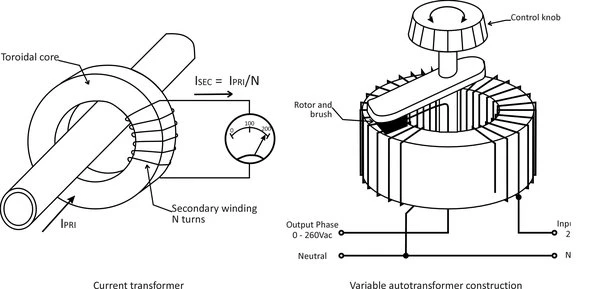
Figure 3: Toroidal Core Examples
400Hz Cores: For transformers for use on 400Hz (e.g. aerospace industry), the hysteresis losses of the silicon steel common for 50 or 60 Hz applications may become unmanageable, so materials with a more linear excitation (B-H) curve and lower hysteresis are required. Amorphous steel cores (metallic glass) have these enhanced properties and are suitable for these applications. At 50 / 60 Hz these have one-third the losses of conventional silicon steel but are twice as expensive.
High-Frequency Cores: At high frequencies (1kHz and above), the above materials are not suitable because of their high hysteresis losses. So, a ferrite material is normally chosen. Ferrites are ceramic compounds of transition metals with oxygen, which are ferrimagnetic but nonconductive. Ferrites that are used in transformer or electromagnetic cores contain iron oxides combined with nickel, zinc, and/or manganese compounds. They have a low coercivity which is highly beneficial for high frequency operation.

Figure 4: Examples of Ferrite Cores
Ferrite cores can be cast into any required shape, as indicated in the above figure.


