
 Español
 Türkçe
 Français
 عربي
عربي  dansk
dansk 한국어
한국어 Deutsch
 Việt Nam
 Italiano
 日本語
日本語 Português

Does the quality of a Pre-Engineered Building (PEB) depend solely on the strength of the steel, the welding process, and the fabrication process? It has to do with the environment.
Many buyers carefully specify steel grades, connection details, load requirements, and structural calculations. Yet they overlook a critical question: what environment will this steel structure operate in for the next 20, 30, or even 50 years? A coating system suitable for a dry inland region may fail rapidly when exposed to tropical humidity, coastal salt spray, or industrial pollution. And once corrosion begins, reversing the damage becomes expensive and sometimes impossible.
📍Sub-grade paint coating is just one of the major pitfalls overseas contractors fall into. Review the full list in our strategic master guide:
[10 Structural Steel Sourcing Mistakes That Cost Thousands].
Why Climate Matters More Than Most Buyers Realize
Structural steel is exposed to different levels of atmospheric corrosion depending on its geographic location. A warehouse built in an arid region faces a completely different environment than:
-
A port warehouse in Indonesia
-
A manufacturing plant in Vietnam
-
A logistics center in the Philippines
-
An industrial facility in Malaysia
Yet many buyers still request "standard painting" without defining the corrosion category, coating system, dry film thickness (DFT), or service life expectations. This creates significant long-term structural and financial risk.
Understanding ISO 12944 Corrosion Categories
Most industrial projects reference ISO 12944 corrosion classifications to help engineers determine the appropriate corrosion protection system.
|
Corrosion Category |
Atmospheric Corrosivity |
Typical External Environments
|
|---|---|---|
|
C1 |
Very Low |
Heated buildings with clean atmospheres (e.g., offices, schools).
|
|
C2 |
Low |
Atmospheres with low levels of pollution; mostly rural areas.
|
|
C3 |
Medium |
Urban and industrial atmospheres, moderate sulfur dioxide pollution; coastal areas with low salinity.
|
|
C4 |
High |
Industrial areas and coastal areas with moderate salinity.
|
|
C5 |
Very High |
Industrial areas with high humidity and aggressive atmospheres; coastal and offshore areas with high salinity.
|
For many Southeast Asian projects located in Vietnam, Indonesia, the Philippines, Thailand, and Malaysia, C4 and C5 protection levels are often mandatory due to high relative humidity and proximity to the ocean. Protecting the coating during ocean transport to these coastal destinations is equally critical.
The "10-Year Mistake" in Action
Imagine a steel warehouse built 2 km from the coastline. The supplier provides a basic paint system designed for a C3 environment because the buyer simply requested "painted steel structure" in the purchase order. A reliable one-stop supplier will proactively specify the correct coating category based on your project location.
Initially, everything looks fine. The coating passes visual inspection, and the project is delivered on schedule. However, after several years, surface rust appears, the coating begins to blister, steel edges deteriorate, and maintenance costs increase. Within 8–10 years, major refurbishment and on-site re-blasting may be required. What looked like a small saving during procurement becomes a significant, recurring lifecycle expense.
📍Buying baseline material weight without defining clear performance standards is a dangerous habit. Read about structural failures in:
[Q235 vs Q355 Structural Steel: The Hidden Procurement Mistake].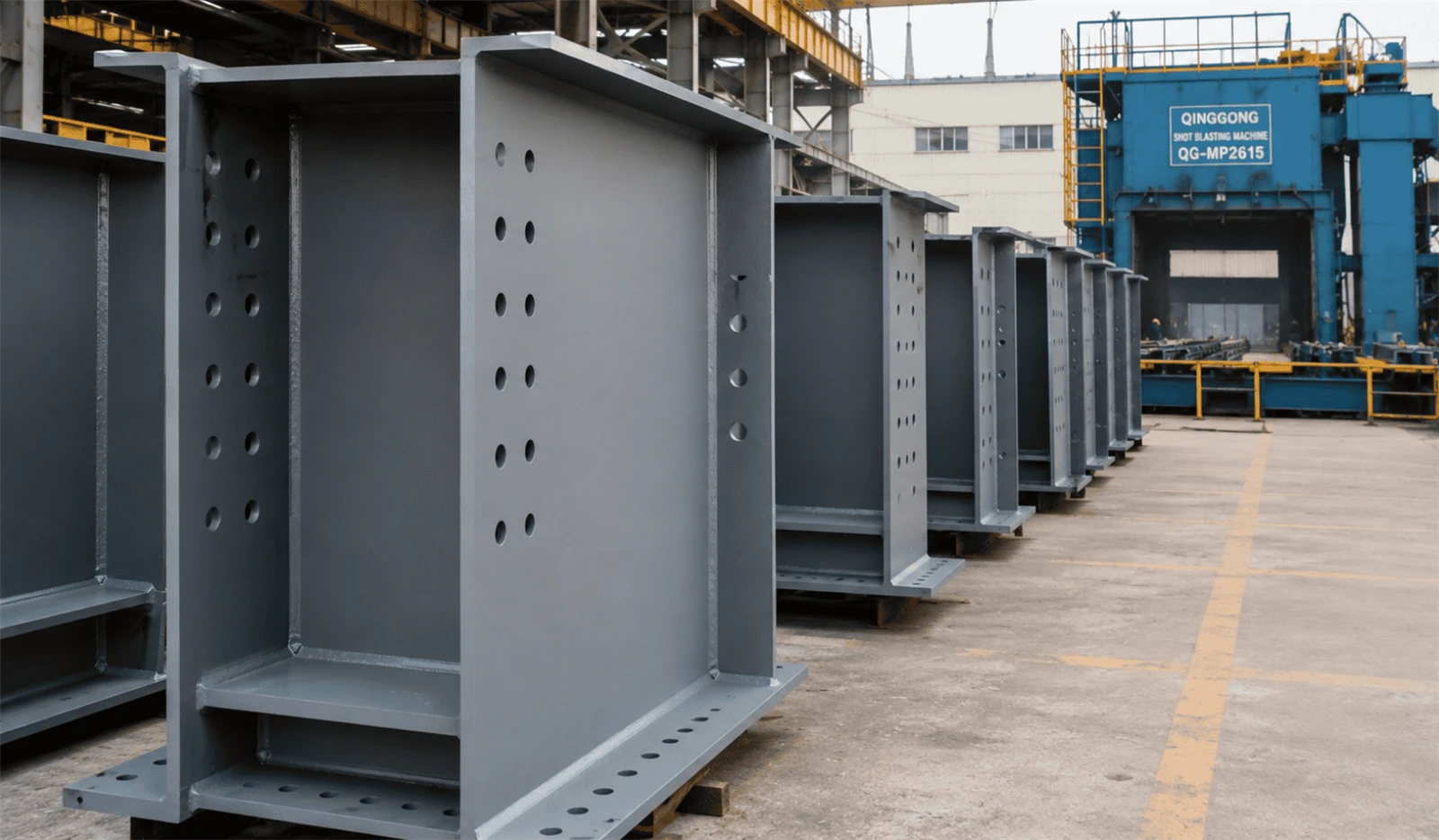
Why "Painting" Is Not a Technical Specification
One of the most common mistakes is treating painting as a simple commodity line item. In reality, professional corrosion protection specifications must include three distinct layers over a precisely prepared surface:
-
Surface Preparation: Prior to painting, the steel must be cleaned of mill scale and rust. Examples include Sa 2.0 or Sa 2.5 Shot Blasting to achieve the correct anchor profile. Surface preparation quality can only be meaningfully verified by third-party inspectors during the coating stage-not after shipment.
-
Primer Type: The foundational layer that bonds directly to the steel substrate. Examples include Epoxy Zinc-Rich Primer or Inorganic Zinc Silicate Primer.
-
Intermediate Coat: Builds film thickness and creates a barrier against moisture ingress. Examples include Epoxy MIO (Micaceous Iron Oxide) or High-Build Epoxy.
-
Top Coat: Provides UV resistance and final color retention. Examples include Polyurethane or Fluorocarbon Coating.
Without these details, two suppliers may both claim a "three-coat painting system" while delivering completely different levels of durability.
Why Dry Film Thickness (DFT) Matters
Dry Film Thickness (DFT)-measured in microns ($\mu m$)-is one of the most important indicators of coating performance. A coating system with insufficient thickness will permit oxygen and water molecules to penetrate to the raw steel surface years earlier than expected.
Simply adding layers of paint without measuring and controlling dry film thickness does not guarantee performance.
📍Extreme environments demand rigorous technical execution across the entire building package. See how to evaluate integrated fabricators:
[How to Choose a Reliable One-Stop Steel Structure Supplier].
Recommended Coating Systems for Export Projects
C3 Environment (Typical Urban Industrial Environments)
-
System Structure: Epoxy Zinc-Rich Primer + Epoxy Intermediate Coat + Polyurethane Top Coat
-
Total Target DFT: 150–200 µm
C4 Environment (Coastal Industrial Projects)
-
System Structure: Epoxy Zinc-Rich Primer + High-Build Epoxy Intermediate + Polyurethane Finish
-
Total Target DFT: 220–300 µm
C5 Environment (Marine and Tropical Coastal Exposure)
-
System Structure: Epoxy Zinc-Rich Primer + High-Build Epoxy + Polyurethane / Fluorocarbon Finish
-
Total Target DFT: 320–450 µm
Why Epoxy Zinc-Rich Primer Is the Engineering Baseline
Most professional EPC specifications begin with an Epoxy Zinc-Rich Primer because it provides excellent corrosion resistance, galvanic/cathodic protection, strong substrate adhesion, and long-term durability. It serves as the physical first line of defense against moisture. For most exported industrial steel structures, it is considered the minimum acceptable standard.
Questions Buyers Should Ask Their Steel Supplier
Before approving a coating system submittal, run through these direct questions with your supplier to gauge their technical compliance:
-
What specific ISO 12944 corrosion category is this coating system designed to withstand?
-
What is the target total Dry Film Thickness (DFT) and individual layer thicknesses across the structure?
-
What brand and chemical type of primer, intermediate, and topcoat are being utilized?
-
What surface preparation blasting standard (Sa 2.0, Sa 2.5, etc.) will be applied before coating application?
-
What design service life expectation does this coating layout provide for our specific region?
-
Can you provide third-party validation or product datasheets showing full compliance with ISO 12944 parameters?
If the supplier cannot answer these questions clearly, the coating specification is likely inadequate for cross-border projects.
📍Shipping components overseas exposes your paint to salt air before it even arrives. Review our logistics protocols:
[Why Logistics Planning Is Critical for Structural Steel Export Projects].
The Fix: Specify Performance, Not Just Paint
Professional buyers should never request a generic "painted structural steel structure." Instead, transform corrosion protection into a measurable engineering standard by explicitly specifying:
-
✔ Corrosion category (C3 / C4 / C5 per ISO 12944)
-
✔ Surface preparation standard (e.g., Sa 2.5 Shot Blasting)
-
✔ Complete multi-coat coating system layout
-
✔ Precise primer type (e.g., Epoxy Zinc-Rich)
-
✔ Minimum total and per-layer Dry Film Thickness (DFT)
-
✔ Target design service life parameters
Conclusion
In structural steel procurement, corrosion is rarely caused by poor raw steel; it is usually caused by poor coating specifications. A steel structure designed for a dry inland climate may survive decades with minimal maintenance. The same structure placed in a humid coastal environment without proper corrosion protection can experience significant structural deterioration within years.
Operating as a dedicated structural steel supply chain provider backed by independent processing capabilities and direct ties to major state-owned mills, Promisteel treats corrosion prevention as an exact science. We verify every micron of paint to ensure your project stands the test of time.
When sourcing structural steel for overseas projects, don't simply ask for paint. Ask for a specific corrosion category, coating system, dry film thickness, and design life. Because a coating decision made today determines whether your steel structure performs flawlessly for 10 years-or 50 years.
📍Internal Link Placeholder: 👉 Structural safety starts long before painting. Ensure your shop drawings are natively coordinated in 3D:
[Why 2D PDF Drawings Cause Expensive Structural Steel Mistakes in Overseas Projects].
FAQ
Q: Why can't I just use standard industrial paint for my coastal project?
A: Standard industrial paints typically lack the barrier performance and dry film thickness required to block moisture and chloride ions. In a high-salinity environment, standard paint will break down, leading to rapid underside rust creeping and coating detachment.
Q: What is the difference between Sa 2.0 and Sa 2.5 surface preparation?
A: SA 2.0 represents thorough blast-cleaning where mill scale and rust are largely removed. Sa 2.5 represents very thorough blast-cleaning, removing all visible mill scale, rust, and foreign matter, leaving only slight stains. SA 2.5 is mandatory for heavy-duty epoxy coatings to ensure proper adhesion.
Q: Does hot-dip galvanizing eliminate the need for ISO 12944 paint specifications?
A: Hot-dip galvanizing provides excellent long-term protection, but it has its own oxidation patterns. In aggressive C5 marine environments, a duplex system (hot-dip galvanizing plus a top layer of protective paint according to ISO 12944 standards) is recommended for maximum service life.
Stop Losing Money - Start Sourcing Smarter
Structural steel sourcing looks like purchasing, but it is actually rigorous risk management.The risks compound exponentially in global procurement when you treat structural steel as a basic commodity.Every shortcut you or an unverified vendor accepts-whether it is an unspecified steel grade, a vague 2D drawing, a rubber-stamp inspection, or cheap oceanic packaging-does not save money.It simply transfers cost from your initial purchase order straight to your on-site construction schedule, where errors compound by the hour.
Whether you are an experienced procurement manager or an EPC contractor executing your first cross-border development, these ten mistakes share a common root: treating highly engineered steel components as off-the-shelf stock.The fix is straightforward-specify exactly what your project demands, verify what you receive at every stage of fabrication, and partner with supply chain experts who engineer your project rather than just fill your tonnage order.
Next time you review a structural steel quotation, run through these ten points.Five minutes of careful technical scrutiny now can save your company five months of project delays and hundreds of thousands of dollars in asset losses later.
Get a Professional Blueprint & Specification Review - Free of Charge
Are you currently vetting suppliers or attempting to untangle a confusing set of structural blueprints for an upcoming industrial or commercial project? Do not leave your material compliance and logistical safety to chance or empty promises.
Let the PROMISTEEL engineering desk do the technical heavy lifting for you.Submit your current RFQ specifications, structural drawings, or competitive quotes, and our team will provide a comprehensive technical assessment completely free of charge. We will help you:
-
Verify Material Equivalencies: Ensure your specified steel grades match international standards (ASTM, EN, GB) flawlessly.
-
Identify Structural Clashes: Review your layout logic to catch component and connection interferences early.
-
Audit Corrosion Layouts: Validate that your paint Dry Film Thickness (DFT) perfectly complies with local ISO 12944 weathering severities.
-
Optimize Shipping Physics: Evaluate your stowage or packing configurations to eliminate transit deformation risks.
Click Here to Schedule Your Free Engineering Review Specification Audit


