
 Español
 Türkçe
 Français
 عربي
عربي  dansk
dansk 한국어
한국어 Deutsch
 Việt Nam
 Italiano
 日本語
日本語 Português

Roofing nail diameter and head size affect more than the look of the fastener. They influence driving force, resistance to bending, holding behavior, sheet coverage, substrate splitting risk, and the final cost per carton. When buyers request only a nail length, suppliers still need the wire diameter, head dimensions, and application details to produce a reliable quotation.
This guide explains what these dimensions mean and how to specify them without relying on a one-size-fits-all chart. The best roofing nail is the one that fits the roof covering, base material, and local installation practice.
What Does Roofing Nail Diameter Mean?
Nail diameter is the thickness of the shank, normally stated in millimeters or by a wire-gauge convention such as BWG. It is not the same as the head diameter. A larger shank diameter generally increases nail stiffness and resistance to bending, but it also needs more driving force and may raise splitting risk in thin or dry timber.
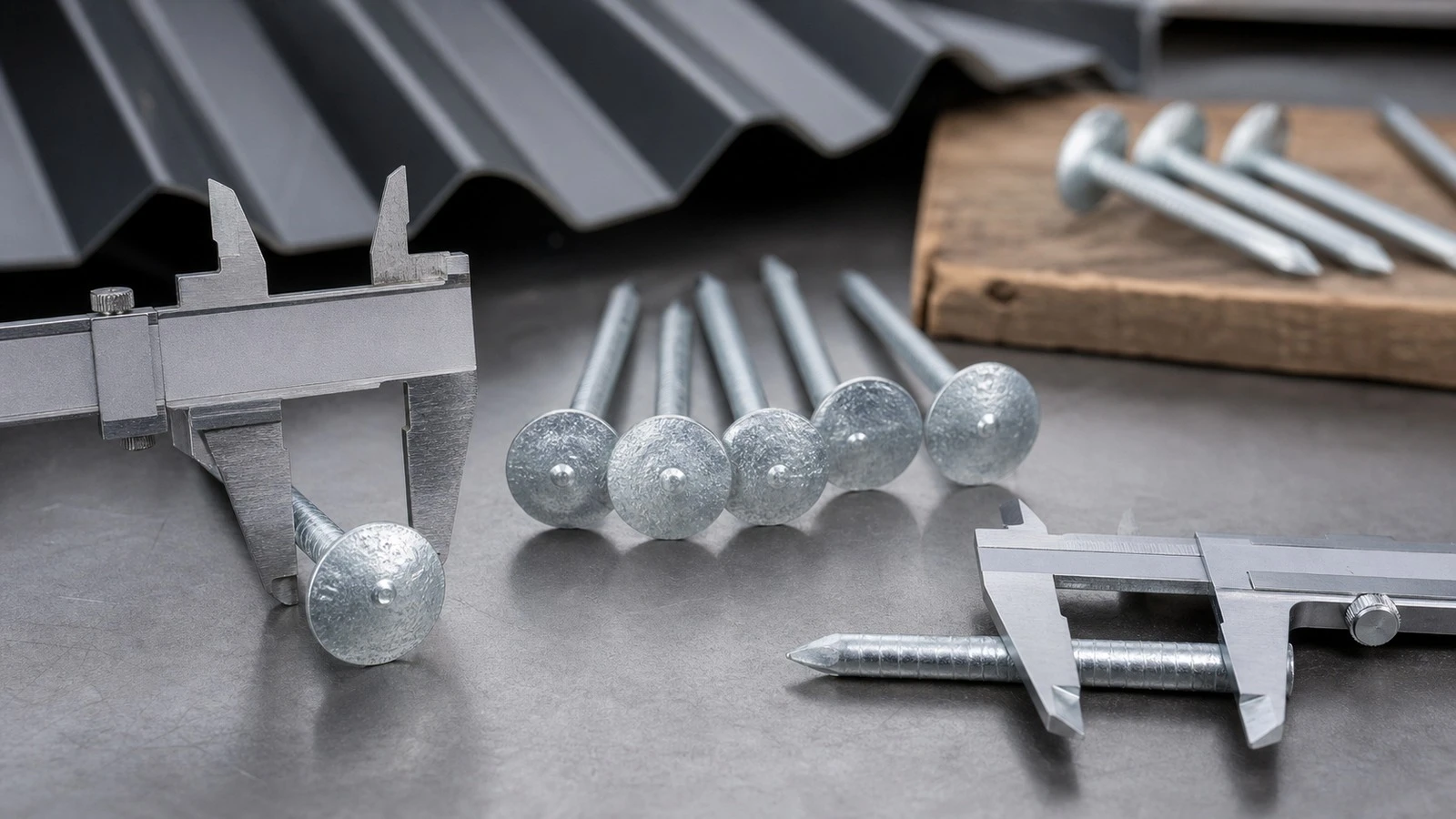 Roofing nail diameter, length, and head dimensions prepared for specification review.
The shank diameter should be selected together with the nail length and substrate. A long nail with an undersized shank may bend during driving. A heavy shank driven into a narrow timber section may create unnecessary splitting. For automated or high-speed installation, consistent diameter tolerance can also affect feed performance.
Why Head Size Matters in Roofing
The head holds the roofing material against the substrate. A wider head provides a larger bearing area, which can help reduce pull-through on roofing felt, thin sheets, or other materials that need better coverage. Umbrella-head roofing nails are widely recognized for this purpose because their formed head offers broad contact area.
Flat-head roofing nails have a different profile and may suit applications where a lower head profile or a particular installation tradition is preferred. The correct head type depends on the roof material, need for washers or seals, wind exposure, and desired appearance.
Do not assume that "large head" is automatically best. The head must work with the sheet profile and installation method. An oversized head can interfere with certain surfaces, while a head that is too small may not distribute load adequately.
The Key Dimensions to Put on a Purchase Order
For a roofing nail quotation, include these measurements:
 Measuring roofing nail head diameter and shank size before quotation.
| Specification Item | Why It Matters |
|---|---|
| Overall length | Must pass through the roof layer and achieve suitable embedment in the substrate |
| Shank diameter or gauge | Influences strength, driving behavior, and material usage |
| Head type | Determines how the nail contacts the roofing material |
| Head diameter | Affects bearing area and resistance to pull-through |
| Shank pattern | Smooth, ring, or screw shank changes holding power |
| Point style | Affects penetration and installation behavior |
| Finish | Determines corrosion resistance for the service environment |
Drawings, samples, or photos with a ruler are useful when a buyer is matching an existing local-market nail. They reduce the risk of confusing head diameter with shank diameter or nominal length with usable penetration length.
Diameter, Length, and Substrate Work Together
Length is often the first dimension buyers discuss, but it cannot be isolated from the rest of the system. The nail should pass through the roof material and hold securely in the supporting timber or board. Roofing thickness, insulation layers, timber density, and expected wind movement all influence the right selection.
For standard timber, an appropriately sized ring shank roofing nail may provide a good balance of driving efficiency and grip. For hardwood, dense timber, or areas where increased withdrawal resistance is needed,
screw shank nails may be worth considering. Smooth shank nails remain a commercial choice where easy driving and economy are the main priorities.
Before confirming a size for mass production, test the nail in the actual or representative substrate. This is especially important for treated wood, very dry timber, dense hardwood, and thin boards.
Head Size and Roofing Material
Different roof coverings place different demands on the head:
- Roofing felt and membranes may need a head with enough bearing area to reduce pull-through.
- Corrugated or metal roofing sheets may require an umbrella head, washer, or system-specific sealing arrangement.
- Timber shingles and wooden roof elements need a head that holds properly without damaging the surface.
- Repair work may need an existing local head style so the finished roof remains consistent.
The roof-system instructions should take priority where a specific fastener type is required. Nail suppliers can provide the manufacturing dimensions; the project designer or installer should confirm the roof-system suitability.
Avoid These Common Specification Mistakes
First, do not quote only "2-inch roofing nails" without the shank diameter, head type, finish, and packing. Second, do not convert gauge and millimeter values casually between markets; confirm the exact target diameter. Third, do not assume all umbrella heads have the same diameter or strength. Finally, do not use a sample from a different application as the only basis for a new project.
For distribution, it is helpful to create a size card for each SKU showing length, diameter, head diameter, finish, weight per box, and intended application. This helps sales teams and end users identify the product correctly.
Quick Buyer Checklist
Before requesting a bulk quotation, send:
- Overall nail length in mm or inch
- Shank diameter in mm or the required gauge system
- Head type and head diameter
- Smooth, ring, or screw shank
- Carbon steel, galvanized finish, or stainless requirement
- Roofing material and substrate
- Packing, private-label artwork, quantity, and destination port
The more exact the specification, the more accurately a supplier can quote, sample, and inspect the order.
Request a Roofing Nail Quote
Send Promisteel your target length, shank diameter, head type, head diameter, finish, packing, and application. We can help convert the requirement into a clear roofing nail specification for quotation.
For project details, samples, or packing confirmation, contact Promisteel with your target specification and destination port.
Promisteel supports overseas buyers with specification review, samples, packing confirmation, and export coordination.
FAQ
Q: Is roofing nail diameter the same as nail gauge?
A: Gauge is a conventional way to describe wire thickness, while millimeters state the actual diameter. Always confirm the required millimeter value or agreed gauge standard with the supplier.
Q: Why do umbrella-head roofing nails have a wide head?
A: The wider head creates more bearing area on the roofing material. This can help reduce pull-through when the selected nail and roof system are suitable for the application.
Q: Can I choose the head diameter separately from the nail length?
A: Yes. They are separate dimensions and should both be stated in the specification, together with shank diameter and head type.


