
 Español
 Türkçe
 Français
 عربي
عربي  dansk
dansk 한국어
한국어 Deutsch
 Việt Nam
 Italiano
 日本語
日本語 Português

Ignoring the "Through-Thickness" Property
This is one of the most overlooked-yet extremely dangerous-technical mistakes in heavy structural steel projects. Many overseas buyers assume that once the steel grade is correct, the material is suitable for fabrication.
But for heavy industrial structures using thick steel plates, that assumption can become a serious engineering risk. Standard structural steel plates may not be enough, especially in projects involving:
- Heavy industrial plants
- Power stations
- Petrochemical facilities
- Mining structures
- Large-span steel buildings
- Offshore structures
- High-load box columns
The Hidden Problem Inside Thick Steel Plates
For heavy structural components-especially plates thicker than 20mm, 40mm, or even 100mm-the internal properties of the steel become critically important.
Most buyers focus only on yield strength, tensile strength, and surface quality. But they ignore a key property: through-thickness performance, also known as Z-direction properties. This determines how the steel behaves under stress through the thickness of the plate during welding and loading.
Most buyers focus only on yield strength, tensile strength, and surface quality. (Note: Specifying the correct baseline yield strength is a critical first step. See our technical breakdown on [why confusing Q235 and Q355 structural steel is a costly procurement trap].) But they ignore a key property for heavy structures: through-thickness performance, also known as Z-direction properties.
What Is Lamellar Tearing?
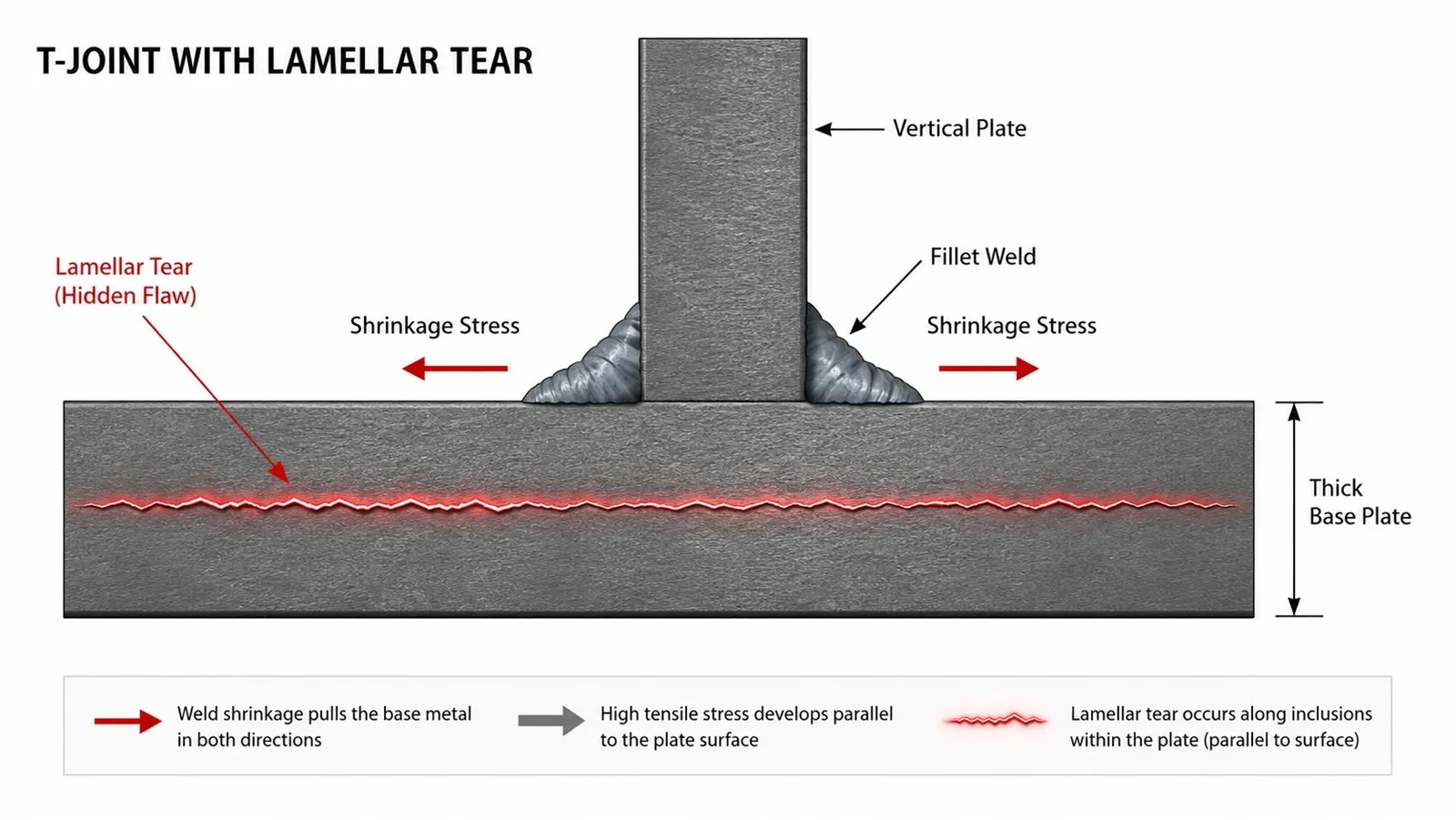
Lamellar tearing is a hidden welding defect that occurs inside thick steel plates. It usually develops when heavy welding shrinkage stress occurs, the steel has poor through-thickness ductility, and non-metallic inclusions exist inside the plate.
The crack forms internally and propagates parallel to the plate surface. This is especially common in:
T-joints
Corner joints
Thick welded box columns
Heavy restraint welding areas
The dangerous part is that lamellar tearing may not be immediately visible from the outside. But internally, the structure may already be compromised.
Why Heavy Industrial Projects Are High-Risk
In large industrial steel structures, welded joints often carry enormous loads. Examples include crane-support columns, heavy equipment platforms, steel mill structures, power plant frames, and offshore modules.
These projects typically use thick plates, multi-layer welding, high heat input, and deep penetration welds. Without proper through-thickness properties, welding stress can exceed the steel's internal resistance capacity. The result can be internal cracking, weld failure, structural weakness, and reduced fatigue life. In extreme cases, critical structural failure may occur after the project enters operation.
These projects typically use thick plates, multi-layer welding, high heat input, and deep penetration welds. (For a complete guide on selecting the right welding parameters for heavy columns, read our engineering comparison of [CJP vs. PJP welding in structural steel].) Without proper through-thickness properties, welding stress can exceed the steel's internal resistance capacity.
Why Standard Steel Plates May Not Be Suitable
Ordinary structural plates are primarily tested for tensile strength, yield strength, and elongation. Always verify these test results against authentic Mill Test Certificates. But they are not always tested for reduction of area in the Z-direction, which measures the steel's ductility through its thickness.
In thick plates, microscopic non-metallic inclusions become layered during rolling. These internal layers weaken the steel's resistance to through-thickness stress. That is why heavy welded structures often require Z15 steel, Z25 steel, or Z35 steel.
What Do Z15, Z25, and Z35 Mean?
These classifications represent the steel's through-thickness reduction of area performance. Higher Z-values mean better ductility, better resistance to lamellar tearing, and higher welding reliability.
| Grade | Minimum Reduction of Area | Application Safety Level |
| Z15 |
≥15% |
Basic through-thickness resistance for moderate structural loads. |
| Z25 |
≥25% |
High reliability for heavy industrial framing and standard thick plates. |
| Z35 |
≥35% |
Provides the best protection for critical heavy structures and extreme dynamic loads. |
Common Buyer Mistakes
Many procurement teams make the mistake of ordering only "Q355B steel plate" without specifying Z-direction requirements.
As a result, suppliers may provide ordinary plates, fabricators encounter welding cracks, and site repairs become extremely costly. This is why third-party inspections must begin during fabrication, not after. In some cases, the issue is discovered only after installation. At that point, rework becomes difficult, delays become unavoidable, and structural confidence decreases dramatically.
The Real Cost of Ignoring Z-Direction Testing
The hidden costs can be enormous:
| Problem | Consequence |
|
Welding cracks |
Repair and grinding |
| Structural defects | Inspection failure |
| Delayed installation | Project penalties |
| Re-fabrication | Massive cost increase |
| Long-term fatigue issues | Reduced service life |
In overseas EPC projects, even small welding failures can create major contractual disputes. Combined with inadequate logistics planning, these failures multiply fast.
The Fix: How Professional Buyers Prevent This Risk

Experienced steel buyers and EPC contractors control this risk from the beginning. As a seasoned trade merchant with a dedicated processing center and direct ties to major state-owned mills, we implement these exact controls for our heavy-duty exports.
- Specify Z-Direction Requirements Clearly: Do not simply order "Q355 steel plate." Instead, specify Q355B Z15, Q355D Z25, or Q355E Z35, depending on project requirements.
- Evaluate Plate Thickness Carefully: The thicker the plate, the greater the risk. Projects using 20mm+, 40mm+, 60mm+, or ultra-heavy plates should carefully evaluate through-thickness requirements.
- Review Welding Design: Critical welded joints should be analyzed carefully, especially T-joints, cross joints, and fully restrained connections. Good welding design reduces tearing risk significantly.
- Require Third-Party Testing: Professional projects often require Z-direction tensile testing, ultrasonic testing (UT), and material traceability reports before fabrication begins.
Final Takeaway
In heavy structural steel projects, strength alone is not enough. A steel plate may meet yield strength requirements while still failing internally during welding. That is why professional industrial projects pay close attention to through-thickness properties, Z-direction testing, and welding stress resistance.
For critical heavy structures, choosing the wrong plate is not just a material mistake. It is a structural risk. And in overseas industrial projects, hidden structural risks eventually become expensive project problems.
And in overseas industrial projects, hidden structural risks eventually become expensive project problems.


