
 Español
 Türkçe
 Français
 عربي
 dansk
 한국어
 Deutsch
 Việt Nam
 Italiano
 日本語
 Português


Whether you are manufacturing sleek, mirror-finish refrigerator doors or durable, long-lasting color-coated roofing sheets, you know that the quality of your final product begins with your raw materials. But the real challenge isn't just finding a steel coil with the right color; it's finding one with the right performance. Many quality issues that cause customer complaints and warranty claims originate from properties you can't see on the surface. This article dives into these "invisible" performance metrics and explains how they dictate your brand's reputation and profitability.
The Appliance Maker's Dilemma: Perfect Look vs. Tough Performance
For appliance manufacturers, the production line is a battle between aesthetics and formability. You need a flawless, high-gloss finish, but you also need that finish to withstand deep drawing, stamping, and bending without cracking or peeling. This is where the concept of appliance-grade pre-painted steel becomes critical. It's more than just a pretty face; it's a sophisticated system engineered for flexibility. The secret lies in superior paint adhesion. Without a strong bond between the paint and the steel substrate, even the most beautiful coating will fail under the stress of fabrication, leading to costly rejects and production halts. A simple T-bend test can often reveal the true quality of the material's formability.
Two Manifestations of White Rust Issues in Color-Coated Steel Coils
White rust issues can occur at two distinct stages, with slightly different causes and consequences.
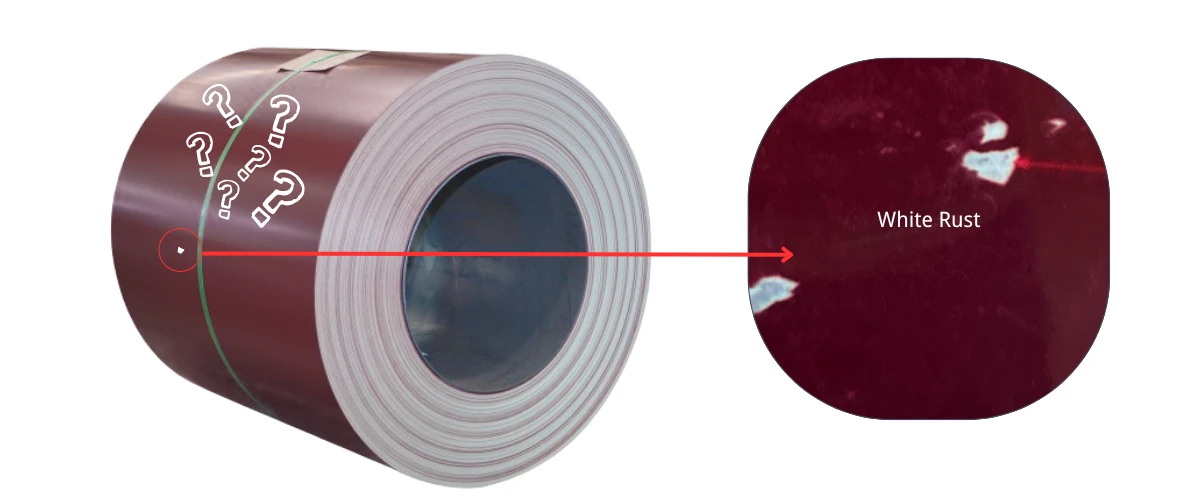
Form 1: White Rust on the Substrate Before Coating
This is the most common and severe scenario. Specifically, the galvanized substrate used to produce color-coated steel coils has already developed white rust due to improper storage or transportation before entering the coating line.
1,Causes:
- Improper substrate storage: Galvanized coils are stored for extended periods in damp, poorly ventilated warehouses.
- Water ingress during transportation: During sea or land transport, damaged packaging allows rainwater or condensation to penetrate the steel coils.
- Condensation: Temperature fluctuations cause condensation to form inside the steel coils, creating an oxygen-free, damp environment between coils.
2,Hazards:
- A deadly adhesion killer: White rust is a loose powder with no adhesion. If the steel mill fails to thoroughly remove this white rust before coating, the paint is effectively applied to this "powder" layer rather than tightly bonding to the zinc layer.
- Inevitable coating failure: Such color-coated sheets have virtually no effective adhesion between the coating and the substrate. During subsequent processing (such as bending or stamping) or use, the coating will peel off in large sheets very easily.
- Hidden "time bomb": Even if it appears intact upon production, the coating will fail with even slight external force or changes in temperature and humidity. This is one of the most severe cases of quality fraud or negligence.
Form 2: White rust forming under the paint film after color coating
This situation is relatively rare but equally destructive. It refers to moisture penetrating beneath the coating during use, causing corrosion of the zinc layer and the formation of white rust.
1. Causes:
- Coating defects: The coating itself may have defects such as pinholes, missed areas, or scratches, providing pathways for moisture to invade.
- Edge cutting areas: The edges of the cut are exposed, allowing moisture to penetrate horizontally beneath the coating (edge creep corrosion), triggering white rust.
- Coating permeability: Poor-quality coatings may inherently possess some degree of permeability.
2. Hazards:
- Coating blistering and peeling: The white rust forming beneath the coating expands in volume, generating pressure that lifts the coating, forming bubbles (blistering). As corrosion worsens, this ultimately leads to coating peeling.
- Consumption of the zinc layer and reduced lifespan: The formation of white rust indicates that the protective zinc layer is being consumed. This significantly shortens the corrosion resistance lifespan and overall service life of the color-coated steel sheet.
To Know More ppgi/ppgl steel issues
How to Prevent White Rust Issues at the Source?
Preventing white rust requires comprehensive control throughout the entire process, from substrate procurement to finished product protection.

For manufacturers:
Strict incoming substrate inspection (IQC):
This is the first and most critical line of defense. Every incoming galvanized substrate coil must be unrolled and inspected, particularly checking the head, tail, and sides of the steel coil for water stains, rust stains, or white rust.
If white rust is detected, the entire coil must be returned; under no circumstances should it be used in production.
Scientific substrate storage management:
The warehouse must remain dry and well-ventilated, avoiding drastic temperature fluctuations.
Coil rolls should be stored off the ground and maintained at appropriate intervals.
High-quality coating process:
Ensure the coating is free of defects such as pinholes or missed areas, providing a complete physical barrier.
Use high-quality, low-permeability coatings.
For purchasers (traders or end-users):
Selecting a reliable supplier:
A reliable supplier must have strict substrate IQC processes and storage management standards. During factory audits, focus on inspecting raw material warehouses and incoming material inspection records.
Marketing points: At Promisteel we understand that the substrate is the "foundation" of color-coated products. We only collaborate with top-tier steel mills that share our "zero-tolerance" approach to substrate quality, and conduct uncoiling inspections on every batch of raw materials to ensure your project is built on a solid foundation from the very first step.
Clear contract terms:
In the procurement contract, you can explicitly require that "the substrate must not have any form of rust, including white rust."
Proper storage and protection of finished products:
- Received color-coated coils or sheets should be stored in a dry, well-ventilated indoor environment.
- Avoid exposing the products to rain or immersion. If this occurs, immediately wipe them dry and allow them to air dry completely.
- Pay special attention to protecting the cut edges, which can be further protected using edge sealing paint, etc.
The Roofer's Challenge: Battling the Elements for Decades
If you're a roofing panel manufacturer, your customers are buying a promise of longevity. They expect their roof to withstand the sun, rain, and salt for years without fading or rusting. When your clients search for the best steel for metal roofing, they are fundamentally asking for long-term corrosion resistance. This is especially true in coastal or industrial areas where the environment is harsh. A common and costly problem is premature rusting, particularly at the edges. This leads us to a critical question we hear often: how to prevent rust on cut edges of steel panels? While proper installation helps, the solution starts with the coil itself. Advanced substrates with heavier zinc layers or modern Zinc-Aluminum-Magnesium (ZAM) coatings provide superior sacrificial protection. The quality of this protection can be quantified through standardized tests like the salt spray test for PPGI, a critical piece of data you should request from your supplier.

The Hidden Defect That Haunts Both Industries: The "White Rust" Time Bomb
Perhaps the most catastrophic and deceptive issue is when the coating peels off in large sheets from a seemingly perfect surface. This often leads to the question: What causes paint to peel off galvanized steel? The answer is often a hidden "time bomb" called white rust.
White rust does not occur on the surface of the color-coated layer but rather on the galvanized layer beneath the coating. When we observe issues caused by "white rust" on finished color-coated sheets, they typically manifest as coating blistering, loss of adhesion, or even white powdery substances beneath the coating.
What is White Rust?
White rust, scientifically known as zinc hydroxide (ZnOH), is a loose, white powdery or spotted corrosion product. It forms on the surface of the galvanized layer when water (or moisture) and oxygen are present, but there is an insufficient supply of carbon dioxide.
Normal conditions:
In a normal dry atmospheric environment, zinc slowly reacts with oxygen, carbon dioxide, and moisture to form a thin, dense, and highly adhesive protective corrosion product-basic zinc carbonate. This layer is gray, stable, and effectively prevents further corrosion of the zinc layer; we refer to this as "passivation."
Formation of white rust:
However, if the galvanized layer is exposed to a humid, poorly ventilated environment for an extended period (e.g., tightly rolled steel coils or closely stacked sheets with moisture between them), insufficient carbon dioxide supply prevents the formation of a dense basic zinc carbonate protective layer. In this case, zinc reacts rapidly with water and oxygen to form white, porous, non-protective zinc hydroxide, which is known as "white rust."
A responsible supplier must have a rigorous incoming quality control (IQC) process to inspect every single base coil for such defects.
From Raw Material to Lasting Legacy: How to Secure Your Supply Chain
Your final product's quality is only as strong as your supply chain. So, how to choose a reliable PPGI supplier? It's about looking beyond the price per ton and evaluating their commitment to quality and transparency. Here are three critical steps:
- Demand Technical Data Sheets (TDS): Don't rely on verbal promises. Ask for a detailed TDS that specifies performance metrics like paint adhesion (T-bend), hardness (pencil hardness), and corrosion resistance (salt spray test hours).
- Verify the Warranty: When a supplier offers a 20-year warranty color color-coated steel, read the fine print. Does it cover color fading? Does it cover peeling? Crucially, does it cover edge corrosion? A strong warranty is a sign of confidence in their product.
- Audit Their Quality Process: Ask potential suppliers about their quality control procedures. How do they inspect incoming raw materials? What online monitoring do they have during production?
At PROMISTEEL, transparency is key. We believe you have the right to know exactly what you are buying. We provide comprehensive TDS and clear warranty documents for all our products. [Click here to request a sample TDS for our roofing-grade material.]


