
 Español
 Türkçe
 Français
 عربي
عربي  dansk
dansk 한국어
한국어 Deutsch
 Việt Nam
 Italiano
 日本語
日本語 Português

China's steel market entered August with a familiar seasonal problem becoming harder to ignore: supply and demand both fell, but inventories still rose. Production cuts are gathering pace as mill losses deepen, yet the contraction in end-user demand remains faster than the reduction in output. At the same time, a sharp split in freight markets, new trade-remedy action in Vietnam and continuing uncertainty around the Strait of Hormuz are making landed-cost planning more complicated for overseas buyers.
For the complete price, inventory, freight and trade-policy data package, download Promisteel's Weekly Steel Industry Report for July 28–August 3, 2026.
Key Takeaways for Steel Buyers
- China's five major steel products recorded lower supply and lower consumption, while total inventory increased to 16.3582 million tonnes.
- Daily hot-metal output at 247 mills fell for a fourth consecutive week to 2.3555 million tonnes, and the share of profitable mills dropped to 33.77%.
- China's July manufacturing PMI fell to 49.2, signalling weaker new orders and a softer near-term outlook for industrial steel demand.
- Container freight rebounded sharply on the US routes, while Europe rates continued to decline; the Baltic Dry Index also moved to a two-week high.
- Vietnam opened an anti-dumping investigation into Chinese prestressed steel and began an interim review of anti-dumping duties on Chinese hot-rolled products.
China's Steel Balance Remains Weak Despite Faster Production Cuts
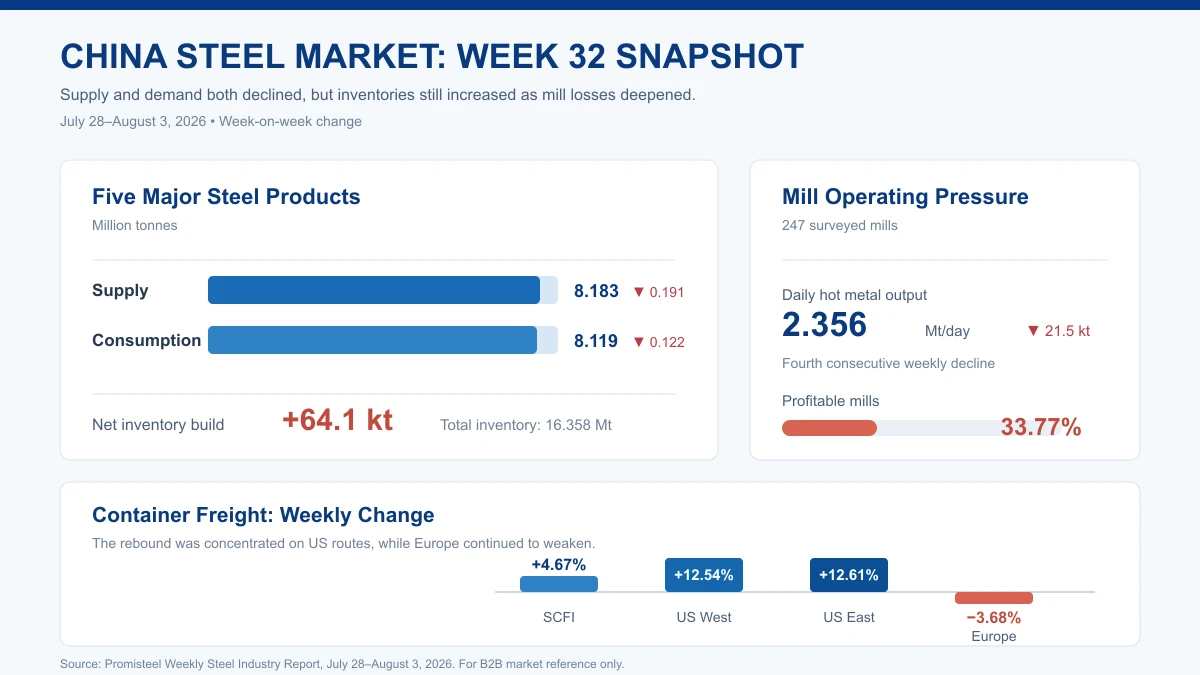
During the latest survey week, combined supply of China's five major steel products declined by 191,300 tonnes week on week to 8.183 million tonnes. Consumption also fell, dropping by 121,900 tonnes to 8.1189 million tonnes. Because demand weakened at the same time as mills reduced output, total inventory still edged up by 64,100 tonnes to 16.3582 million tonnes.
The pattern matters more than the headline direction. Summer heat, rain and slow project-fund deployment are limiting construction activity and keeping spot purchasing restrained. Rebar output has already fallen to a low level for this point in the cycle, but rebar inventories still rose to 6.9907 million tonnes as demand weakened in parallel. For standard-grade hot-rolled steel, cold-rolled steel and coated steel, that combination leaves the market in a weakly volatile rather than a clear recovery phase.
Supply-side discipline is becoming more visible. Daily hot-metal production among 247 surveyed mills declined by 21,500 tonnes to 2.3555 million tonnes per day, the fourth straight weekly fall. Blast-furnace operating rates eased to 81.85%, while mill profitability slipped to 33.77%, meaning that nearly seven in ten mills were operating at a loss. Maintenance programs and production cuts are expanding, which should gradually build a supply-side floor; however, they have not yet been large enough to reverse the inventory build.
Raw-material costs are providing limited relief rather than strong price support. A second round of coke price cuts took effect on July 29, and iron-ore port inventory climbed to around 166 million tonnes. Lower input costs can ease pressure on mills, but they also reduce the immediate cost floor under finished-steel prices.
July PMI and Export Data Point to Softer Demand
China's official manufacturing PMI fell to 49.2 in July, down 1.1 percentage points from June and back below the 50-point expansion threshold. New-order and new-export-order readings both weakened, reinforcing the view that the summer lull is broad-based rather than limited to one downstream sector. For procurement teams, this means that near-term negotiating conditions remain favourable for regular specifications, even though availability of specialised grades can tighten quickly if loss-making mills extend maintenance.
China exported 10.3201 million tonnes of steel in June. First-half exports reached 54.8852 million tonnes, down 5.61% year on year. The decline reflects both rising trade friction and the new export-licensing framework. With destination markets adding more compliance requirements, the export environment is no longer defined by the steel base price alone; documentation, tariff exposure and routing now have a larger effect on the final offer.
Globally, June crude-steel output rose 1.7% year on year to 155.7 million tonnes, ending a nine-month sequence of declines. European Union output increased 4.6%, with Germany up 9.5%. The improvement may partly reflect restocking, while end-user demand remains soft, so buyers should be careful about treating one month of higher output as a durable global recovery.
Freight Markets Split Between US-Route Strength and European Weakness
The container market delivered the week's sharpest contrast. The Shanghai Containerized Freight Index (SCFI) rose 4.67% to 3,205.97, ending a three-week decline. US West Coast rates rose 12.54% to USD 6,229 per FEU, while US East Coast rates climbed 12.61% to USD 9,054 per FEU. August general rate increases, reduced Panama Canal draft limits and delays at Asian ports combined to push the US lanes higher.
Europe moved in the opposite direction. Rates to Europe fell 3.68% to USD 3,039 per TEU and Mediterranean rates dropped 3.72% to USD 4,189 per TEU. Weak demand and available capacity continue to pressure those lanes, and no August rate increase was expected at the time of the report. Buyers should therefore avoid applying one freight assumption across all destinations: US-bound cargoes need earlier booking and separate contingency budgeting, while Europe-bound orders may retain more room for rate negotiation.
Dry-bulk shipping was firmer. The Baltic Dry Index rose 4.06% to 2,843, a two-week high, led by a 6.24% gain in the Capesize index. Miners brought forward late-August and early-September cargoes on Western Australia–China and Brazil–China iron-ore routes, supporting vessel earnings and creating some support for bulk raw-material transport costs.
Vietnam Adds New Trade Friction for Chinese Steel
Trade policy remains a direct sourcing risk. On July 27, Vietnam initiated an anti-dumping investigation into Chinese prestressed steel products, including silicon-manganese alloy round bars, wires and coils with diameters of 7.1–12.6 mm. Vietnam is one of China's most important steel export destinations, so any eventual duty could affect long-product volumes and pricing strategies in Southeast Asia.
On the same day, Vietnam also began its first interim review of anti-dumping duties on Chinese hot-rolled steel products, covering 27 HS codes. The review may create an opportunity for individual Chinese exporters to seek lower duty rates, but it also leaves commercial terms uncertain during the review period. Elsewhere, India extended anti-dumping duties on Chinese seamless pipe and hollow-section products until January 27, 2027, while the European Union's tougher safeguard regime continues to narrow the viable duty-free window for several steel categories.
Before confirming new export quotations, suppliers and buyers should verify HS classification, origin records, quota availability, destination-specific anti-dumping exposure and the documentation required under China's export-licensing rules. This is especially important for hot-rolled coil, prestressed steel, seamless pipe and products with further processing or third-country routing.
Hormuz and Red Sea Risks Still Affect Delivery Planning
Geopolitical signals around the Strait of Hormuz shifted quickly during the week. Although the market saw signs of de-escalation, commercial transit through the strait remained far below normal levels and the risk premium did not disappear. The Persian Gulf freight rate rose 6.8% to USD 4,894 per TEU, reflecting lower effective capacity, insurance concerns and the possibility of further routing disruption.
Risks around the Red Sea and Bab el-Mandeb also remain relevant. The practical implication for steel buyers is not only the quoted ocean rate: insurance, vessel availability, transshipment options and delivery reliability can all change before cargo sails. Gulf- and Red Sea-bound orders should keep the steel base price, freight, war-risk insurance and delivery window as separate commercial assumptions.
What This Week Means for Buyers
The immediate market outlook remains cautiously bearish for standard steel products. Demand is soft, inventories are accumulating and raw-material support has eased. At the same time, a profitability rate below 34% and a fourth straight decline in hot-metal output mean that a deeper production response could tighten selected grades later in the cycle.
- Keep inventories lean for readily available standard grades, but secure allocations early for customised widths, coatings and fixed-delivery projects.
- For US-bound cargo, confirm booking windows and freight validity before finalising the steel order; do not use Europe-route freight as a proxy.
- For Gulf and Red Sea destinations, quote freight, insurance and delivery conditions separately from the steel price.
- Review tariffs, quotas, anti-dumping cases, origin documents and export-licensing requirements before pricing any new destination.
- Watch five-product inventory, hot-metal output, mill profitability and August production-cut announcements for confirmation of the next market move.
For the full weekly data set, including domestic prices, inventory indicators, raw-material trends, freight indices and trade-policy updates, download the Promisteel Weekly Steel Industry Report for July 28–August 3, 2026.
Promisteel tracks steel prices, mill operations, logistics conditions and trade-policy changes each week to help customers make better sourcing decisions. Our product range includes coils, sheets, pipes, tubes, structural profiles and galvanized or coated steel for construction, manufacturing, energy and industrial projects worldwide. Contact the Promisteel team to discuss product availability, shipment planning or landed-cost implications for your market.


