
 Español
 Türkçe
 Français
 عربي
عربي  dansk
dansk 한국어
한국어 Deutsch
 Việt Nam
 Italiano
 日本語
日本語 Português

China's steel market moved through another volatile summer week on August 4–10, 2026. Finished-steel output declined, but consumption fell faster and total inventories rose again. Mill profitability dropped to 32.03%, leaving nearly seven in ten surveyed producers loss-making. At the same time, dry-bulk freight surged, container rates split sharply by route and new trade-remedy actions increased the compliance burden for international steel buyers.
For the complete price, inventory, raw-material, freight and trade-policy data package, download Promisteel's Weekly Steel Industry Report for August 4–10, 2026.
Key Takeaways for Steel Buyers
- Supply of China's five major steel products fell 1.5% week on week to 8.0596 million tonnes, while consumption declined 2.9% to 7.8859 million tonnes.
- Total five-product inventory increased by 173,700 tonnes to 16.5319 million tonnes and was 20.2% higher year on year.
- Only 32.03% of 247 surveyed steel mills were profitable, with rebar and hot-rolled coil margins remaining negative.
- China exported 10.121 million tonnes of steel in July; January–July exports reached 64.995 million tonnes, down 4.4% year on year.
- The Baltic Dry Index rose 13.1% during the week, while container freight increased on US and Persian Gulf routes but continued to decline on Europe services.
- Trade-remedy exposure expanded across galvanized, prepainted and cold-rolled steel markets, making destination-specific compliance checks essential before quotation.
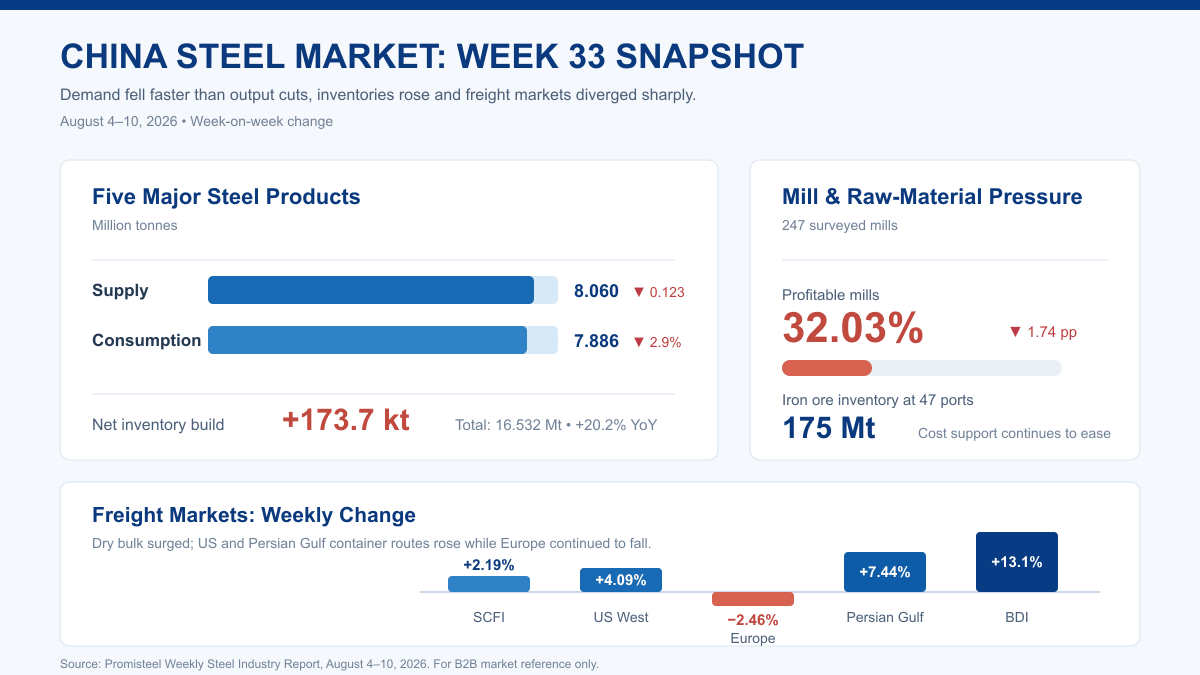 China steel and freight market snapshot for August 4–10, 2026. Source: Promisteel Weekly Steel Industry Report.
China Steel Supply Falls, but Demand Weakens Faster
Combined supply of China's five major steel products fell by 123,400 tonnes week on week to 8.0596 million tonnes. Consumption declined more quickly, dropping 2.9% to 7.8859 million tonnes. Building-steel consumption fell 9.6%, while flat-steel demand edged up only 0.6%. That difference pushed total inventory up by 173,700 tonnes to 16.5319 million tonnes.
The year-on-year comparison is the more important warning signal. Total inventory was 2.778 million tonnes, or 20.2%, above the same period last year. Mill stocks and social stocks accumulated together, showing that the problem was not limited to one part of the distribution chain. Seasonal heat, rainfall and slower project activity continued to restrict construction demand, while cautious end users avoided building excess raw-material inventories.
For buyers of standard hot-rolled steel, cold-rolled steel and coated steel, the current environment remains favourable for price negotiation. However, the market is not simply oversupplied across every specification. Custom widths, tight tolerances, specialised coatings and fixed-delivery project orders can still require earlier production planning, especially if mills extend maintenance later in August.
Mill Profitability Drops to 32.03% as Cost Support Eases
The share of profitable mills among the 247 producers surveyed fell another 1.74 percentage points to 32.03%, close to the bottom of its two-year range. Rebar margins were approximately minus RMB 117 per tonne, while hot-rolled coil margins were around minus RMB 34 per tonne. With almost 70% of mills operating at a loss, more maintenance and output reductions are likely to be announced for mid-to-late August.
Supply contraction has not yet been strong enough to offset weak demand. Hot-metal output rebounded temporarily after environmental maintenance in Tangshan ended, but the weekly report expects production to move back toward 2.35 million tonnes per day. The third round of coke price reductions also took effect, while iron-ore inventory across 47 ports increased to approximately 175 million tonnes. Lower raw-material costs give mills some relief, but they also weaken the cost floor supporting finished-steel prices.
For procurement teams, this creates a two-sided risk. Near-term standard-grade prices may remain soft while inventories are still building, but deeper mill maintenance could tighten selected grades and delivery slots quickly. Buyers should separate commodity exposure from specification and schedule risk instead of treating every steel product as one market.
China's July Steel Exports Decline as Trade Barriers Spread
China exported 10.121 million tonnes of steel in July. January–July exports totalled 64.995 million tonnes, down 4.4% year on year. Imports reached 445,000 tonnes in July and 3.14 million tonnes during the first seven months, a decline of 10.1% year on year.
The export slowdown reflects more than seasonal demand. China's steel export-licensing framework now covers 300 HS codes, while importing countries are expanding anti-dumping, safeguard and origin-tracing controls. The OECD Steel Outlook 2026 reported that 395 steel anti-dumping and countervailing measures initiated since 2016 were active in 2025, with China the largest target. It also found evidence of trade diversion through third markets, increasing scrutiny of processing origin and transshipment routes.
Japan's investigation into hot-dipped galvanized coil, sheet and strip from China and South Korea reached a preliminary determination stage in late July. Japan's Ministry of Finance and Ministry of Economy, Trade and Industry also extended the investigation period to December 12, 2026, keeping duty exposure active for importers. Malaysia opened further review and investigation procedures involving Chinese prepainted steel coils and aluminium-zinc-coated flat products, while the European Union continued tightening controls on cold-rolled flat steel and broader safeguard quotas.
These measures matter directly for buyers of galvanized steel, prepainted coil and cold-rolled flat products. Before confirming a new order, both parties should verify the HS classification, product scope, producer or exporter rate, quota status, melt-and-pour origin, export licence and documentary requirements. A competitive FOB price can become unworkable if trade-remedy exposure is checked only after production.
Freight Markets Diverge: BDI Surges While Europe Container Rates Fall
The Shanghai Containerized Freight Index rose 2.19% to 3,276.14 points on August 7, extending its rebound to a second week. US West Coast rates increased 4.09% to USD 6,484 per FEU, and US East Coast rates rose 2.61% to USD 9,290 per FEU. Seasonal cargo demand, carrier capacity management and Panama Canal draft restrictions supported the trans-Pacific market.
Europe moved in the opposite direction. The Europe rate fell 2.46% to USD 2,964 per TEU, its fifth consecutive weekly decline, while Mediterranean rates dropped 3.36% to USD 4,048 per TEU. Capacity recovery and softer demand continued to pressure both routes. Persian Gulf freight rose 7.44% to USD 5,258 per TEU as limited Strait of Hormuz transit and renewed geopolitical uncertainty maintained a high risk premium.
Dry-bulk freight delivered the largest weekly move. The Baltic Dry Index reached 3,083 points on August 10, up 13.1% for the week and at its highest level since June 3. The Capesize index rose 19.4% to 5,105 points, with average Capesize earnings at USD 42,797 per day. Stronger iron-ore cargo demand and miner vessel bookings supported the market, while Panamax earnings also improved on firmer grain and coal trade.
Hormuz and Oil Volatility Add Landed-Cost Risk
Energy and shipping markets remained highly sensitive to negotiations affecting the Strait of Hormuz. Oil prices fell sharply early in the week on signs of progress, then rebounded when talks stalled. On August 10, WTI rose 5.05% to USD 82.13 per barrel and Brent gained about 5% to USD 87.72 per barrel, according to the weekly report.
The steel price is only one part of the commercial impact. Higher fuel costs can feed into ocean freight and inland transport, while war-risk insurance, vessel availability, rerouting and delivery reliability can change before cargo sails. This is especially important for Gulf-bound shipments and for buyers whose supply chains depend on raw materials or semi-finished steel moving through the region.
Procurement teams should keep the steel base price, ocean freight, insurance, local charges and delivery window as separate commercial assumptions. A single all-in figure with a long validity period can hide more risk than it removes when freight and energy markets are moving in different directions.
What This Week Means for Steel Buyers
The near-term China steel market remains under pressure from high inventories, weak seasonal demand and declining raw-material costs. At the same time, low mill profitability is increasing the probability of additional production cuts. The result is not a clear one-way price trend, but a market in which buyers need to manage timing, specification and destination risk separately.
- Keep purchasing flexible for readily available standard grades while inventory remains high, but reserve customised specifications and project-critical delivery slots early.
- Track mill maintenance, hot-metal output and five-product inventory together; a sustained inventory decline would be a stronger recovery signal than a short futures rebound.
- Use route-specific freight assumptions. US, Europe and Persian Gulf services are currently moving in different directions.
- Check anti-dumping scope, HS codes, origin records, quota availability and licence documentation before finalising destination-market pricing.
- For Gulf-related shipments, separate freight and insurance validity from the steel quotation and allow contingency time in the delivery schedule.
For the full weekly data set, including China domestic prices, inventory indicators, raw-material trends, freight indices and the trade-policy tracker, download the Promisteel Weekly Steel Industry Report for August 4–10, 2026.
Promisteel tracks steel prices, mill operations, logistics conditions and trade-policy changes to help international customers make better sourcing decisions. Our range includes coils, sheets, pipes, tubes, structural profiles and galvanized or coated steel for construction, manufacturing, energy and industrial projects. Contact the Promisteel team to discuss product availability, shipment planning or landed-cost implications for your market.
Data sources summarized in the linked weekly report include Mysteel, the General Administration of Customs of China, the Shanghai Shipping Exchange and the Baltic Exchange. Additional policy context was checked against Japan's Ministry of Finance and METI, Malaysia's trade-remedies portal, the European Union's EUR-Lex database and the OECD Steel Outlook 2026. This article is for B2B market reference only and does not constitute investment advice.


