
 Español
 Türkçe
 Français
 عربي
عربي  dansk
dansk 한국어
한국어 Deutsch
 Việt Nam
 Italiano
 日本語
日本語 Português

Hardwood and dense timber can be demanding roofing substrates. They offer strong support, but their density can increase driving resistance, cause nail bending, and make an unsuitable fastener more likely to split the wood or loosen over time. The best roofing nails for hardwood are normally selected by balancing grip, nail strength, penetration, and practical installation, rather than simply choosing the largest nail available.
For many high-hold applications, screw shank roofing nails are a strong starting point because their spiral shank can improve withdrawal resistance. Ring shank nails may also be suitable when the required grip is high but installation efficiency is important. The final selection should be validated through trial installation in the actual timber and roofing assembly.
Why Dense Timber Changes the Nail Choice
Dense wood fibers resist penetration more than softwood. This means the nail point, wire diameter, shank profile, driving tool, and timber moisture condition all matter. A thin nail may bend before reaching the required depth. A thick nail may need excessive force or split a narrow timber member. A smooth shank nail may be easy to drive in one substrate but offer less resistance to withdrawal in a high-movement roof section.
Hardwood roofing projects may also be exposed to wind uplift, thermal movement, and moisture changes. The fastener must retain the roof material without compromising the timber or the corrosion protection expected from an exterior application.
Start with Screw Shank for High Withdrawal Resistance
Screw shank roofing nails have a spiral or twisted profile that creates a screw-like hold in timber. This design is commonly considered for hardwood, dense timber, rigid boards, and applications where resistance to back-out is important. The spiral profile engages the wood fibers more aggressively than a smooth shank.
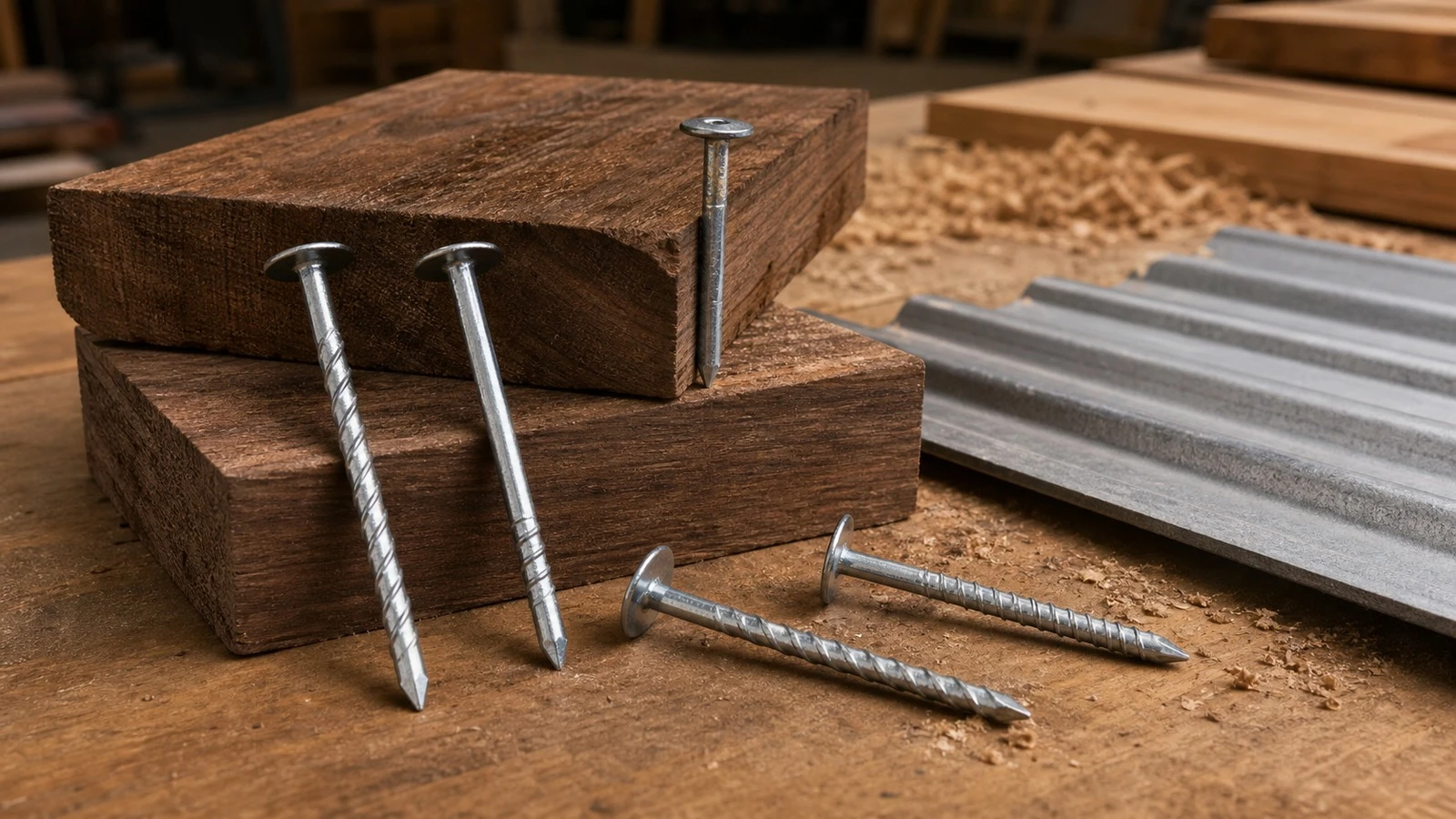 Screw shank roofing nails are often selected for dense timber and hardwood applications that need stronger hold.
That additional grip can come with greater driving resistance. Test the nail with the intended tool and substrate before approving a bulk order. Check that the nail reaches the required depth without bending, that the timber does not split excessively, and that the head seats correctly against the roofing material.
When Ring Shank Nails May Be the Better Balance
Ring shank roofing nails use annular ribs to increase grip. They provide stronger holding power than smooth shank nails and can be a useful choice for dense timber when the project needs a practical balance of holding performance, availability, and installation speed.
For some standard timber roofing systems, ring shank nails may meet the fastening need without the additional driving effort of screw shank. The correct answer depends on the roof load, timber thickness, roof material, and applicable system instructions. Do not select a shank profile without testing or checking the project requirement.
Select Diameter and Length Together
Diameter helps a nail resist bending, but a larger diameter is not always preferable. In dense or dry hardwood, oversizing can increase splitting risk. Length must be sufficient to pass through the roof covering and achieve suitable embedment in the substrate, while avoiding hazards behind the timber member.
Diameter and length should be selected together to balance driving performance, hold, and splitting risk.
State the actual shank diameter in millimeters or the agreed gauge standard. Also state the overall nail length, head diameter, and required tolerance. If matching an existing product, supply a drawing or retained sample. This prevents a manufacturer from quoting a nominally similar but mechanically different nail.
Use the Right Head for the Roofing Material
The head must support the roof covering. Umbrella-head roofing nails provide a wider bearing area and can be useful for roofing sheets or felt where pull-through is a concern. Flat heads may suit other applications. The head choice should follow the roof covering and system practice, not the density of the timber alone.
Where the roof system uses washers or seals, check the full assembly. A strong nail shank cannot compensate for an incompatible washer, poor sealing detail, or an incorrect fixing position on the roofing sheet.
Protect Against Corrosion
Hardwood selection does not remove the need to consider climate. Carbon steel nails with hot-dipped galvanizing are commonly used for exterior roofing and humid conditions. Stainless steel may be selected for more severe coastal, marine, or corrosive environments. The best finish depends on exposure, service-life expectation, roof material compatibility, and project requirements.
Keep bulk nails dry during storage and shipping. Wet cartons can damage the visible finish or create customer concerns even when the nail was correctly produced.
Test Before You Commit to a Container Order
Use samples to check:
- Penetration and driving force in the actual hardwood
- Nail bending and point performance
- Timber splitting near edges or thin sections
- Head seating and roofing-material condition
- Pull-out behavior after installation
- Coating condition after handling
For a project with engineering requirements, the installer or engineer should confirm the fastening pattern, spacing, and system compliance. The supplier can help provide the specified product but should not replace project-level design approval.
Bulk Buying Checklist for Hardwood Roofing Nails
Send a supplier the roofing material, timber species or density description, nail length, diameter, head type, shank type, finish, packing, order quantity, and destination port. Mention whether the nails will be installed manually or with pneumatic equipment. This allows the supplier to prepare a more relevant sample and quotation.
For distributors, stock screw shank as the high-hold option and ring shank as the broad general-roofing option, using clear labels to distinguish the intended applications.
Request a Roofing Nail Quote
For hardwood or dense-timber roofing, send Promisteel the substrate, roof material, nail size, shank preference, finish, packing, and volume. We can help prepare samples and a suitable bulk specification.
For project details, samples, or packing confirmation, contact Promisteel with your target specification and destination port.
Promisteel supports overseas buyers with specification review, samples, packing confirmation, and export coordination.
FAQ
Q: Are screw shank roofing nails best for hardwood?
A: They are often a strong option because the spiral shank can improve withdrawal resistance in dense timber. The actual nail size and installation method should still be tested in the project substrate.
Q: Can ring shank nails work in hardwood?
A: Yes, ring shank nails can be suitable when they meet the required hold and installation conditions. Compare them with screw shank through samples or project testing.
Q: Do hardwood roofing nails need a galvanized finish?
A: For exterior use, corrosion protection is usually important. Select the finish according to climate and project requirements, such as hot-dipped galvanizing or stainless steel for more severe environments.


