
 Español
 Türkçe
 Français
 عربي
عربي  dansk
dansk 한국어
한국어 Deutsch
 Việt Nam
 Italiano
 日本語
日本語 Português

Introduction
If you run a manufacturing plant, oversee construction contracts, work as a local steel distributor, or handle on-site steel framing work, you must know how much impact H-beam choices bring to your whole building project. Many project managers only focus on unit price when buying steel beams, ignoring actual bearing needs, installation difficulty, and long-term building stability, which easily leads to budget overruns or hidden structural risks later on.
In daily construction work, two types of H-beams are most widely used: hot-rolled H-beams straight from steel mills and site/factory-fabricated welded H-beams, also known as built-up steel sections. A lot of overseas buyers get stuck making choices: standard rolled beams are easy to get but size ranges are limited; custom welded H-beams fit special designs well, yet many people worry about unstable workmanship and longer production lead time.
I have been engaged in steel structure material supply and on-site matching service for years and have dealt with countless factory building renovation, large warehouse frame, and heavy industry workshop construction projects. This article talks purely from actual project experience, sorting out real pros, cons, and applicable scenes of these two beam types, helping you pick the most cost-effective solution totally based on your own construction situation.
Rolled H-Beams: In-Standard Ready-Made Structural Beams
What Exactly Are Rolled H-Beams?
Hot-rolled H-beams are finished steel profiles mass-produced by large steel factories through a high-temperature rolling process. The whole production goes through billet heating, multi-pass roller pressing, and one-piece forming; no cutting, splicing, or welding procedures are involved at all.
This kind of steel beam is produced fully following unified industry standards; common material grades include S235, S355, and other mainstream structural steel grades. According to actual usage needs, it is divided into wide flange, medium flange, and narrow flange types, covering most regular building frame sizes used in daily civil construction and light industrial buildings. All dimensions, flatness, and mechanical properties are fixed after leaving the factory; no secondary adjustment is needed in general situations.
Real Advantages in Practical Use
First of all, the biggest strength is stable overall performance. Since it is integrally formed by rolling, the internal steel structure is even, without welding seams and heat-affected zones caused by manual welding. Even when placed in workshops with frequent equipment vibration for a long time, it is not easy to deform or lose stability, and later maintenance cost is very low.
Secondly, the market supply is very sufficient. Common conventional sizes are always in stock at major steel warehouses; buyers can arrange shipment quickly after confirming orders, and goods can arrive at construction sites in a short time, which is very friendly for projects with tight construction schedules and urgent material demand.
In terms of procurement cost, large-batch standardized production greatly cuts down single-product manufacturing cost. Under the same bearing standard, the purchase price of rolled H-beams is much lower than that of tailor-made welded beams, which can effectively control the overall material cost for medium- and small-sized projects.
Besides, unified finished-size tolerance makes on-site installation much easier. Construction workers do not need to spend much time trimming and correcting components, which directly speeds up the whole frame assembly progress and saves extra labor costs on site.
Shortcomings That Cannot Be Ignored
The most obvious drawback is the fixed single specification. All rolled H-beams are produced according to fixed size series; buyers cannot adjust beam height, flange width, and board thickness freely according to their own construction drawings.
Once your project involves extra-long span building design or needs to bear large mechanical equipment loads, conventional rolled H-beams will fail to meet the stress-bearing standard. If you blindly choose larger-sized standard beams to meet the demand, it will cause a lot of steel waste and virtually increase unnecessary procurement expenses.
Suitable Usage Places
Combined with years of project service experience, rolled H-beams are most suitable for these scenes:
- Common single-layer and multi-layer storage warehouses without large tonnage crane equipment.
- Urban commercial shops, office building outer frames and indoor auxiliary supporting structures.
- Civilian light steel residential frames and outdoor simple operation platforms.
- Small and medium-sized light processing factories equipped with only light handling tools.
- All secondary supporting components that do not bear main building pressure.
Welded H-Beams & Built-Up Steel Sections: Custom-Made Heavy Load Beams
Basic Production Flow
Different from finished rolled beams, welded H-beams are all processed and customized according to actual construction drawings. The raw materials used are qualified medium and heavy steel plates purchased in bulk first.
Unsure which steel grade to choose for these plates?
Read our comparison on [Q355 vs. S355 vs. A572 for primary frames].
Production staff first use professional cutting equipment to divide whole steel plates into required web boards and flange boards, then do edge groove treatment to ensure later welding firmness. After component positioning and fixing by special tooling, formal automatic submerged arc welding is carried out.
After welding work is finished, workers need to correct beam body deformation caused by high temperature welding, remove surface rust and spray anti-rust protective paint. Every production step is adjusted around customer's project demands, completely breaking the size limit of traditional standard steel beams.
Core Usage Strengths
The top advantage is unrestricted personalized customization. No matter what special height, width or asymmetric plate thickness matching you need for your building design, welded H-beams can be produced one by one accurately according to drawings, perfectly solving the difficulty that standard beams cannot match non-standard designs.
In terms of load bearing capacity, this kind of fabricated beam has far stronger performance. By matching thickened flange boards and reinforced web boards, it can fully bear long-term operation loads of large tonnage workshop cranes and stable supporting pressure of super-long span roofs, which is an irreplaceable core component in heavy industrial construction.
In actual cost matching, professional manufacturers can reasonably distribute plate thickness according to different stress-bearing positions of beams, avoid overall uniform thickening leading to material waste, make steel distribution more reasonable, and effectively control overall steel consumption within a proper range.
Moreover, pre-embedded connecting holes and local stiffener reinforcement can be completed in advance during factory processing, which simplifies complex processing work on construction sites and greatly shortens the later overall construction cycle.
Points You Need to Think Twice About
Compared with spot rolled beams, customized welded H-beams need to go through cutting, assembly, welding, shaping and repeated inspection processes, so the whole production cycle will be longer. Project side must reserve enough production time in advance to avoid delaying the overall construction schedule.
Meanwhile, extra processing fees and manual welding costs make its unit comprehensive cost higher than conventional standard beams. If used for simple light-load conventional buildings, it will obviously cause unnecessary cost waste.
In addition, the final finished product quality is closely linked to the processing strength and construction experience of the cooperative factory. Poor equipment and immature operating technology are easy to cause welding defects and beam body distortion, so it is very important to pick a reliable processing supplier.
Main Applicable Construction Scenarios
Welded custom H-beams are mostly used in high-load and special-shaped engineering projects:
- Heavy-duty industrial workshops installed with large tonnage overhead cranes
- Large-span public venues such as exhibition halls, stadiums and comprehensive transport hubs
- Main load-bearing columns and large-span connecting girders of high-rise buildings
- Municipal infrastructure supporting frames and large-span bridge auxiliary beam components
- Special mechanical equipment base frames and non-standard industrial facility supporting structures
Visual Structure Difference
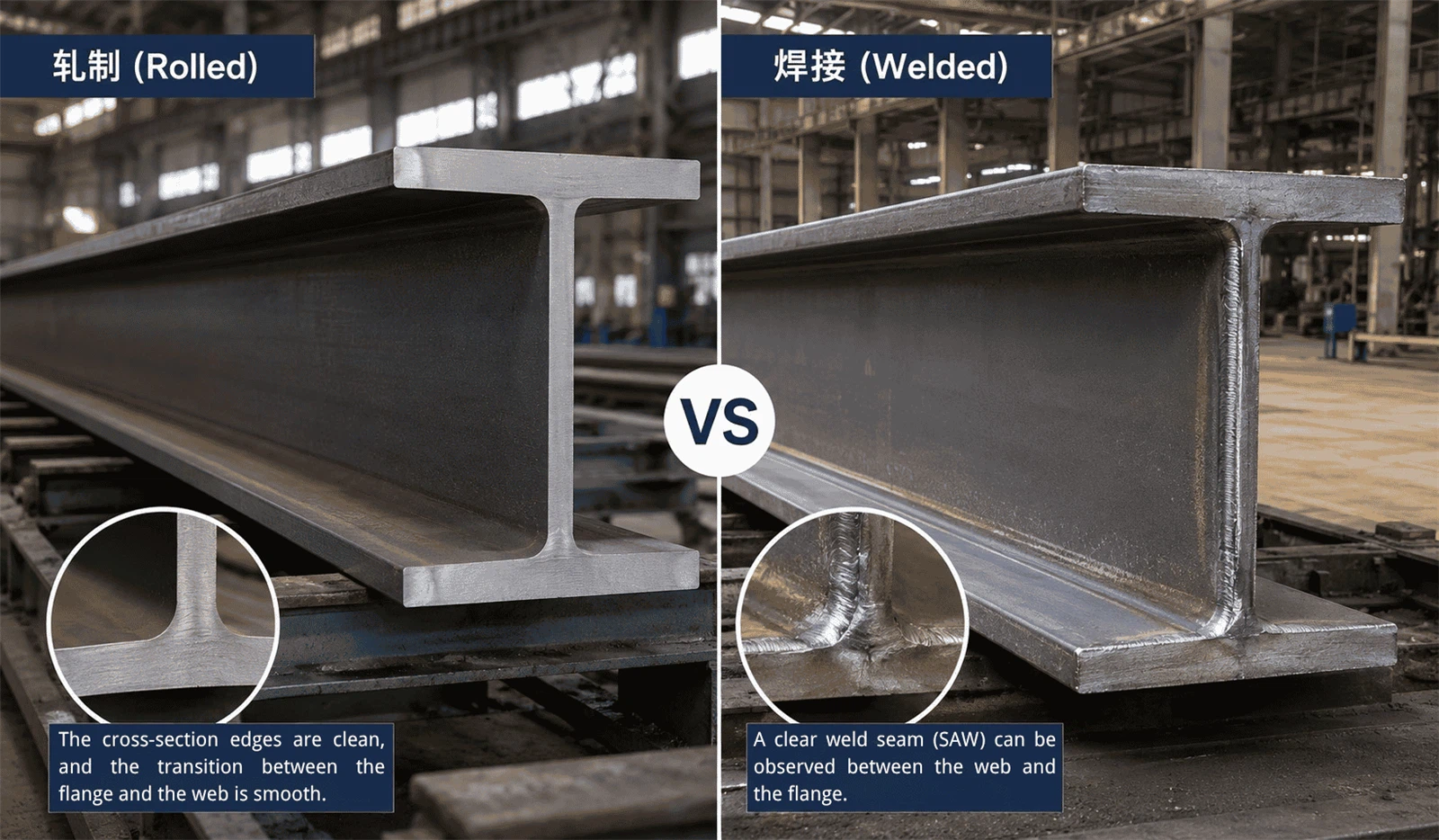
Rolled VS Welded H-Beams Clear Comparison
|
Comparison Item |
Rolled H-Beam |
Welded H-Beam (Built-up Section) |
|
Manufacturing Method |
One-piece hot rolling finished by steel mill |
Steel plate cutting + assembly + automatic welding |
|
Size Range |
Fixed standard sizes only |
Fully customizable any height, width and thickness |
|
Stock & Lead Time |
Abundant stock, fast delivery within 1-2 weeks |
Made to order, production lead time 2-4 weeks |
|
Load Capacity |
Suitable for light & medium load |
Perfect for heavy load & long span structure |
|
Unit Cost |
Low cost for regular sizes |
Higher processing cost, cost-effective for oversized design |
|
Structural Stability |
Uniform texture, no welding residual stress |
Stable after straightening, fit special stress demand |
|
Application Priority |
Secondary structure, warehouse, light workshop |
Main girder, crane beam, high-rise frame |
How to Correctly Select Beams According to Your Own Project
Choose Rolled H-Beams If You Meet These Conditions
Your building span belongs to conventional common range, and there is no large heavy equipment inside the building for long-term pressure bearing. The whole project has clear time limit requirements, and you hope materials can enter the site quickly to push forward construction progress smoothly. The project budget is controlled strictly, and all structural parts adopt conventional unified design without any special-shaped structure design. Under such circumstances, choosing in-stock rolled H-beams is the most stable and labor-saving choice.
Choose Welded H-Beams Under These Circumstances
Your construction project has super-long span frame design, or the factory interior needs to be equipped with large tonnage crane facilities for long-term use. The conventional standard rolled steel beams circulating in the market cannot reach the size and bearing parameters required by your design, and it is difficult to purchase qualified oversized finished rolled products. The design side puts forward targeted local stress optimization plans, requiring different positions of steel beams to adopt different thickness matching. In these cases, you must choose customized welded H-beams as the main structural materials.
Industry Common Hybrid Matching Method
In current large-scale comprehensive building projects, most experienced engineering teams will adopt mixed collocation mode to balance cost and safety. Use low-cost spot rolled H-beams for secondary frames, wall edge supporting beams and other low-load parts; adopt factory customized welded H-beams for core stress-bearing parts such as main building girders and crane special load-bearing beams. This matching method can not only control overall project investment well, but also fully guarantee the safety and stability of core building structures.
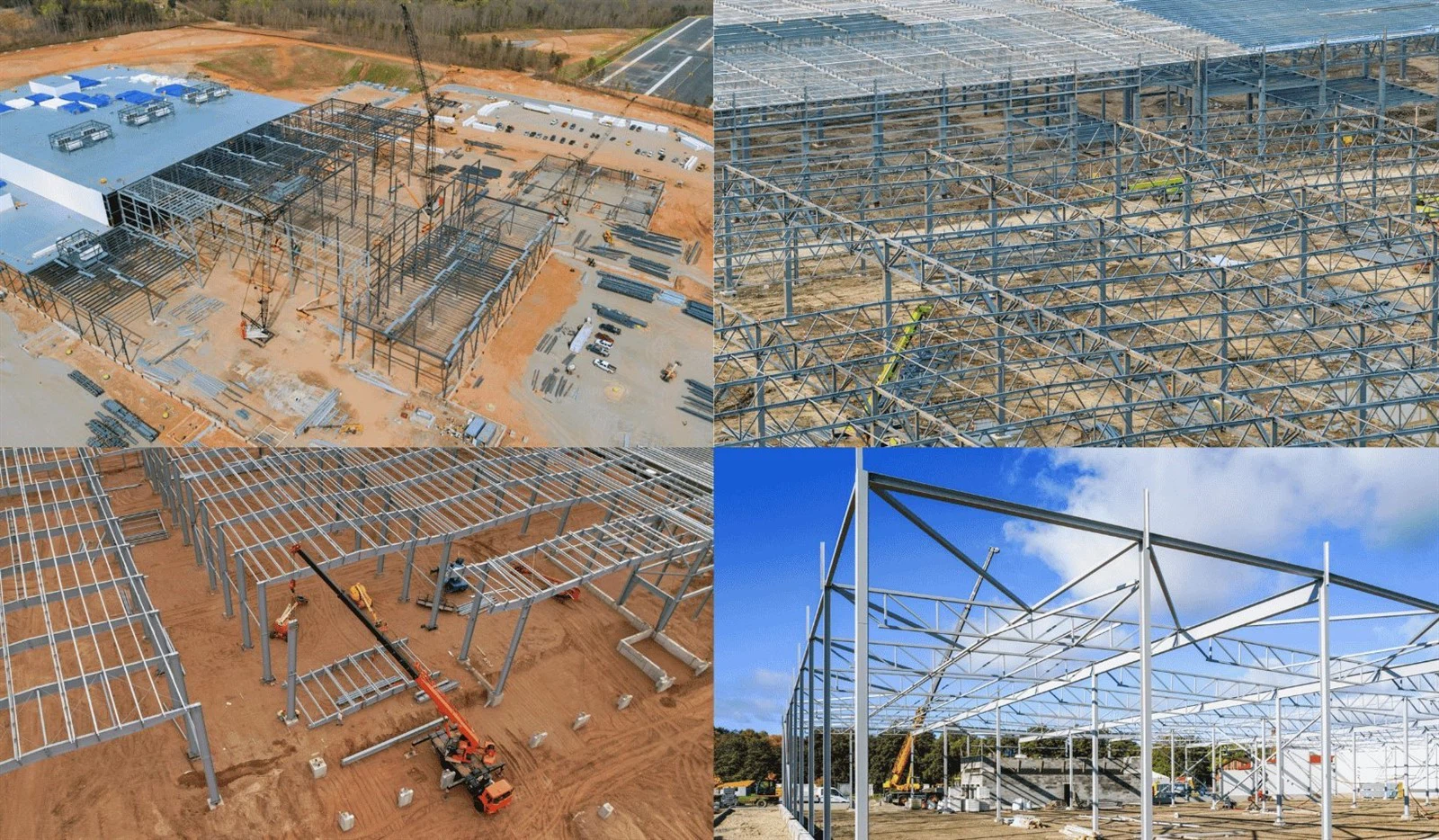
Why Clients Prefer to Cooperate with Promisteel
In the overseas steel structure supply industry, most suppliers only do simple steel product resale business, without their own supporting processing capacity, so they can only provide single standard steel materials. Different from these common traders, Promisteel has complete upstream raw material docking channels and independent physical processing factories.
We keep rich stock of various common specifications of rolled H-beams all year round, covering multiple mainstream international steel grades, which can quickly respond to customers' urgent demand for conventional engineering materials. At the same time, our own processing workshop is equipped with complete sets of mature cutting equipment, automatic welding production lines and finished product precision correction devices, capable of undertaking various types of custom H beams fabrication work steadily.
Relying on long-term stable bulk procurement advantage of medium and heavy steel plates, we can effectively control raw material cost, and truly pass the favorable price to every cooperative customer without excessive intermediate profit markup. Our team has rich practical experience in overseas engineering projects, can combine local building standards and actual construction environment, give customers reasonable material selection suggestions for free, help you distinguish which components are suitable for standard materials and which need customized processing, and avoid later troubles caused by wrong material selection.
All steel products we supply strictly follow international construction use standards, and can provide complete factory inspection documents and qualified customs clearance materials. Up to now, our standard rolled sections and custom welded structural beams have been stably supplied to many overseas regions, and we are very familiar with local engineering acceptance standards and cross-border goods delivery arrangements.
Final Summary
In actual steel structure construction work, there is no absolute distinction between good and bad for rolled H-beams and welded built-up sections. The core of selection is always whether the product can fit your project's actual span, load demand, capital budget and construction schedule.
For all conventional light-load and medium-span construction projects, standard rolled steel beams are still the most practical and cost-saving choice. Once encountering heavy load bearing, super-long span design and personalized special-shaped construction demands, customized welded H-beams are the most reliable and safe solution. Clarify your core construction demands first, and you can easily confirm the most suitable steel structure matching plan.
Call To Action
If you are currently arranging raw material procurement for factory building construction, commercial frame engineering and steel structure supporting projects, and still feel confused about H-beam specification selection, budget control and customized production arrangement, welcome to contact our professional service team through the official website www.promisteel.com directly.
You can send us your building span data, internal equipment load parameters, required steel material standards and specific procurement quantity demands. We will arrange professional staff to sort out the most appropriate material matching plan for you free of charge, and offer real factory direct sales quotation.
We are not merely a steel material supplier for you, but also your exclusive reliable partner who understands overseas steel structure engineering construction. We sincerely look forward to establishing long-term stable mutually beneficial cooperative relations with more global builders, project investors and steel distributors.


