
 Español
 Türkçe
 Français
 عربي
عربي  dansk
dansk 한국어
한국어 Deutsch
 Việt Nam
 Italiano
 日本語
日本語 Português

Last year, a warehouse developer in Saudi Arabia came to us with a problem. He had received three quotes for a 12,000 sqm Pre-Engineered Building (PEB) warehouse in Dammam. The spread was staggering-$62 to $94 per square meter for the steel package alone. Same building dimensions, same loading requirements, same site location.
The difference? Two suppliers had quoted what the drawings showed without questioning the design. One supplier-our engineering team-spotted five optimizations that brought the steel tonnage down by 14% while keeping structural performance identical. That $32 per square meter gap translated to nearly $384,000 on a single project. And it wasn't about using cheaper materials or cutting corners; it was about smart engineering decisions made early.
I've spent over a decade in structural steel export, and the pattern repeats itself across markets: a project moves straight from architectural concept to fabrication drawings without anyone pausing to ask, "Is there a more cost-effective way to achieve the same result?" PEB steel building cost reduction isn't about sacrificing quality. The most effective savings come from decisions made before the first beam is fabricated-during the design phase, when every millimeter of plate thickness and every meter of bay spacing can be optimized without touching structural integrity.
Here are ten practical ways to achieve real PEB steel building cost reduction, drawn from actual projects across the Middle East, Africa, Southeast Asia, and South America.
5-Second Executive Summary: PEB Cost Optimization at a Glance
For project developers and EPC managers balancing strict structural timelines and tight budgets, this rapid checklist summarizes the high-impact cost reduction levers in PEB procurement:
| Cost Optimization Lever | Primary Action Item | Expected Steel Package Savings |
Sourcing Impact Factor |
| 1. Standard Bay Spacing | Align grid layouts with 6m, 7.5m, 8m, or 9m increments. | 3% – 7% |
Cuts factory scrap rates from 12% down to 3%. |
| 2. Multi-Span Frame Systems | Introduce interior columns if process workflows permit. | 15% – 30% |
Reduces main girder weight and column base footprint. |
| 3. Graded Steel Mixing | Apply high-strength Q355 only where utilization exceeds 80%. | $15 – $20 per ton |
Stops over-specifying non-critical secondary members. |
| 4. Component Consolidation | Group purlins, plates, and bolts into fewer unique thicknesses. | 8% – 15% (Labor) |
Speeds up shop machinery setups and welding throughput. |
| 5. Geotechnical Alignment | Match column reactions to actual soil bearing capacity (kPa). | 20% – 30% (Concrete) |
Shrinks footing sizing by avoiding worst-case baseline assumptions. |
1. Optimize Building Dimensions to Standard Bay Spacing
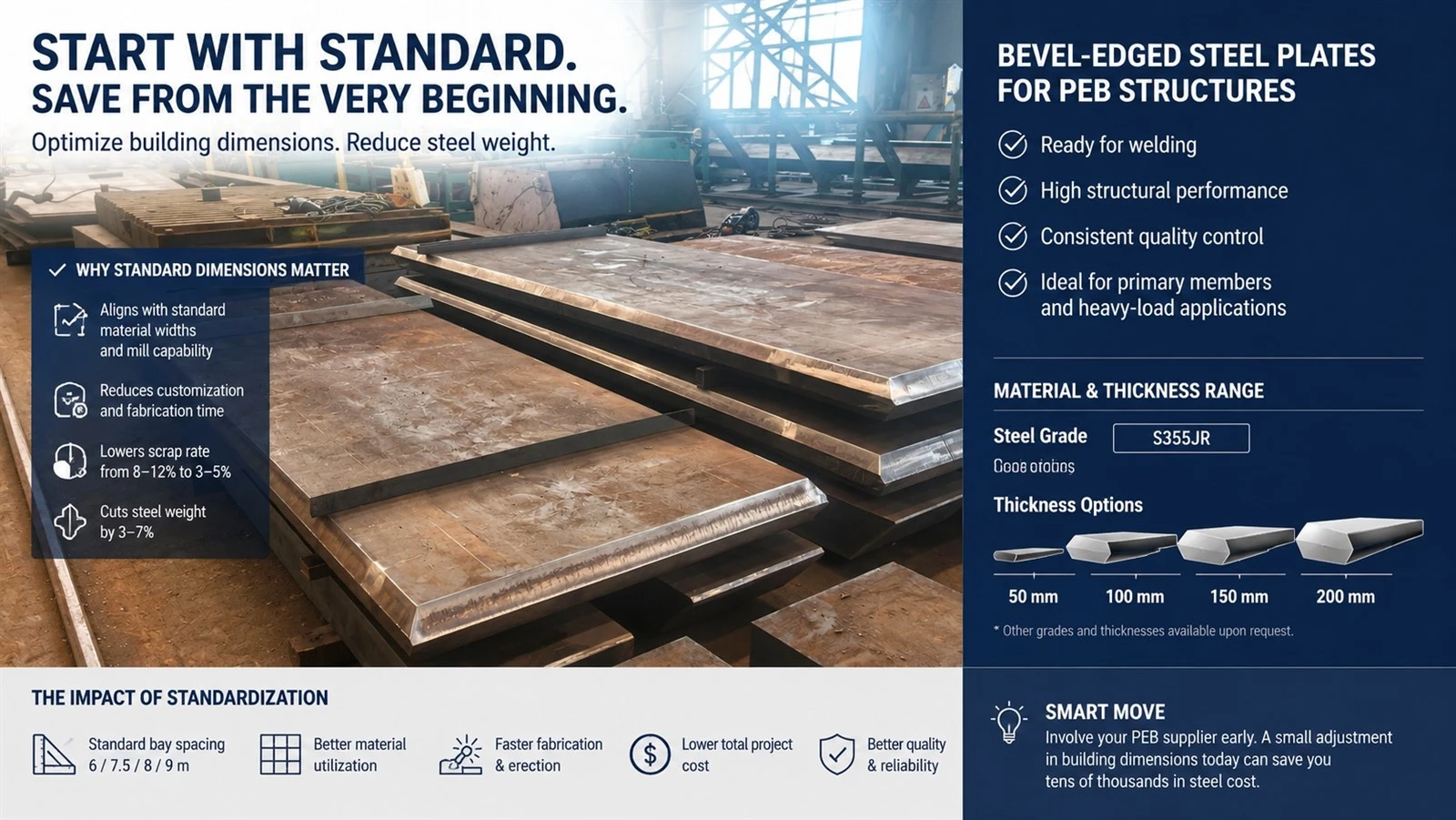
I've watched too many projects inherit building dimensions from site boundary surveys that had nothing to do with structural efficiency. A 47.3-meter width instead of 48 meters, or a 7.7-meter bay spacing instead of 8 meters. These odd numbers might seem trivial on paper, but they ripple through every fabrication step.
Standard PEB bay spacing-typically 6, 7.5, 8, or 9 meters depending on the frame system and local practice-aligns with mill-standard plate widths and standard purlin lengths. When your building drifts from these increments, the fabrication shop has to custom-cut every secondary member. Scrap rates climb from 3–5% to 8–12%. Labor hours per ton increase because standard jigs and fixtures no longer match.
In our Nigeria projects, we've consistently found that adjusting building width or length by as little as 0.5 to 1 meter-when site conditions allow-cuts the steel weight by 3–7% with zero impact on usable floor area. A 60m × 80m warehouse with 8m bay spacing versus a 61m × 79m structure with 7.5m spacing might look like the same building, but the steel package weight can differ by 18 tons.
The smart move: Get your PEB supplier involved before finalizing building dimensions. A 30-minute review at the concept stage often identifies minor adjustments that save tens of thousands. If the site boundary is fixed, let your supplier optimize bay spacing within those dimensions rather than copying an architect's arbitrary grid.
2. Choose the Right Frame System: Clear-Span vs. Multi-Span
Frame selection is where pre-engineered steel building savings start to show up-or disappear. The choice between clear-span rigid frames and multi-span frames with intermediate columns is one of the highest-impact decisions on your steel building cost per square meter.
| Frame System Evaluation Factor | Clear-Span Rigid Frame |
Multi-Span Frame (With Interior Columns) |
| Typical Span Range | 18–60 meters (single span) |
18–30 meters per span (2–5 spans) |
| Steel Weight per Sqm (30m wide building) | 32–38 kg/sqm |
22–28 kg/sqm |
| Interior Column Obstruction | None |
Columns placed every 18–30 meters |
| Crane Integration | More complex, requiring heavier frames |
Natural support points located at column lines |
| Foundation Dynamics | Heavier column base moment reactions |
Lighter individual footings, though more of them |
| Relative Steel Package Cost | 100% (Baseline) |
70% – 85% |
| Best Architectural Fits | Aircraft hangars, sports halls, large assembly plants |
Warehouses, factories, logistics distribution centers |
On a 5,000 sqm building in Ghana we quoted last year, the clear-span design came in at 158 metric tons of primary steel. The multi-span version-same footprint, same loading-came in at 124 metric tons. That's 34 tons of steel saved, roughly $28,000 at current export pricing, plus downstream savings on foundations because the individual column loads were lighter.
However, experience dictates that you shouldn't blindly choose multi-span just to save upfront cash. If you're building a logistics distribution center where forklifts need unrestricted omnidirectional movement, those interior columns become a daily operational headache that costs far more than the steel you saved. For a textile factory with fixed, permanent production lines, interior columns are often a non-issue, meaning the savings go straight to your bottom line. Map your operational workflow first, then let the frame system follow.
3. Select Appropriate Steel Grade-Don't Over-Specify
One of the most common PEB design optimization oversights I encounter is blanket-specifying high-strength Q355 (equivalent to S355 / Grade 50) steel for an entire building when Q235 (equivalent to S235 / Grade 36) would perform perfectly for most components.
Never under-specify critical load-bearing members. Main frame columns, crane runway beams, and primary truss chords need high-yield strength grades to carry primary bending moments, period. A structural failure costs infinitely more than any material saving. But a typical PEB building only needs higher-grade steel in roughly 20–40% of its members. The rest-secondary framing, girts, purlins, girt clips, sag rods, and bracing angles-can use Q235 without approaching design limits.
🔗 Structural Sourcing Insight: Blanket material specifications are a primary driver of unneeded procurement inflation.
To understand how steel grade selection matches up with international standards, see our comprehensive guide:
Choosing Steel Grades for PEB Primary Frames: A Guide for Industrial Building Procurement.
On a 1,000-ton project, if you can shift 300 tons of secondary steel from Q355 to Q235, the material cost difference alone is approximately $15–20 per ton at current Chinese mill pricing. That is $4,500 to $6,000 in direct material savings from running member-by-member design checks rather than applying a blanket specification.
At PROMISTEEL, our standard approach is to model the structure and assign steel grades based on actual utilization ratios-typically Q355 for members above 80% utilization, and Q235 for everything below. Ask your PEB supplier to provide the steel grade schedule by member type, not just a single blanket grade. If every component is quoted as Q355, someone is taking shortcuts on the engineering side, and you're paying for it.
4. Standardize Component Sizes to Reduce Fabrication Waste
Steel fabrication costs are heavily driven by the number of unique profiles and plate sizes in a building. Standardizing components requires engineering effort upfront, and some basic fabricators prefer to cut exactly what's on the drawing rather than propose value-engineered improvements.
Each time a shop has to change cutting machine settings, switch automated welding parameters, or pull different raw plate stock from inventory, efficiency drops. Multiply that by thousands of components, and the difference between a well-standardized design and one with 40 unique section types is 8% to 15% on fabrication labor cost.
We reviewed a PEB design for a logistics center in Kenya where the original engineering package specified seven different purlin thicknesses-1.5mm, 1.6mm, 1.8mm, 2.0mm, 2.2mm, 2.3mm, and 2.5mm Z-sections-across various spans. The structural analysis showed that consolidating to just three thicknesses (1.6mm, 2.0mm, and 2.5mm) kept every purlin above 90% structural utilization.
- The material cost increase from slightly heavier purlins in a few minor bays was $1,200.
- The fabrication labor saving from running three machinery setups instead of seven was roughly $4,800.
- Net saving: $3,600 on that project alone, with faster production as an added bonus.
Fewer unique items means your supplier's shop floor works more efficiently, and those savings should flow straight into your quote.
5. Optimize Foundation Design for Local Soil Conditions
The concrete under your steel building represents 15–25% of the total PEB construction budget, and it's an area where over-design runs rampant without anyone noticing.
A structural engineer in a consultant's office often receives building column reactions from the PEB supplier and designs the foundations for the worst plausible case because local geotechnical details are unknown. This results in footings that are 30–50% larger than required.
In one project in Abu Dhabi, a proper geotechnical investigation revealed a true bearing capacity of 280 kPa at 1.5 meters depth-well above the conservative 150 kPa the consultant had assumed. Resizing the footings for actual site conditions reduced concrete volume by 28% and rebar weight by 22%. Total foundation costs dropped from $142,000 to $108,000-a $34,000 saving driven entirely by real data.
The interaction between your steel frame behavior and foundation design is bidirectional. If your supplier assumes fixed column bases (which generate significant bending moments and require larger footings) while your soil can't realistically provide fixity, you're paying for a design assumption that fails in practice. Pinned base assumptions reduce foundation reactions-and foundation costs-substantially. Commission a proper geotechnical investigation before finalizing your design.
6. Right-Size Your Crane Systems
Not every industrial warehouse needs a 32-ton overhead crane. Yet I regularly see PEB designs with crane capacities that far exceed any load the facility will ever handle-simply because someone wrote "heavy duty crane" in the project brief.
A crane system doesn't just add the cost of the crane itself. Upgrading crane capacity changes everything about your building structure: deeper crane runway beams, heavier column cross-sections, larger base plates, stronger bracing, and stiffer frame connections. On a typical 80-meter-long building, upgrading from a 10-ton to a 32-ton crane capacity can add 25–40 tons of structural steel-roughly $20,000–$35,000 in material alone, plus larger foundations.
- A 5-ton crane handles most palletized warehouse loads, steel coil handling, and standard machinery installation.
- A 10-ton crane can lift a fully loaded 20-foot shipping container.
- A 32-ton crane lifts a mid-size excavator.
If your heaviest lift is a forklift battery change, you don't need 32 tons. Calculate your actual maximum lift requirement based on product weights, add a reasonable safety margin of 20–25%, and strike out excessive specifications that add zero operational value.
7. Use Efficient Roof and Wall Panel Systems
The building envelope typically accounts for 30–40% of the total steel building cost, and your selection here drives installation labor, material costs, and logistics.
In hot climates like Saudi Arabia, the UAE, and Nigeria, insulated sandwich panels (typically PIR or mineral wool core between steel facings) deliver dual benefits: they provide both the structural envelope and thermal insulation in a single installation step. A 50mm PIR sandwich panel provides an R-value of 2.5 m²K/W, which is sufficient for most industrial applications. Going to 75mm or 100mm adds cost and marginal insulation benefit unless you are running a specialized cold storage facility.
Built-up systems-where you install steel sheets, insulation, and liner panels in separate on-site operations-cost more in labor and extend installation time by 30–50%. In markets where skilled installation labor is expensive (UAE, Saudi Arabia), single-pass sandwich panels win on total installed cost. In markets where labor is less expensive but imported panels face high duties, built-up systems using locally sourced insulation can be more economical.
🔗 Sourcing Matrix Insight: Coating performance on your roof and cladding panels determines your facility's long-term weathering lifespan.
To prevent rapid rusting in coastal areas, review our technical guide:
Ignoring ISO 12944 Corrosion Protection Standards: The Hidden Risk in Coastal and Humid Climates.
8. Plan for Efficient Container Loading and Shipping
If you're importing steel from China, container optimization might be the single largest controllable cost factor in your PEB construction budget. Steel components-tapered columns, welded plate girders, and curved rafters-don't stack like regular boxes. Without deliberate loading optimization, even experienced logistics teams leave 15–25% of container volume unused. On a 1,000-ton PEB order, that's the difference between 36 containers and 28–30 containers. At $3,500–$5,500 per container to Middle East ports, you're looking at $21,000 to $33,000 in pure freight savings.
Our logistics team at PROMISTEEL approaches container nesting as a design-phase activity. Components that can nest inside each other-such as girts inside rafters, or purlins bundled and tucked into column web spaces-are identified during detailing.
Frame segmentation is another major lever. Shipping a 30-meter rafter as a single piece requires an open-top or flat-rack container, which costs 40–60% more than a standard container and requires special handling at both ports. Splitting that rafter into 2–3 segments with bolted field splices adds a modest fabrication cost (perhaps $150–200 per splice) but eliminates the premium container requirement entirely. On a building with 25 frame lines, that's $2,500–$3,750 in splice fabrication versus $12,000–$18,000 in premium container charges-a clear win.
🔗 Sourcing Matrix Insight: Inefficient loading plans can quietly inflate your freight invoices and cause coating abrasion during transit.
Read our detailed operational playbook:
Steel Container Loading: The Complete Optimization Playbook.
9. Consider Local Fabrication vs. Full Import Strategy
The traditional model for steel exporters is straightforward: fabricate everything in China, ship it, and handle on-site erection. For many projects, that's still the right approach. But in certain markets, a hybrid strategy-primary frames from China, secondary members and cladding fabricated locally-delivers meaningful pre-engineered steel building savings.
- The Nigeria Example: Sourcing secondary members (purlins, girts, sag rods) and cladding locally in Lagos saved roughly 18% on freight (those components are bulky relative to their value) and eliminated a 35% import duty on finished steel products.
- The Brazil Example: Local steel coil prices are competitive, but the import duty on fabricated steel structures runs 14–16%. Having your PEB supplier fabricate secondary members to imported coil specifications and shipping only the primary frames-which benefit most from specialized welding and plate processing equipment-can trim 8–12% from the total landed cost.
This hybrid strategy requires competent local fabricators who have coil-fed roll-forming lines for purlins, and it adds a layer of coordination complexity. Ask your PEB supplier whether they've executed hybrid local/import projects in your market, and request a cost comparison.
10. Value-Engineer Your Accessories and Finishes
Accessories are where scope creep is hardest to resist. Every additional feature feels essential during the design phase, but when the bills arrive, you realize you specified items that will never earn back their cost.
Consider this real example from a project in Indonesia: the original specification called for motorized ridge ventilators with rain sensors on a 6,000 sqm warehouse, costing roughly $28,000 in equipment. After reviewing the building orientation and prevailing wind data, our team demonstrated that fixed ridge ventilators combined with properly sized wall louvers would deliver equivalent air changes per hour. The cost dropped from $28,000 to $6,200 with zero ventilation complaints after three years of operation.
Paint systems are another common over-specification area. A standard two-coat alkyd system provides 8–12 years of service in most non-coastal industrial environments. Specifying a three-coat epoxy zinc-rich system adds roughly $3–5 per square meter of painted surface-fully justified for coastal sites in Dammam or Lagos, but wasteful for an inland warehouse in Riyadh or Nairobi.
Other accessories worth a hard look include:
- Canopies and Overhangs: A 3-meter canopy adds significant structure, cladding, and connection weight ($80–100 per linear meter). Question whether a 2-meter overhang would serve the same operational purpose.
- Mezzanine Floors: Check whether a high-density racking system could provide the same storage volume at a lower total cost than a structural mezzanine floor.
Conclusion: Smart Engineering Drives Real Savings
PEB steel building cost reduction is not achieved by chasing the lowest unit price or cutting quality gates. True structural economy is driven by data-based engineering choices made early in the design phase-where bay spacing adjustments, grade optimization, and container physics can be built directly into the fabric of the building.
Operating as an integrated supply chain service provider backed by deep state-owned mill networks and advanced internal processing centers, PROMISTEEL approaches PEB projects with strict engineering discipline. We analyze the component profiles, optimize the frame systems, and protect your logistics loop so your project can deliver maximum performance for the lowest total cost of ownership.
Stop Losing Money - Start Sourcing Smarter
Structural steel sourcing looks like purchasing, but it is actually rigorous risk management. The risks compound exponentially in global procurement when you treat structural steel as a basic commodity. Every shortcut you or an unverified vendor accepts-whether it is an unspecified steel grade, a vague 2D drawing, a rubber-stamp inspection, or cheap oceanic packaging-does not save money. It simply transfers cost from your initial purchase order straight to your on-site construction schedule, where errors compound by the hour.
Whether you are an experienced procurement manager or an EPC contractor executing your first cross-border development, these ten mistakes share a common root: treating highly engineered steel components as off-the-shelf stock. The fix is straightforward-specify exactly what your project demands, verify what you receive at every stage of fabrication, and partner with supply chain experts who engineer your project rather than just fill your tonnage order.
Next time you review a structural steel quotation, run through these ten points. Five minutes of careful technical scrutiny now can save your company five months of project delays and hundreds of thousands of dollars in asset losses later.
Get a Professional Blueprint & Specification Review - Free of Charge
Are you currently vetting suppliers or attempting to untangle a confusing set of structural blueprints for an upcoming industrial or commercial project? Do not leave your material compliance and logistical safety to chance or empty promises.
Let the PROMISTEEL engineering desk do the technical heavy lifting for you. Submit your current RFQ specifications, structural drawings, or competitive quotes, and our team will provide a comprehensive technical assessment completely free of charge. We will help you:
- Verify Material Equivalencies: Ensure your specified steel grades match international standards (ASTM, EN, GB) flawlessly.
- Identify Structural Clashes: Review your layout logic to catch component and connection interferences early.
- Audit Corrosion Layouts: Validate that your paint Dry Film Thickness (DFT) perfectly complies with local ISO 12944 weathering severities.
- Optimize Shipping Physics: Evaluate your stowage or packing configurations to eliminate transit deformation risks.
[Click Here to Schedule Your Free Engineering Review Specification Audit]
FAQ
Q: What is the typical steel building cost per square meter for a standard PEB warehouse?
A: For a standard clear-span PEB warehouse exported from China to Middle East or African ports, expect $45 to $75 per sqm for the steel structure package (framing, purlins, bracing, and connections). Cladding and insulated accessories add $20–$35 per sqm. Larger buildings (above 10,000 sqm) trend toward the lower end of this range due to economies of scale.
Q: How early should I involve my PEB supplier in the project?
A: Ideally during the schematic design phase or immediately after your geotechnical soil report is completed. Engaging a supplier after detailed designs are completely locked limits your cost reduction options to minor material-grade and fabrication tweaks (saving 3–5%), whereas early involvement unlocks fundamental systemic optimizations that save 10–20%.
Q: Does using higher-grade steel always mean a stronger, safer building?
A: No. Higher-grade steel has higher yield strength, which simply allows thinner steel sections to carry the same structural load. What matters is whether the designed profiles meet required structural utilization ratios. A properly designed Q235 member at 85% utilization is just as safe as a Q355 member at 55% utilization-the latter just costs more and wastes material.
Q: How do I verify that my incoming PEB quotation includes proper cost optimization?
A: Request four specific technical documents from your supplier before signing a contract: (a) a component standardization summary showing profile variations; (b) a member-by-member steel grade utilization schedule; (c) a 3D container loading plan; and (d) a frame configuration cost comparison (e.g., clear-span vs. multi-span options). If a vendor cannot provide these, they are likely leaving your money on the table.


