
 Español
 Türkçe
 Français
 عربي
عربي  dansk
dansk 한국어
한국어 Deutsch
 Việt Nam
 Italiano
 日本語
日本語 Português

Quick answer
Steel shot hardness affects how blasting media deforms, wears, and breaks down over repeated impact cycles. A higher HRC range does not automatically produce faster cleaning or lower consumption. The appropriate grade balances shot size, numeric hardness range, microstructure, machine settings, separator performance, required surface condition, and total cost per accepted part.
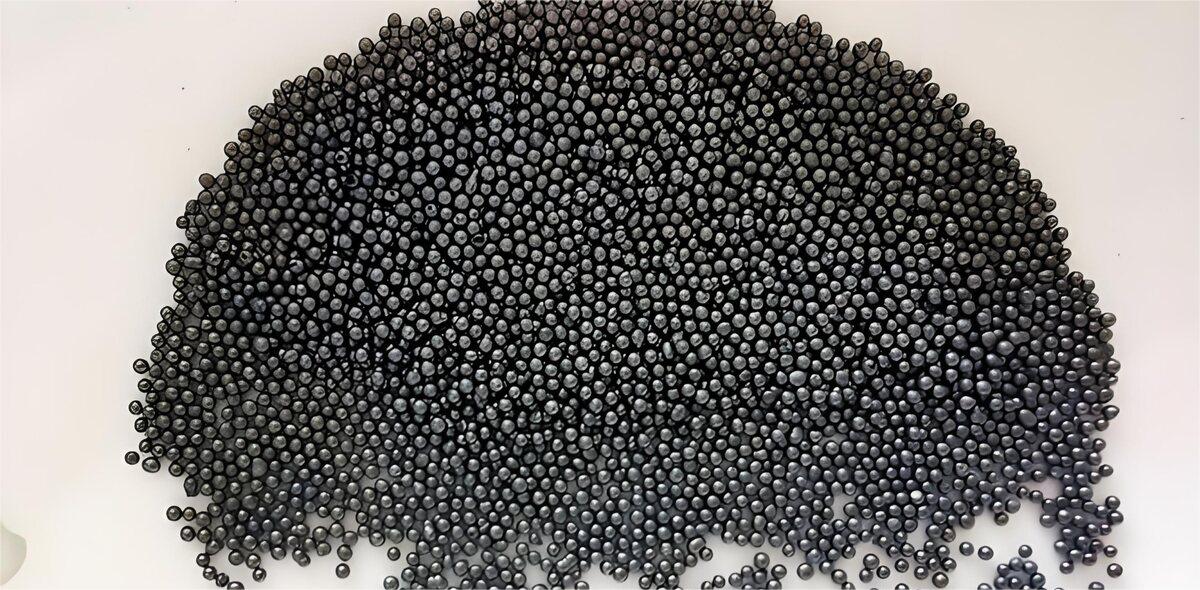
Real steel shot product photograph. Final publication may replace this with a macro sample beside an HRC tester or wheel-blast machine.
Contents
Steel shot quotations usually lead with particle size: S110, S170, S230 or S330. Size is visible, familiar and easy to compare. Hardness is less obvious, yet it influences what happens after thousands of impacts inside the machine.
A low-priced abrasive may become expensive if it breaks down quickly and requires frequent top-up. The opposite can also occur: paying for a harder grade adds no value if the workpiece, machine and required finish do not benefit. The useful question is not "Which shot is hardest?" but "Which hardness range delivers the required surface result with a stable working mix and acceptable total cost?"
Contact nowWhat Does Steel Shot Hardness Mean?
Hardness describes resistance to indentation and plastic deformation. For industrial cast steel shot it is commonly expressed on the Rockwell C scale (HRC), but a complete specification also states the applicable standard, test method, sampling plan, and acceptance range.
SAE J827 describes chemical and physical-characteristic requirements for high-carbon cast steel shot used in blast cleaning or shot peening. SAE J2175 covers low-carbon cast steel shot. These standards address multiple numbers; buyers should review the applicable edition and the ordered product rather than relying on a generic online hardness chart.
Promisteel's current cast steel shot product specification lists 40-51 HRC as its standard reference range, with other requirements subject to process confirmation.
Important classification note
GP, GL and GH are supplier labels, not a substitute for the numeric purchase specification. Their definitions can vary, and they are frequently used in steel-grit product ranges. If a supplier applies them to an abrasive offer, record the agreed HRC range, test method and allowable variation in the order.
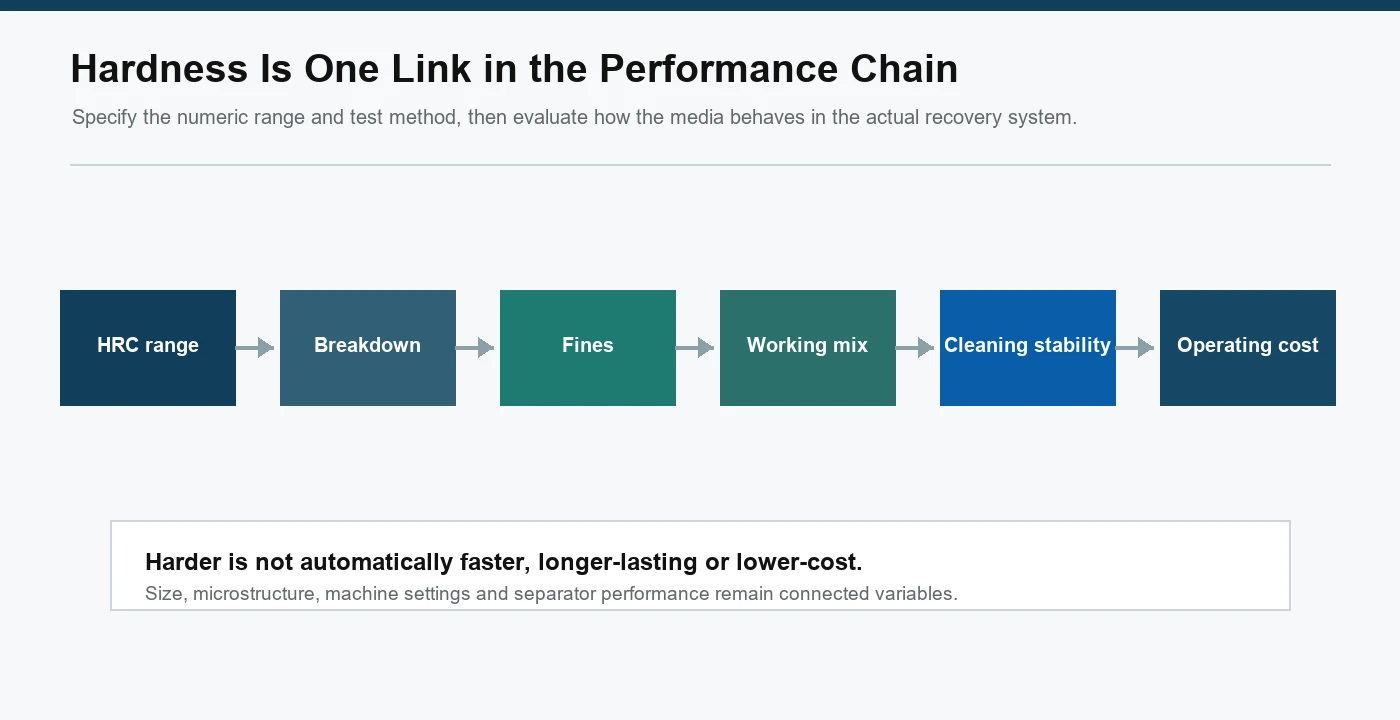
Hardness affects performance through a chain of connected process variables; it is not an isolated cleaning-speed setting.
Does Harder Steel Shot Clean Faster?
Not necessarily. A harder particle may resist deformation differently, but cleaning rate also depends on shot size, particle velocity, blast-wheel design, abrasive flow, workpiece condition, contamination thickness, impact angle, exposure time and the circulating working mix.
Consider two plants using nominally identical S330 shot. Plant A maintains a controlled working mix and an efficient separator. Plant B uses a higher-hardness product but allows excessive fines to remain in circulation. Plant A may clean more consistently because useful impact energy reaches the workpiece more reliably.
Recommended final photograph: wheel-blast equipment, abrasive flow and a representative cleaned workpiece.
Before changing hardness to improve cleaning speed, check the existing shot size, wheel speed, abrasive flow, separator adjustment, contamination level and working-mix distribution. A hardness change cannot correct a fundamentally unsuitable particle size or poorly adjusted recovery system.
How Does Hardness Affect Steel Shot Life?
As shot circulates, particles wear, become smaller, change shape and eventually fracture or leave the usable size range. Hardness can influence this behavior, but service life also depends on microstructure, heat treatment, internal defects, machine energy, impact conditions and the workpiece.
Two products with the same nominal size and average HRC can therefore produce different top-up rates. A useful purchasing specification considers:
- the ordered HRC range and permitted variation;
- hardness distribution across the sample;
- microstructure and internal condition;
- particle-size distribution and morphology;
- batch-to-batch manufacturing consistency;
- measured performance in the buyer's machine.
What Are Fines and Why Do They Matter?
Fines are undersized particles and fragments produced as the abrasive wears and breaks down. Some generation is unavoidable. The problem begins when fines accumulate faster than the separator and dust-control system can remove them.
Excess fines can reduce effective impact energy, increase dust, destabilize the surface result, and force the operator to add more fresh media. This is why production teams should connect hardness to breakdown rate, separator discharge, circulating size distribution and top-up consumption.
Recommended final photograph: serviceable working mix beside separator discharge, dust and rejected fines.
How Does Hardness Change the Working Mix?
The abrasive circulating during normal production includes newer shot, worn serviceable particles, and smaller media approaching the separator cut point. A grade that breaks down quickly may require more frequent additions. A more stable product may remain usable longer, but maximum hardness is not the objective if it increases equipment wear or produces an unsuitable surface.
The target is a repeatable working mix that delivers the required cleaning condition with controlled consumption, dust, and maintenance.
Why Is Hardness Distribution More Useful Than One Average?
An average of 58 HRC can describe very different batches. One batch may be tightly grouped around the target, while another contains a wide spread of softer and harder particles. Those populations may wear and fragment differently even though the reported average is identical.
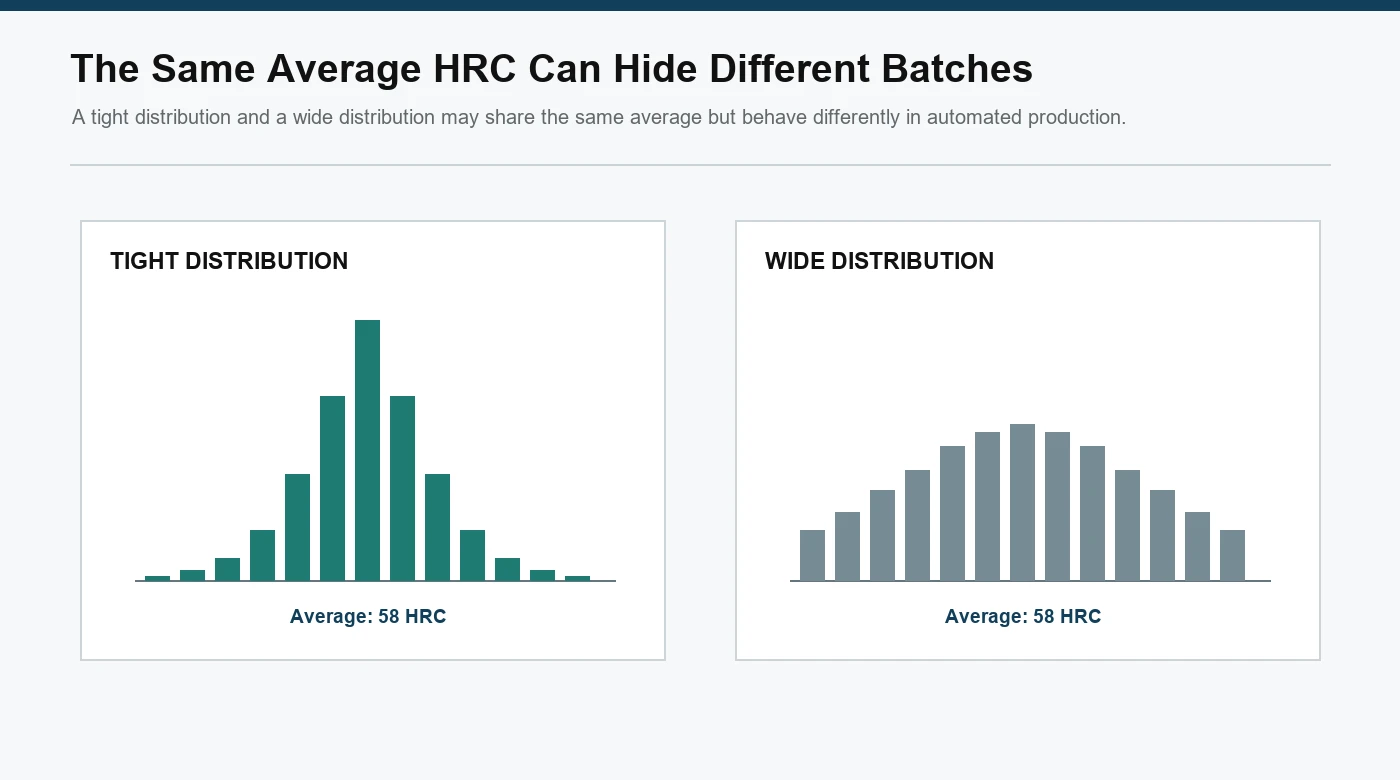
Illustrative distributions only. Agree the actual range, sampling procedure, number of measurements, and acceptance rule with the supplier.
When hardness consistency matters, confirm the sampling method, test method, number of measurements, permitted deviation and batch traceability. Automated lines running many hours per day need predictable behavior, not merely a persuasive average.
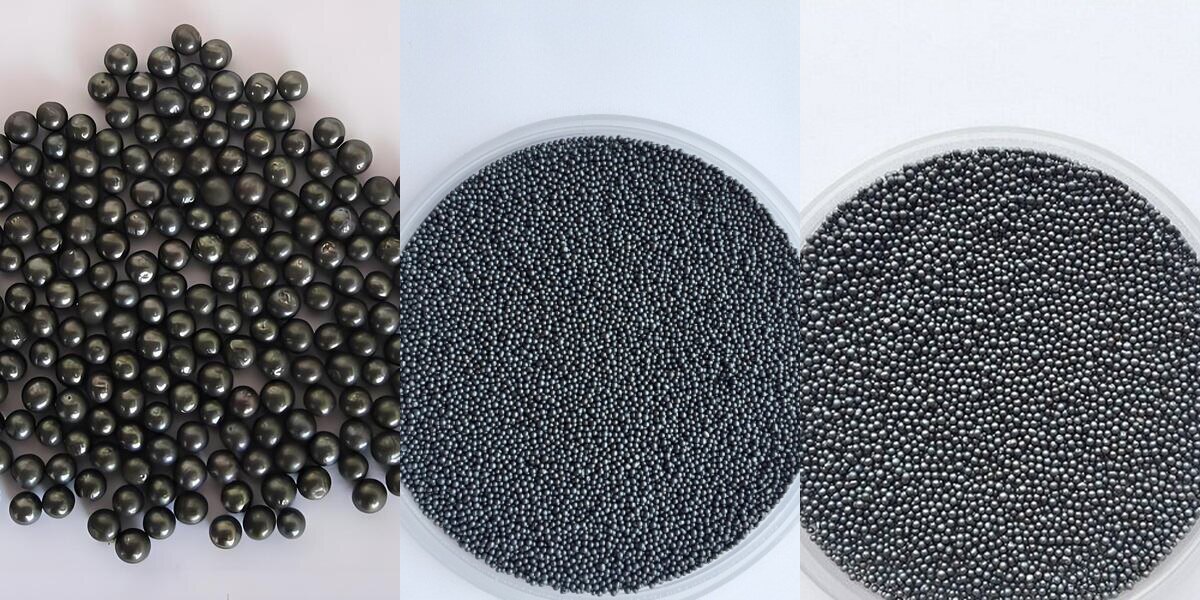
Recommended final photograph: prepared steel-shot sample, Rockwell hardness tester and recorded readings.
Which Steel Shot Hardness Range Should You Choose?
There is no universal range for every blast-cleaning line. Start with the application and verify the supplier's numeric offer:
Lower or Standard Hardness
May be evaluated for general cleaning, lighter scale, selected foundry work or applications where overly aggressive impact is undesirable. Suitability depends on the ordered product and machine.
Intermediate Hardness
May provide a practical balance between cleaning behavior and durability for steel components, forgings, castings, fabricated sections and general descaling.
Higher Hardness
May be considered where a different breakdown pattern or greater resistance to deformation is required. It can also change machine wear, dust and surface response, so the benefit must be demonstrated rather than assumed.
Why Must Size and Hardness Be Selected Together?
S170 at a higher hardness and S390 at an intermediate hardness are not interchangeable choices. Particle mass and geometry change the individual impact, while hardness influences how that particle behaves through repeated cycles. A useful RFQ defines size + HRC range + application + machine + acceptance method, not size and price alone.
Use the cast steel shot size selection guide to establish the particle-size side of the specification.
What Causes Steel Shot to Break Down Too Quickly?
Rapid consumption may indicate unsuitable abrasive, but it can also arise from excessive wheel speed, poor separator adjustment, contamination entering the circuit, inappropriate shot size, repeated impact against machine components or an unstable working mix.
Inspect the media after circulation. Measure the proportion of broken particles, size distribution, separator discharge and fresh-media additions. These observations are more diagnostic than a monthly purchase total alone.
Check first: wheel speed and abrasive flow
Inspect: separator cut, dust and rejected fines
Compare: incoming media versus operating mix
Measure: top-up per accepted part or cleaned tonne
How Should Buyers Compare Two Steel Shot Suppliers?
Two offers may both state S330 and 55-60 HRC, yet differ in size distribution, hardness consistency, microstructure, internal condition and batch control. Ask each supplier for comparable evidence:
- hardness results and distribution;
- particle-size analysis;
- microstructure or internal-condition report where required;
- chemical composition and density;
- batch number, COA, TDS and SDS;
- sample availability and controlled-trial support.
What Should a Steel Shot COA Include?
The exact certificate follows the agreed product and contract. Relevant fields may include product designation, shot size, hardness result, chemical composition, physical characteristics, batch number, and inspection date. For hardness-sensitive applications, the certificate should identify the requirement and testing basis clearly enough to connect the delivered lot to the purchase specification.
Retaining COAs by batch allows a plant to compare any change in consumption or surface result with the material actually used. The broader steel abrasive buyer's guide covers supporting documents, packaging and supplier checks.
When Should You Run a Steel Shot Hardness Trial?
Run a controlled trial when changing hardness, supplier, particle size, wheel settings or workpiece, and when consumption or cleaning stability changes unexpectedly. Keep other variables as constant as practical. If size, hardness, wheel speed and flow all change together, the result will not identify which variable caused the difference.
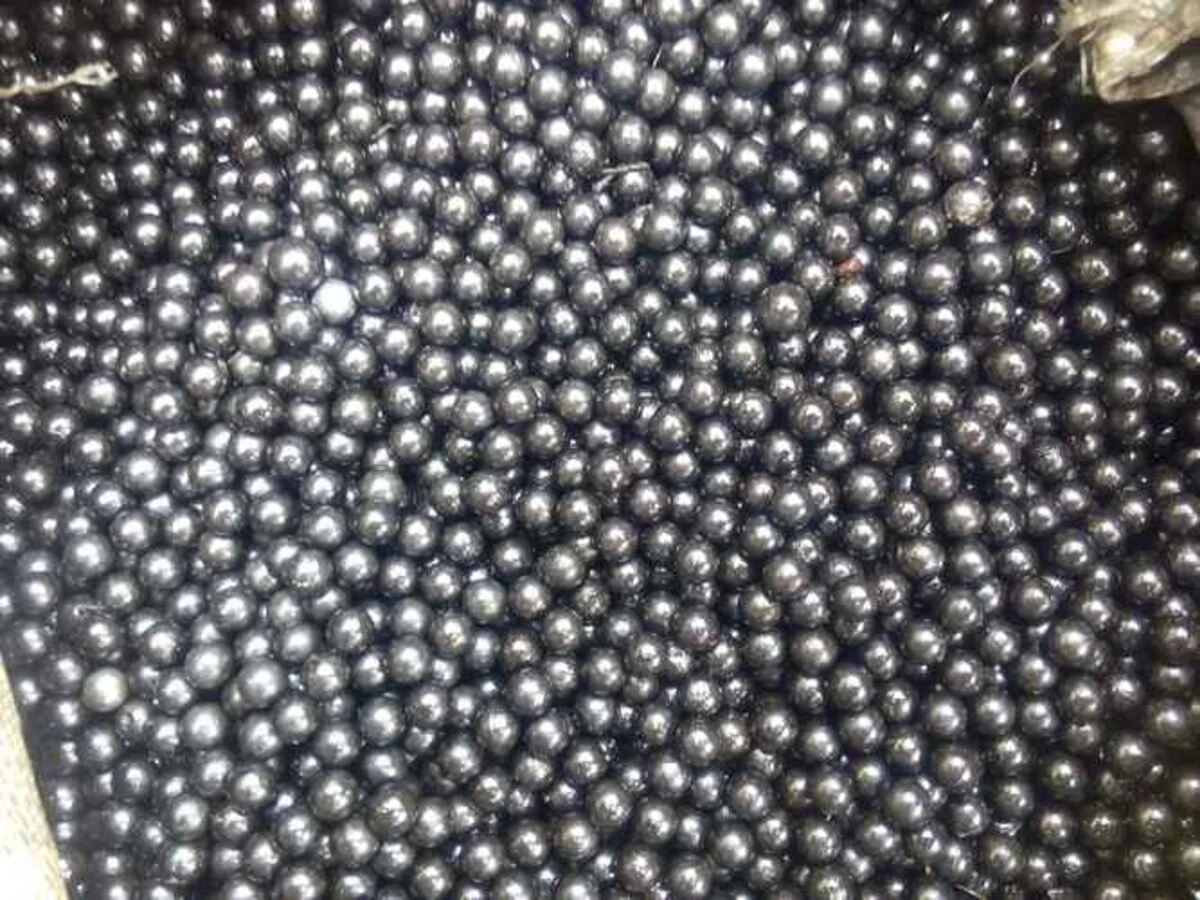
Recommended final photograph: trial samples, cleaned workpieces and a production log showing cycle time, top-up and fines.
What Should You Measure?
| Trial measure | What to record | Why it matters |
|---|---|---|
| Cleaning rate | Time to the required surface condition | Shows useful production throughput |
| Consumption | Fresh shot added over a defined output | Supports cost-per-part comparison |
| Fines | Working mix and separator discharge | Indicates breakdown and recovery behavior |
| Surface result | Cleanliness, roughness or approved appearance | Confirms acceptance, not just speed |
| Equipment condition | Wheel, liner and handling-system observations | Captures maintenance tradeoffs |
| Stability | Results after repeated recycling cycles | Tests the operating mix rather than new media only |
Why Purchase Price Can Give the Wrong Answer
A lower-hardness Grade A may cost less per tonne but require frequent top-up because the working mix generates more fines. A higher-priced Grade B may maintain a stable mix and lower the cost per cleaned tonne. The reverse is also possible: if the harder grade provides no measurable benefit, its premium is wasted. Only a controlled trial can establish which case applies.
Common Mistakes When Selecting Steel Shot Hardness
- Choosing the hardest grade. Maximum hardness is not a universal performance target.
- Looking only at average HRC. Distribution and consistency can matter as much as the average.
- Ignoring the operating mix. Results depend on recycled media, not only fresh product.
- Blaming the abrasive for every consumption problem. Machine and separator conditions must be checked.
- Comparing suppliers only by price. Use comparable documents and trial data.
Steel Shot Hardness Buyer Checklist
- Shot size and particle-size distribution
- Product type: high-carbon or low-carbon cast steel shot
- Numeric HRC range and test method
- Hardness distribution or deviation requirement
- Microstructure and internal-condition criteria
- Chemical composition, density and particle condition
- COA and batch-traceability requirements
- Current machine, separator and working-mix baseline
- Controlled production-trial procedure and acceptance criteria
Final Takeaway
Hardness is important, but it is not an isolated quality score. The meaningful relationship is hardness - breakdown - fines - working mix - cleaning stability - operating cost. A suitable range can support stable performance; an unsuitable combination may increase dust, top-up, machine wear or inconsistency.
Combine the supplier's documents with measurements from the real blast line. If a plant is experiencing high consumption or excessive fines, changing hardness may help, but first identify what is happening inside the machine and recovery system.
FAQ: Steel Shot Hardness and Blasting Performance
Does harder steel shot always clean faster?
No. Cleaning rate also depends on size, velocity, flow, blast-wheel design, contamination, impact angle, working mix and separator performance.
How does hardness affect abrasive life?
It can influence deformation and breakdown, but service life also depends on microstructure, manufacturing quality, machine settings and the application.
What are fines in steel shot blasting?
Fines are undersized particles and fragments produced during repeated cycles. Excessive fines can increase dust and destabilize the operating mix.
Why is hardness distribution important?
One average HRC can hide substantial particle-to-particle variation. A controlled distribution can support more predictable production behavior.
When should a hardness trial be run?
Run one when changing hardness, supplier, size, machine settings or workpiece, or when abnormal consumption or cleaning instability appears.
Need Help Balancing Shot Size, HRC, Working Mix and Consumption?
Send the workpiece, contamination, machine model, current media, required surface condition, and consumption data. Promisteel can review the starting specification and trial evidence needed for comparison.
Request Technical ReviewView Steel Abrasive Products


