
 Español
 Türkçe
 Français
 عربي
عربي  dansk
dansk 한국어
한국어 Deutsch
 Việt Nam
 Italiano
 日本語
日本語 Português

Choose the cast steel shot size by evaluating seven interrelated factors: workpiece dimensions and geometry, contamination severity, required surface finish, blast-wheel conditions, separator efficiency, shot hardness, and the working mix inside the machine. Fine grades such as S70-S170 are practical starting points for controlled impact and smaller components; S230-S390 covers many general cleaning applications; and S460-S780 may suit heavier scale and larger workpieces. These ranges are not universal prescriptions. Confirm the final size and hardness through a controlled production trial.
Choosing the right cast steel shot size is not simply a matter of selecting a larger or smaller abrasive. The best size depends on what the line is cleaning, how heavily the surface is contaminated, what result must be achieved, and how the blast machine accelerates, separates and recycles the media.
This is where many purchasing decisions go wrong. A buyer may order a grade that worked well at another factory, only to find that cleaning speed, surface appearance, or abrasive consumption change on their own machine. Steel shot size does not operate independently from the blasting process.
Workpiece dimensions, contamination, blast-wheel configuration, separator performance, abrasive hardness and the working mix all influence the outcome. This guide explains how to choose a practical starting range and how to validate it before committing to regular-volume purchases. Available grades and order variables are listed on the Promisteel cast steel shot product page.
On This Page
What Does Cast Steel Shot Size Actually Mean?
SAE J444:2023 covers standard cast shot and grit size numbers for cleaning and peening. For cast shot, the S-number corresponds to the opening of the nominal test sieve in ten-thousandths of an inch. The sieves referenced by SAE are in accordance with ASTM E11.
Commonly supplied cast steel shot grades include S70, S110, S170, S230, S280, S330, S390, S460, S550, S660 and S780. These are size designations. S780 is not automatically better than S230; it is a much coarser grade and behaves differently in the blast stream.
Size also does not prove that the media is suitable for every shot-peening operation. Fatigue-critical peening requires the customer's approved media specification and process controls. General blast-cleaning media should not be promoted as automatically suitable merely because it carries an SAE size designation.
Should You Choose Fine, Intermediate or Coarse Steel Shot?
A practical first screen is to divide the commonly supplied sizes into three groups. The categories below help narrow the discussion; they are not rigid engineering prescriptions.
| Shot group | Common starting grades | Typical role | Where it may fit |
|---|---|---|---|
| Fine | S70 / S110 / S170 | More controlled individual impact | Smaller parts, lighter contamination, detailed geometry and specified finishing processes |
| Intermediate | S230 / S280 / S330 / S390 | General-purpose cleaning range | Structural sections, castings, fabricated parts and many wheel-blast lines |
| Coarse | S460 / S550 / S660 / S780 | Greater mass per particle | Heavier scale, large workpieces and applications requiring stronger impact |
The same nominal size can perform differently when hardness, wheel speed, abrasive flow, machine design or working mix changes. A useful supplier recommendation therefore starts with the application, not merely the requested S-number.
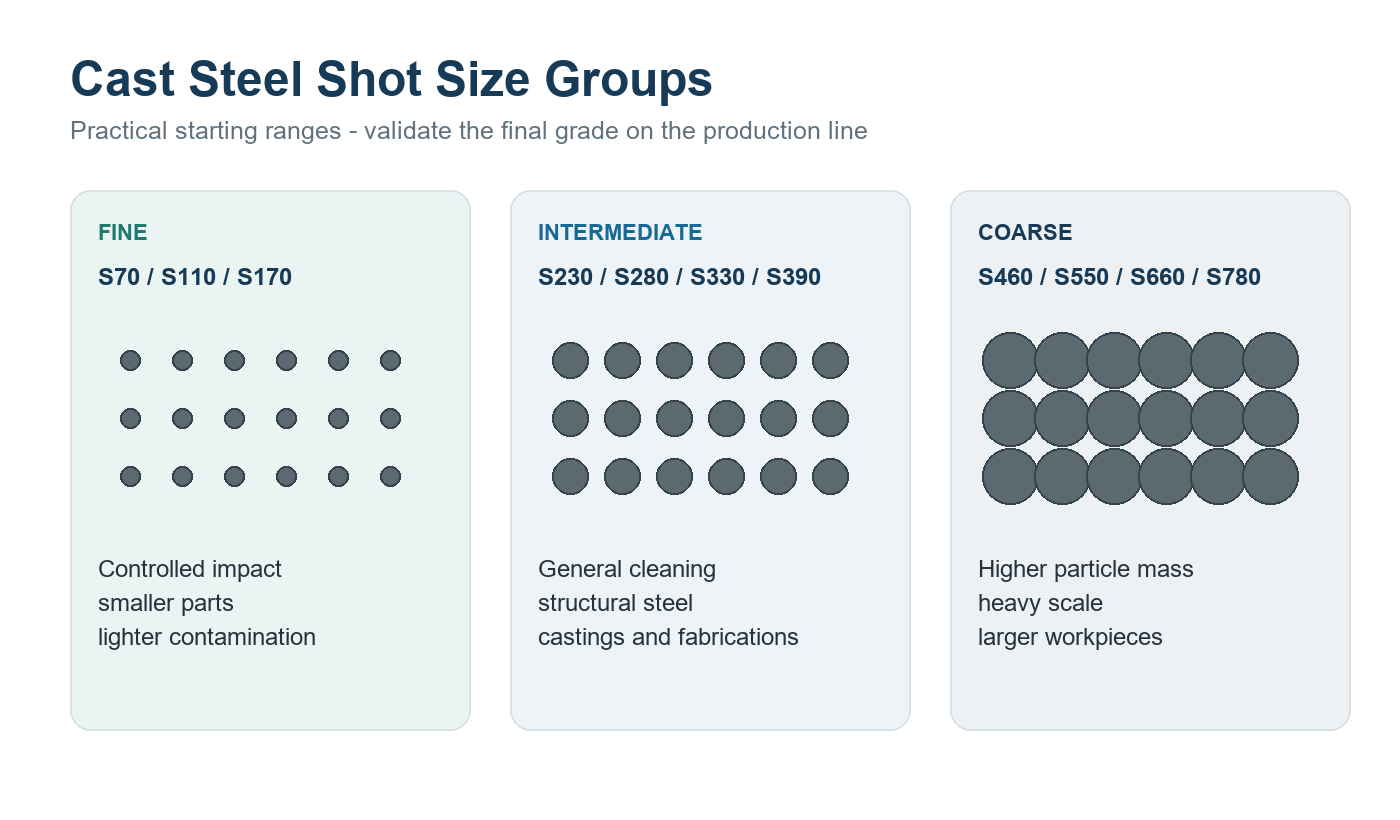
Practical size groups narrow the starting range, but the final grade must be validated against the actual line.
1. Start With the Workpiece Dimensions and Geometry
The size and shape of the workpiece are often overlooked. A manufacturer cleaning small automotive components may be dealing with narrow recesses, holes, corners, thin sections and complex geometry. A steel fabricator may instead be blasting heavy plate, H-beams, welded structures and long profiles.
Using the same specification for both applications may not produce the same result. Finer shot may provide better access to difficult areas and more controlled impact on smaller components. Coarser shot may make sense for large, robust sections when substantial scale must be removed.
Do not choose the most powerful-looking grade. Match particle size to section thickness, geometry and the areas the blast stream must reach.
2. Assess the Scale or Contamination
Light contamination does not need the same impact as heavy mill scale, casting residue or severe corrosion. A newly manufactured component with light scale may respond well to an intermediate size. A heavily scaled casting or large plate may require a more aggressive combination of particle size, hardness and blasting intensity.
However, changing to a larger shot is not always the first or correct solution. Before increasing size, check:
- blast-wheel condition and blast pattern;
- wheel speed and abrasive flow rate;
- current shot hardness and breakdown behavior;
- the size distribution of the circulating working mix;
- separator condition and removal of fines;
- blasting time and workpiece presentation.
If the machine is operating with an unstable working mix, adding larger new shot may temporarily change the result without correcting the underlying problem. Abrasive selection and machine operation should be reviewed together.
3. Define the Required Surface Result
The final surface matters as much as cleaning speed. If the purpose is basic removal of loose contamination, the process window may be relatively broad. If the surface must meet a defined appearance, cleanliness or preparation requirement, the selection becomes more precise.
Finer shot generally produces a denser, more controlled impact pattern. Coarser particles carry more individual mass and can produce stronger impact. For coating preparation, buyers should state the required cleanliness, the target profile where applicable, and the coating system that follows.
This is also why steel shot should not automatically be substituted for steel grit. Round shot acts mainly through impact; angular grit provides more cutting action. Review the steel shot versus steel grit comparison when the project requires old-coating removal or a controlled anchor profile, and check available angular grades on the
4. Match the Shot Size to the Blast Machine
Most industrial wheel-blast systems use a centrifugal wheel to accelerate abrasive toward the workpiece. The media is collected, elevated, separated and returned to the system. The wheel, cabinet, work-handling arrangement, elevator, separator and dust collector all affect production stability.
Two machines using S330 may not produce identical results if wheel configuration, operating speed, abrasive flow or workpiece presentation differs. A practical recommendation should therefore include:
- machine manufacturer and model;
- number and capacity of blast wheels;
- approximate operating speed and abrasive flow;
- workpiece type and production rate;
- current media and top-up rate;
- separator type and current condition.
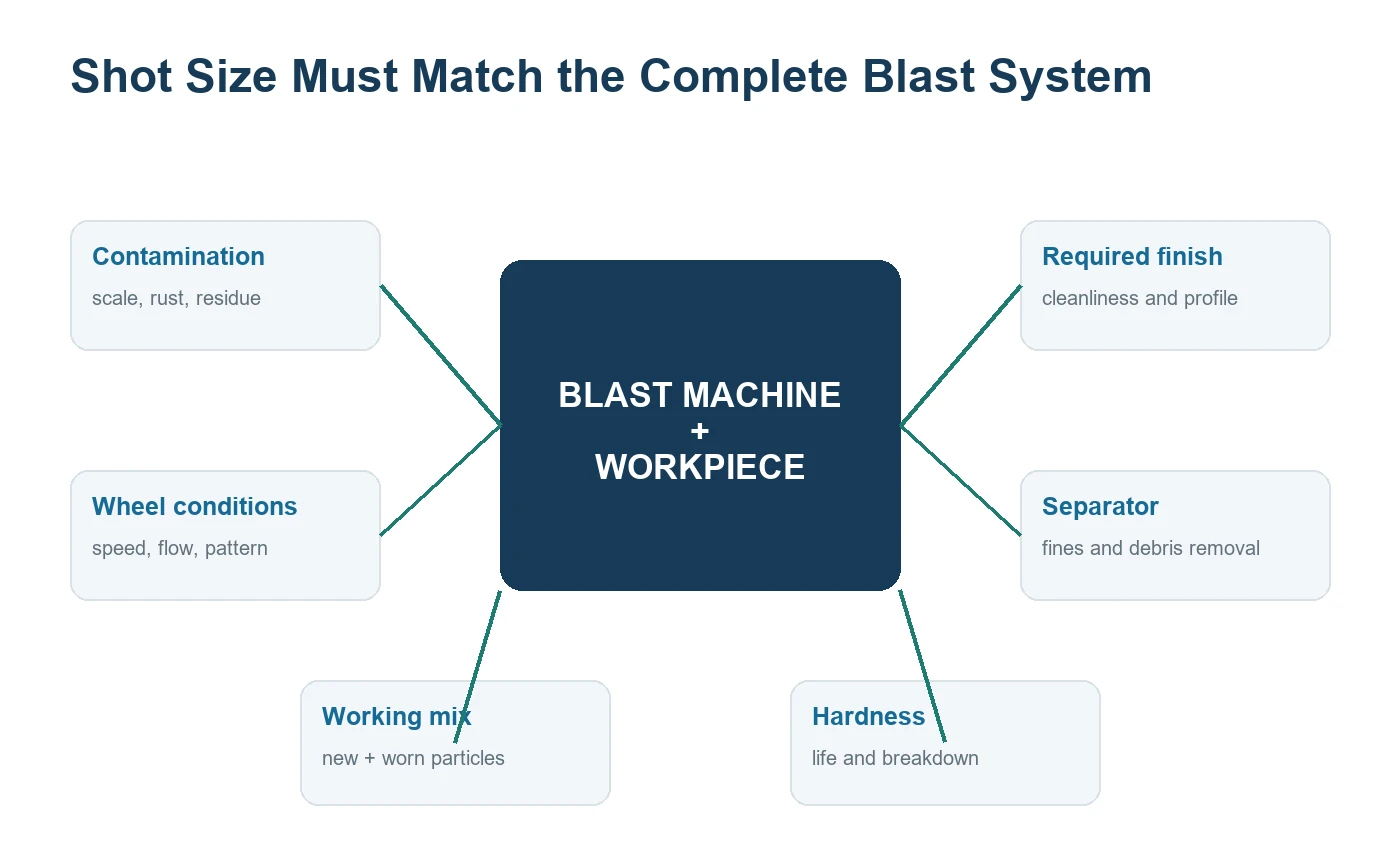
Particle size works as part of a system. Machine settings, hardness, recovery and the target surface all influence the final result.
Why the separator matters
The separator is not merely a housekeeping component. During repeated cycles, the working mix contains new shot, worn particles, smaller particles, broken abrasive, dust and debris. The separator should remove unwanted material while returning usable media to the blast stream.
If it is poorly adjusted, excessive fines may remain. Possible effects include slower cleaning, more dust, unstable appearance and higher consumption. A size that performs well in a properly maintained line can perform poorly when the separator cannot maintain the required mix.
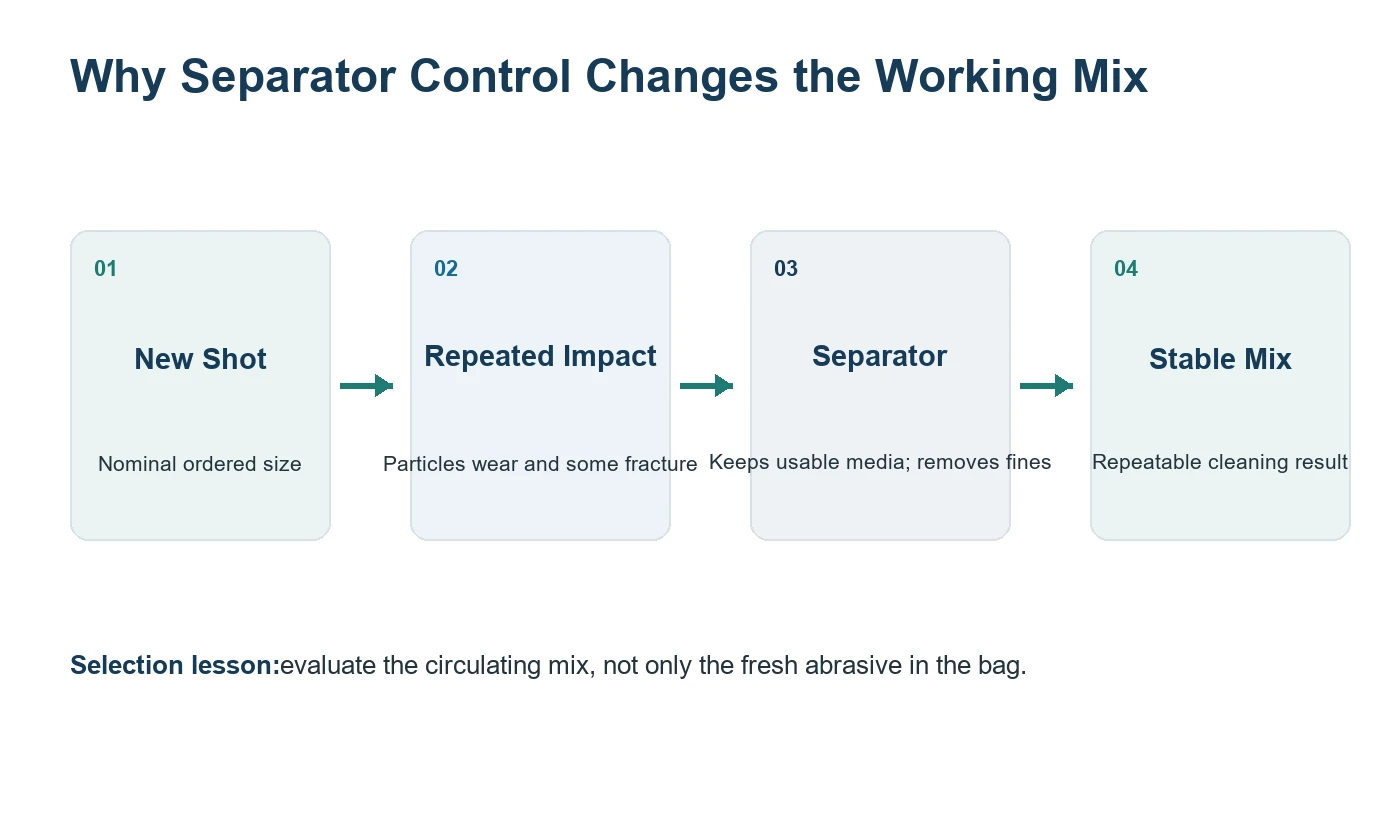
The machine operates with a circulating mix of new and worn particles, not indefinitely with identical fresh shot.
5. Evaluate Working Mix, Hardness and Real Operating Cost
Fine versus coarse: which is more economical?
The answer depends on how economy is measured. Larger particles can deliver greater impact per particle, but media consumption, surface acceptance, recycling behavior, dust, throughput and equipment wear also matter.
Fine shot may be preferable where contamination is light, detailed areas must be reached, a controlled finish is required or excessive impact should be avoided. Coarse shot may be preferable where the workpiece is large, scale is heavy and stronger impact is needed.
The useful purchasing metric is cost per accepted finished workpiece or cleaned area, not simply price per tonne. A slightly slower grade that remains stable in the machine may be more economical than a more aggressive option that increases breakdown, dust or equipment wear.
Why the working mix matters more than fresh abrasive alone
When a customer orders S330, the blast machine does not continue operating with only brand-new S330 particles. Repeated impacts cause wear and some fracture, creating a distribution of particle sizes. The buyer should ask both, "What size should I purchase?" and "What working mix should the line maintain?"
For a recirculating system, the second question may have more influence on daily repeatability. Record top-up rate, sieve distribution and separator rejects during the trial rather than evaluating only the fresh bag.
Size and hardness must be specified together
Two batches with the same nominal size can behave differently if hardness, density, heat treatment or internal condition differs. Harder media may retain impact behavior differently, while brittle particles can break down faster and increase fines.
The appropriate hardness depends on the workpiece, contamination, machine type, recycling conditions and desired media life. A useful order therefore states size, hardness, applicable size classification, inspection documents and packaging, rather than only "S330 steel shot." The current Promisteel product reference lists a common hardness range of 40-51 HRC, with final requirements subject to order confirmation.
6. Confirm the Choice With a Controlled Line Trial
A line trial is strongly recommended for a new production line, a supplier change, a new workpiece or a change in abrasive size. It is especially useful when cleaning targets are missed, consumption rises, the finish changes, a coating system changes or the machine has been modified.
Do not measure only initial cleaning speed. Hold unrelated variables as stable as practical and record the following:
Cleaning
- cycle time;
- cleanliness;
- remaining scale or residue.
Surface
- visual appearance;
- profile where applicable;
- consistency between parts.
Abrasive
- new-media top-up;
- breakdown and fines;
- working-mix distribution.
Machine
- dust level;
- separator performance;
- visible wear and operating current.
The best trial is not necessarily the one with the fastest first cleaning cycle. It is the one that produces the required result consistently at an acceptable total operating cost.
A simple steel shot size selection flow
- Identify the workpiece. Record material, dimensions, thickness and difficult geometry.
- Assess contamination. Classify the surface as lightly contaminated, moderately scaled or heavily contaminated.
- Define the finish. State cleaning, appearance, cleanliness and profile requirements.
- Check the machine. Review wheel, flow, recovery system, separator and current working mix.
- Select a practical size range. Narrow the choice to fine, intermediate or coarse grades.
- Run a controlled production trial. Compare accepted output, consumption, dust and machine behavior.
- Confirm the order specification. State size, hardness, inspection documents, packing and acceptance criteria.
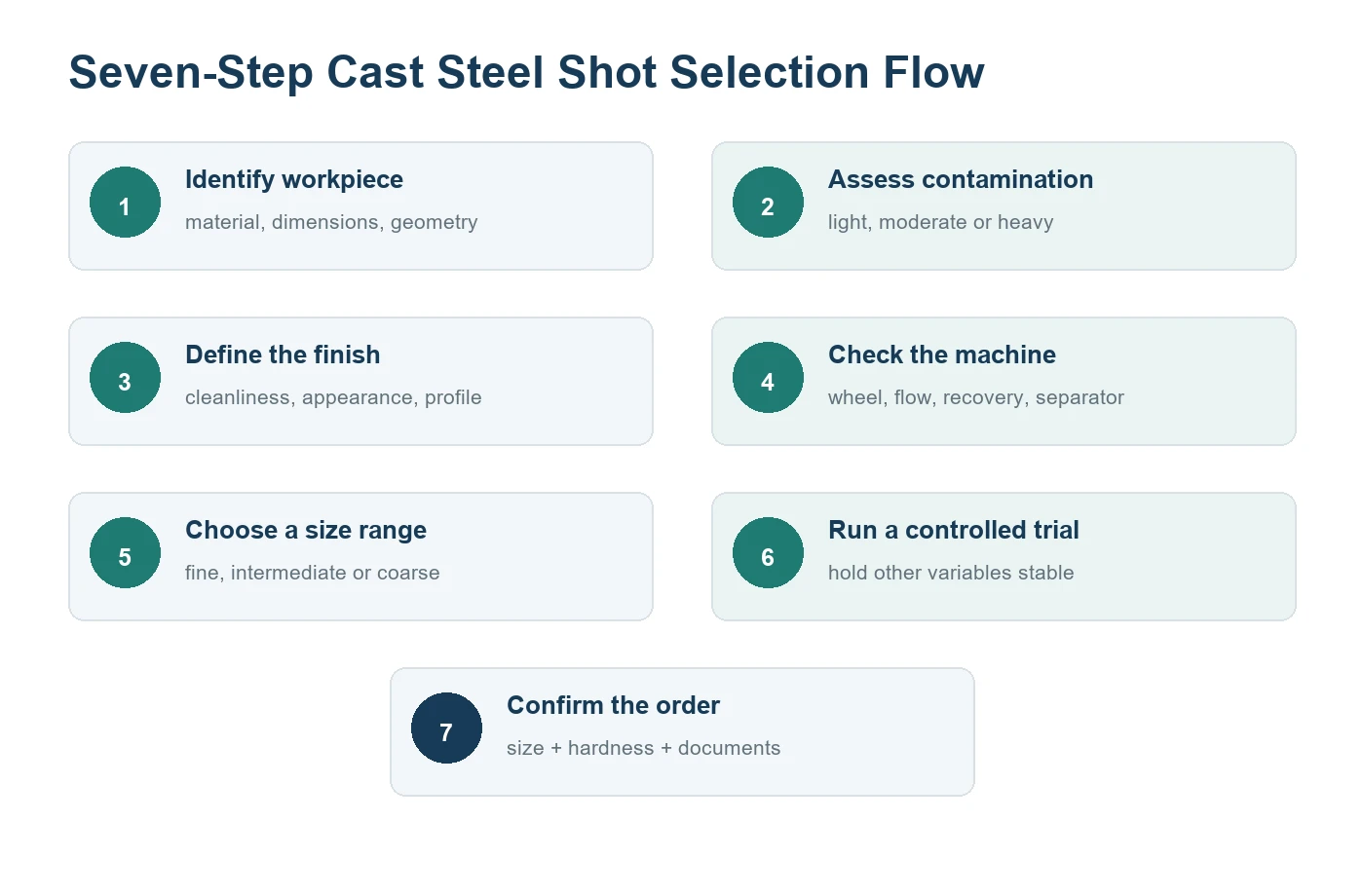
A documented trial turns a broad size range into a repeatable purchasing specification.
What Information Should You Give the Supplier?
Provide enough process information to receive an application-based recommendation rather than a generic product list:
- workpiece material, dimensions and representative photographs;
- surface condition and type or thickness of scale;
- required cleanliness, finish or profile;
- blast-machine type and wheel model if available;
- current size, hardness and monthly consumption;
- production capacity and cycle time;
- separator information and current reject condition;
- coating requirements where applicable;
- required COA, TDS, SDS or batch inspection evidence;
- packing, order quantity and destination port.
For broader procurement guidance covering shot and angular grit, continue to the cast steel shot and steel grit buyer's guide or review the complete
Steel Shot & Steel Grit category.
Common Mistakes When Selecting Cast Steel Shot Size
Choosing the largest size available
Bigger is not automatically better. Additional impact may provide little benefit when contamination is light or the workpiece has detailed geometry.
Copying another factory's specification
A grade that works in another plant may behave differently with another wheel, separator, workpiece mix or production target.
Ignoring the working mix
The fresh abrasive specification is only the starting point in a recirculating blast system.
Looking only at cleaning speed
A faster initial cycle may cost more if media top-up, dust, rejected parts or equipment wear increases.
Changing size without checking the separator
An unsuitable separator setting can undermine an otherwise reasonable abrasive selection.
Frequently Asked Questions
What is the best cast steel shot size for blast cleaning?
There is no universal best size. Choose a starting range from the workpiece, contamination, required finish, machine and working mix, then confirm the size and hardness through a controlled line trial.
Is larger steel shot more aggressive?
A larger particle normally has more mass and can deliver stronger individual impact. Actual cleaning also depends on hardness, wheel speed, abrasive flow, particle distribution and machine configuration.
Which steel shot size is commonly considered for structural steel?
Intermediate sizes such as S280-S330 are common starting points for many structural-steel wheel-blast applications. The final grade still depends on scale, section thickness, required profile, coating system and the machine.
Can a factory change directly from S230 to S330?
A controlled trial is preferable. The change can affect impact, working mix, abrasive flow, surface appearance, consumption and separator behavior.
Does shot size affect abrasive consumption?
Yes, but size alone does not determine consumption. Hardness, breakdown, machine efficiency, separator performance, dust extraction and operating conditions also contribute.
How do I know whether fine or coarse shot is appropriate?
Start with contamination and workpiece geometry. Fine shot is generally more relevant where controlled impact and access to smaller areas matter. Coarser shot becomes more relevant when substantial contamination must be removed from larger, robust workpieces.
Final Takeaway
Selecting cast steel shot size is a process decision, not simply a product decision. The appropriate grade connects the workpiece, contamination, required finish, blast machine, separator, working mix, hardness and production-trial evidence.
If one of these factors changes, the most practical abrasive specification may change as well. A capable supplier should discuss the line and acceptance target rather than only ask which S-number the buyer wants.
APPLICATION-BASED SELECTION
Request a Preliminary Steel Shot Size Review
Send Promisteel the workpiece photos, machine model, current media, contamination, required finish, monthly consumption, quantity and destination port. We can help define a practical trial range before regular-volume purchasing.
Send Your Blast-Line Details


