
 Español
 Türkçe
 Français
 عربي
عربي  dansk
dansk 한국어
한국어 Deutsch
 Việt Nam
 Italiano
 日本語
日本語 Português

Round steel shot is a reusable, predominantly spherical metallic abrasive used for impact-led cleaning in wheel-blast and selected air-blast systems. It commonly suits foundry castings, forged parts, structural steel and automotive components where repeatable cleaning and a relatively uniform finish matter. When the process needs stronger cutting action or a deeper anchor profile, angular steel grit is usually the more relevant starting point.
Contents
In continuous blasting operations, the abrasive does more than strike the workpiece once. Each grain is accelerated, impacts the surface, rebounds, passes through the recovery and separation system, and returns to the blast cycle if it remains serviceable. This repeated loop explains why cast steel shot is a practical option for many closed-loop wheel-blast lines.
It is not the right answer for every job. Abrasive selection should begin with the contamination, required cleanliness or profile, downstream process and equipment configuration - not with media price or a familiar grade label alone.
Why Is Round Steel Shot Widely Used in Wheel-Blast Operations?
Cast steel shot is made by atomizing molten steel into droplets, followed by heat treatment and conditioning to achieve the specified size distribution, hardness and internal condition. The particles are predominantly spherical or rounded, so they transfer energy mainly through repeated impact rather than the cutting action produced by sharp-edged grit.
SAE J444 provides a size-classification framework for cast shot and grit, while SAE J827 addresses high-carbon cast steel shot used for peening and blast cleaning. The grade designation is only part of the purchase specification: buyers should also confirm sieve distribution, hardness, density, particle condition, batch documents and intended process.
Review Promisteel's cast steel shot specification and size range when preparing an RFQ.
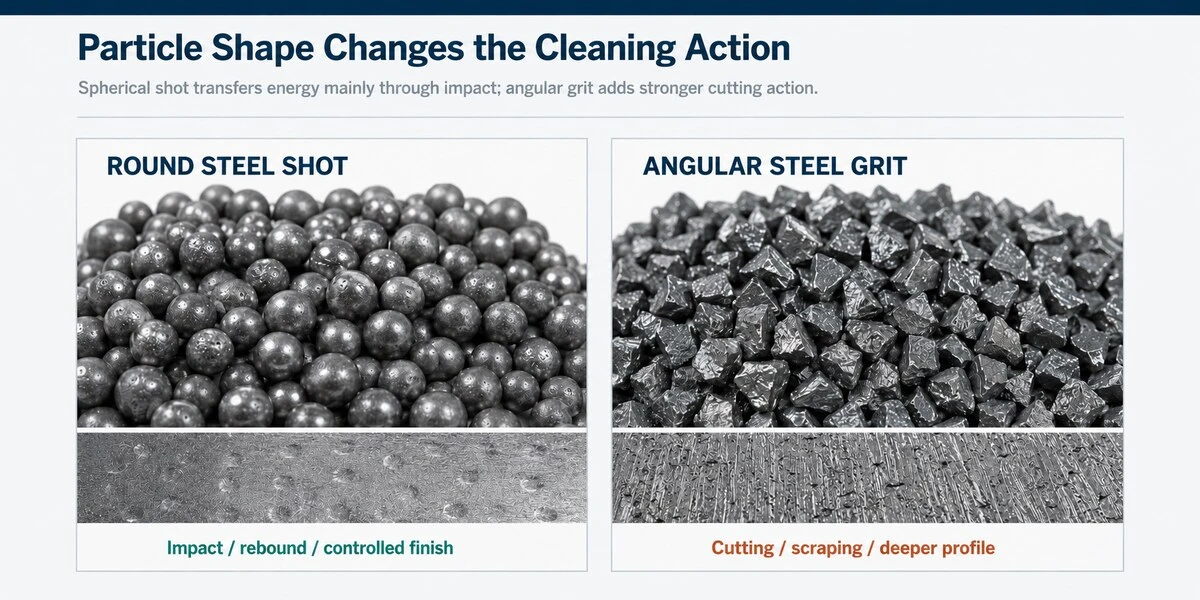
Spherical shot emphasizes impact and rebound; angular grit adds scraping and cutting action.
How Does Spherical Steel Shot Clean Metal Surfaces?
Rotating blast wheels accelerate a controlled flow of abrasive toward the workpiece. Repeated impacts loosen contaminants and dislodge material that is less strongly attached to the base metal. Depending on the grade, machine settings and workpiece, round shot may be evaluated for:
- molding sand and residue on foundry castings;
- heat-treatment oxidation and mill scale;
- surface rust and general contamination;
- controlled cleaning before machining, coating or assembly;
- surface conditioning where excessive cutting of the base metal is undesirable.
The result depends on more than particle shape. Shot size, hardness, abrasive flow rate, wheel speed, blast angle, exposure time, workpiece geometry and the condition of the circulating media all influence cleaning rate and surface appearance.
What Benefits Do Spherical Abrasive Grains Offer?
Repeatable impact behavior. Round particles generally produce a more even impact pattern than angular media when machine conditions are stable.
Compatibility with recovery systems. In a suitable wheel-blast line, serviceable media can be separated and returned to the process many times.
Controlled surface treatment. Shot can support cleaning and finishing where a comparatively uniform surface is preferred over an aggressively cut profile.
Measurable operating economics. Users can track top-up rate, accepted output, dust and equipment wear to compare grades by cost per accepted part rather than unit price alone.
Technical boundary
Industrial blast cleaning and fatigue-critical shot peening are not interchangeable specifications. Do not assume a general cleaning grade is automatically suitable for a controlled peening process. Critical work may require separate media requirements, intensity and coverage verification, machine controls and an approved procedure.
Why Is the Steel Shot Working Mix So Important?
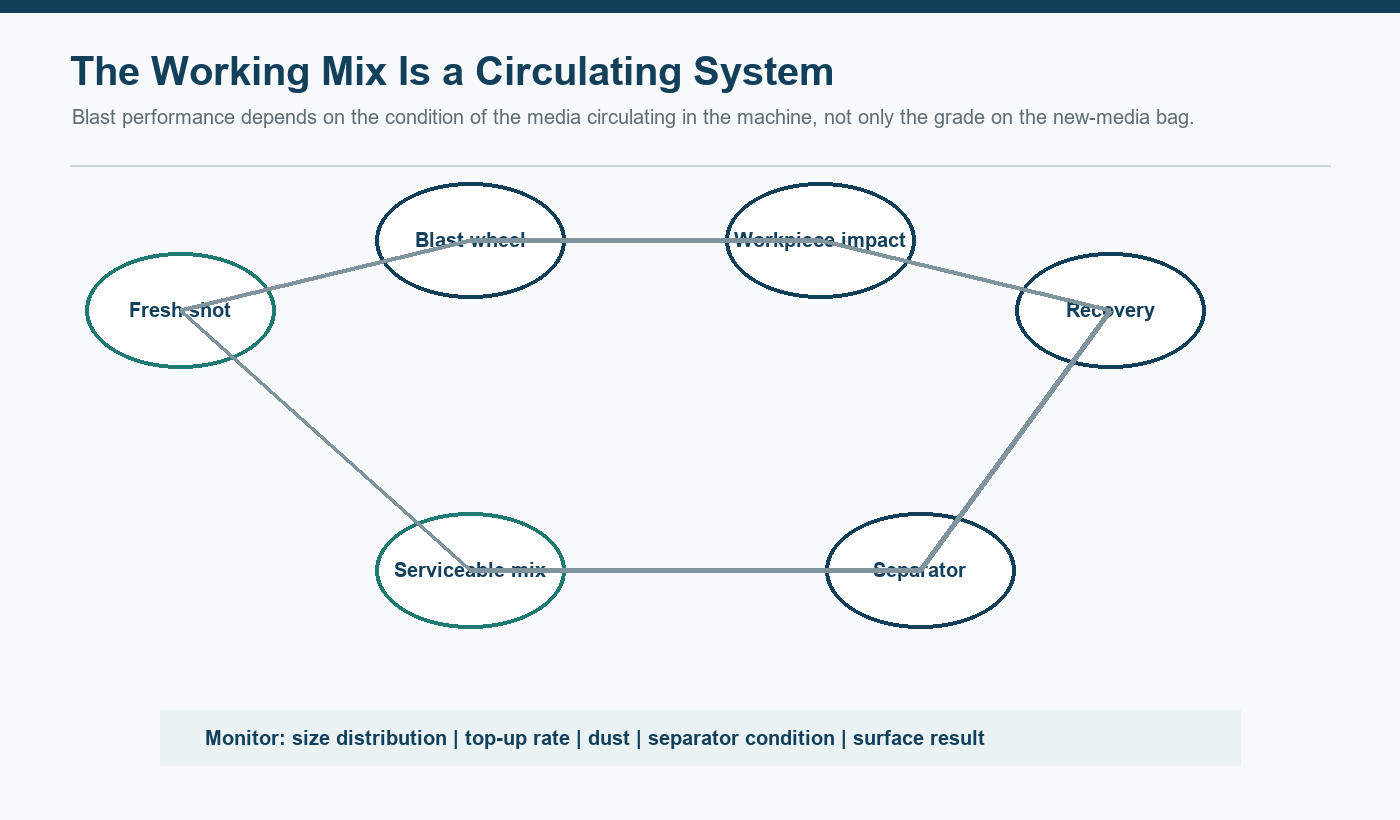
The operating mix contains fresh media, worn serviceable particles, and material moving through recovery and separation.
A wheel-blast machine does not normally operate on 100 percent new shot after start-up. Some grains remain close to their incoming condition, others become smaller through repeated impacts, and unusable fines are removed by the separator and dust-control system. The circulating blend is the working mix.
A stable working mix helps support repeatable cleaning throughput, surface appearance, and abrasive consumption. Too many fines can reduce impact energy and extend cycle time. Adding excessive fresh coarse media without considering the existing mix can also disturb the balance. Operators should therefore monitor:
- particle-size distribution in the circulating media;
- fresh-media top-up per hour or production batch;
- separator setting and removal of fines;
- dust generation and rejected material;
- surface cleanliness, roughness and accepted output.
Which Industrial Applications Commonly Use Round Steel Shot?
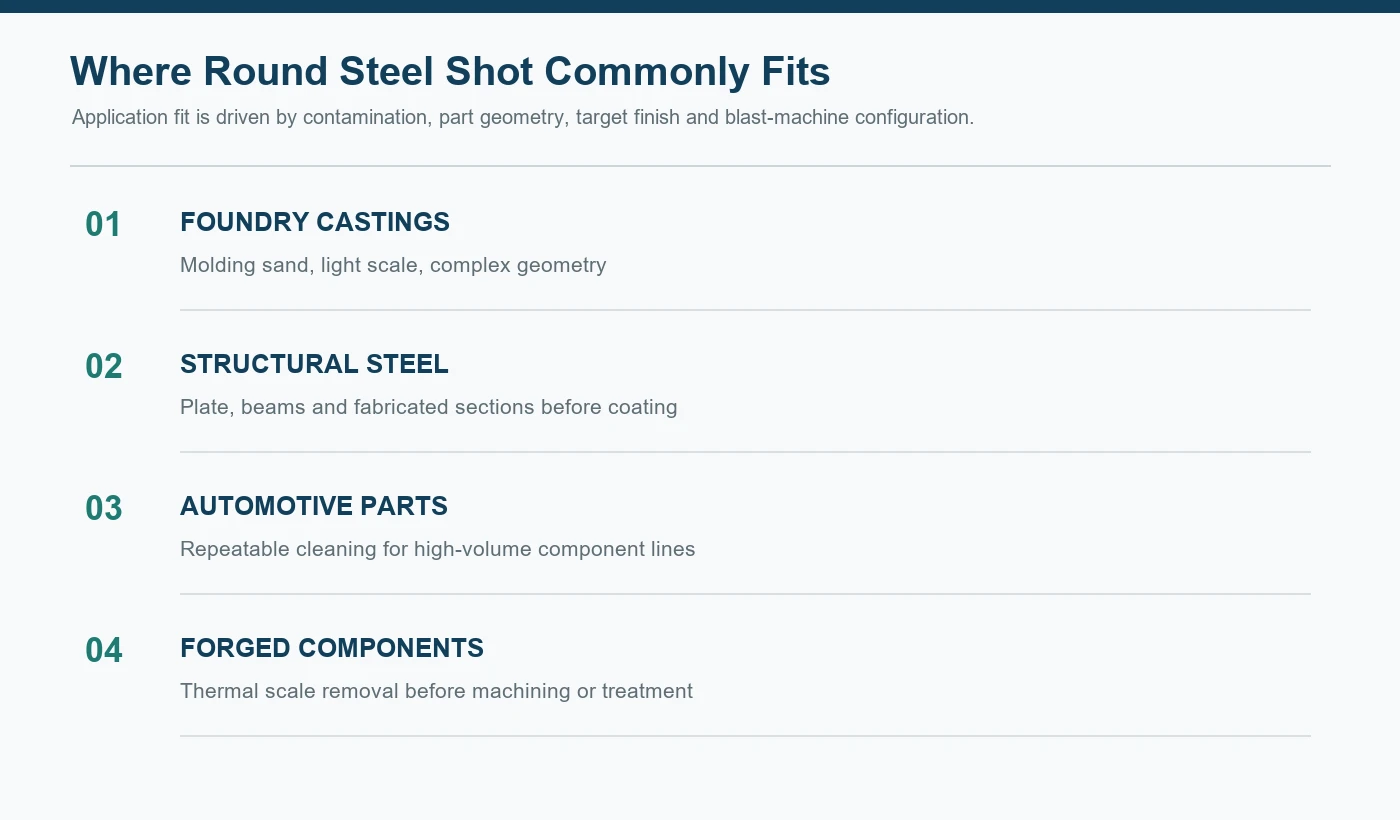
Typical application groups; final media selection remains process-specific.
Foundry Castings
Foundries use steel shot to remove molding sand, oxidation and general residue from cast components. Complex geometry, thin features and recesses affect the suitable particle size. The objective is consistent cleaning without unnecessary erosion or damage to part details.
Steel Plate and Structural Components
Plate, beams, profiles and fabricated sections are often blast cleaned before coating or further fabrication. Selection should consider scale or rust severity, base-metal thickness, target production rate, wheel layout and the required surface condition. There is no single universal shot size for all structural steel.
Automotive Components
High-volume component lines need repeatability. The abrasive should fit the machine's recovery loop and reach recesses, edges and holes without producing unacceptable variation. Any peening requirement must be specified separately from ordinary cleaning.
Forged Parts
Forgings may carry thermal scale that must be removed before machining or another surface-treatment step. Round shot can provide controlled cleaning in automated lines where stable recovery and predictable finish are important.
What Are the Limitations of Round Steel Shot?
The spherical shape that supports impact-led cleaning also limits cutting ability. Round shot may be inefficient where the process must remove multiple layers of aged coating, compacted heavy rust, or stubborn scale while developing a pronounced anchor profile. Angular media is commonly evaluated for those duties.
Cast steel grit is produced by crushing heat-treated shot into angular particles. Its edges provide stronger cutting action, but grade, hardness and the evolving working mix still need to be matched to the equipment and target profile. See the cast steel grit product specification for the available reference range.
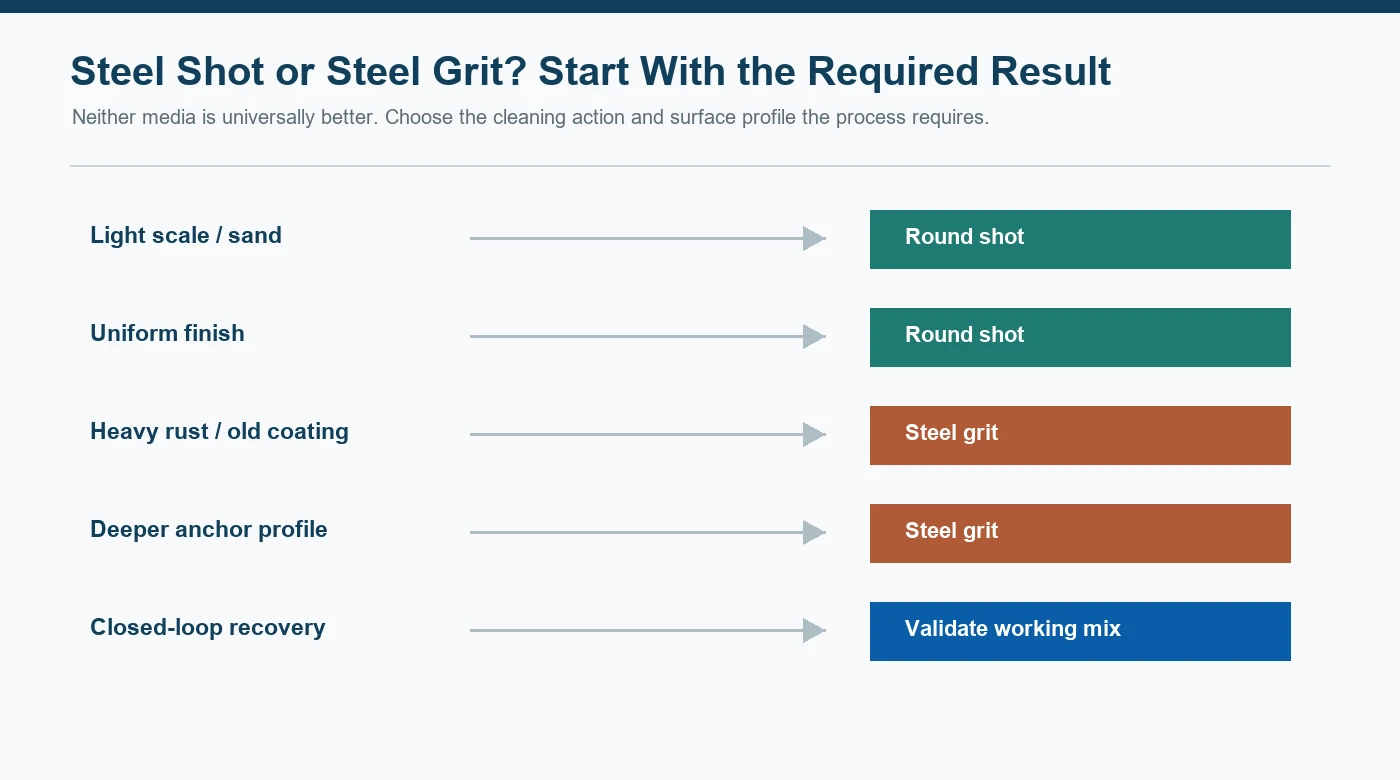
Start with the required cleaning action and surface result, then validate the selected media on the production line.
Round Steel Shot vs. Angular Steel Grit
| Decision factor | Round steel shot | Angular steel grit |
|---|---|---|
| Particle geometry | Spherical or rounded | Angular, crushed particles |
| Primary action | Impact and rebound | Cutting and scraping |
| Typical surface tendency | More uniform, controlled finish | Rougher profile where specified |
| Common contamination | Sand, light-to-moderate scale, general cleaning | Heavy rust, compact scale and aged coatings |
| Common process fit | Foundries, forgings, structural and automotive components | Heavy descaling and coating-preparation work |
| Final selection | Confirm machine fit, working mix, target surface result and trial data. | |
For a deeper technical comparison, read how steel shot and steel grit differ in blast cleaning.
Does Round Steel Shot Perform Better in Wheel-Blast Systems?
Round shot is widely used in wheel-blast systems because these machines accelerate high abrasive volumes and continuously recover serviceable media. Durability, predictable flow and working-mix stability are therefore important. However, installing a wheel-blast machine does not automatically make shot the only acceptable abrasive; angular grit may also be used when the equipment and process require stronger cutting or profile development.
Can Round Steel Shot Be Used in Air-Blast Equipment?
Selected air-blast systems can use steel shot for localized or complex work. Air-blast equipment uses compressed air to propel media through a nozzle and may suit weld-seam cleaning, repair work, irregular components or smaller production batches. Equipment compatibility, nozzle system, recovery method and safety controls must be confirmed before use.
How Should Buyers Select the Correct Round Steel Shot Grade?
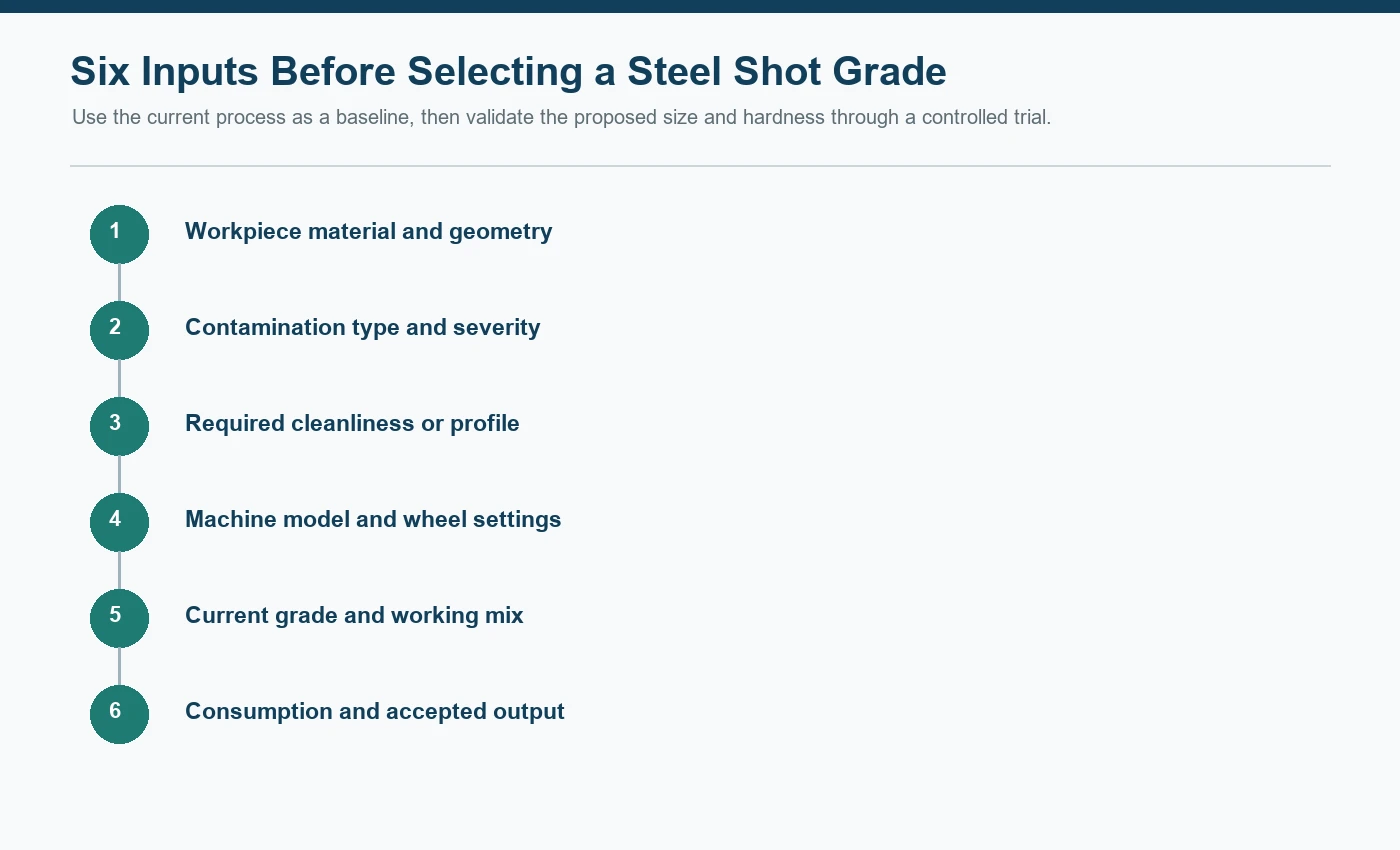
Six inputs establish a useful starting specification before a controlled line trial.
- Define the workpiece. State material, dimensions, wall thickness, geometry and sensitive features.
- Describe the contamination. Identify molding sand, oxidation, scale, rust or coating and estimate severity.
- Set the required result. Confirm cleanliness, roughness, appearance and the downstream coating or machining requirement.
- Document the equipment. Provide machine model, wheel arrangement, operating settings, abrasive flow and separator condition.
- Record the current baseline. Note the current media size, hardness, working mix, cycle time and accepted surface result.
- Measure operating cost. Track monthly consumption, top-up rate, dust, output, downtime and wear.
The wider steel shot and steel grit buyer's guide explains how size, hardness, quality documents and packaging fit into the purchasing decision.
Why Should Buyers Run an On-Site Production Trial?
A trial is especially valuable when changing particle size, hardness, supplier, machine, workpiece material, or downstream coating system. Visual inspection of new media and quoted price are not enough to predict in-service behavior.
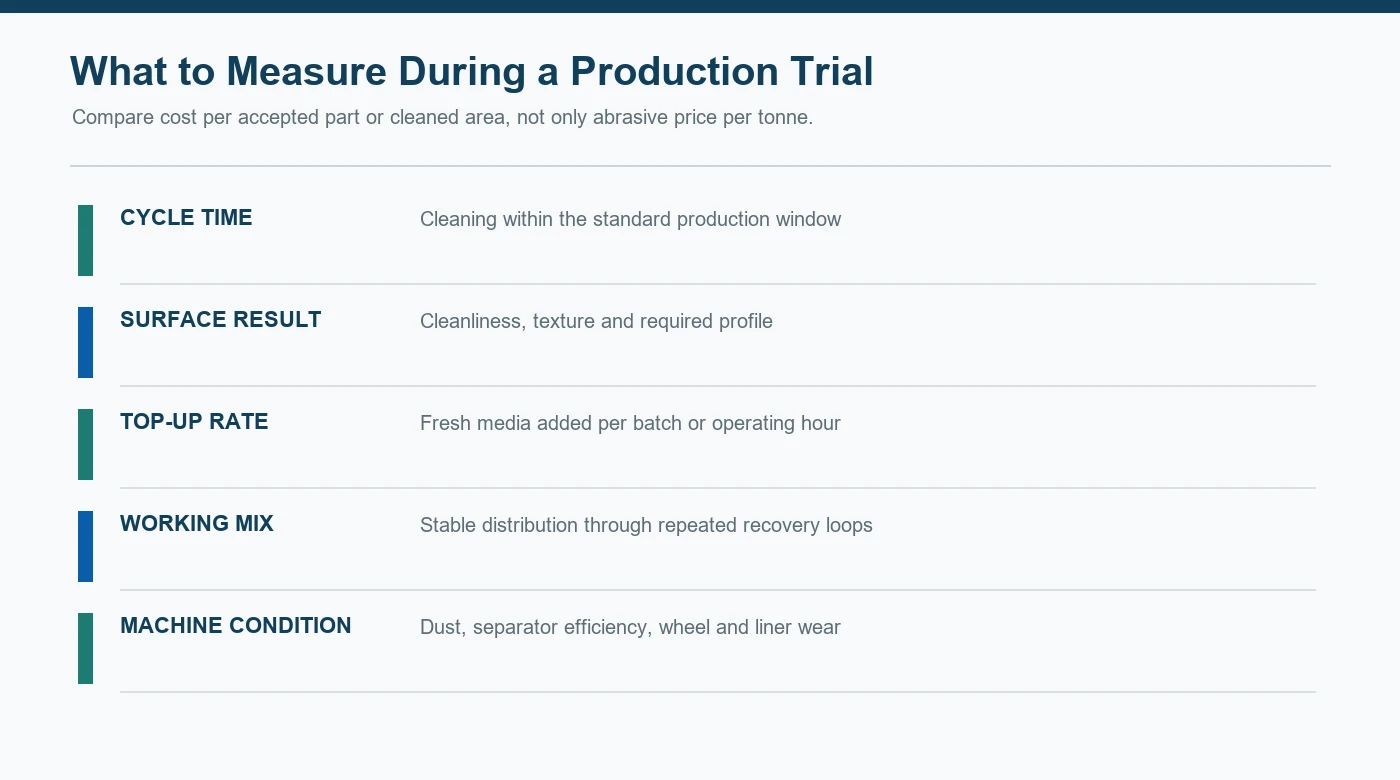
Hold relevant machine variables stable and record measurable results throughout the comparison.
Compare candidates using cycle time, achieved cleanliness or profile, fresh-media top-up, dust, fines, working-mix stability, machine current and wear observations. A media grade that cleans slightly more slowly may still deliver lower total cost if it reduces consumption, rejected work or maintenance.
Two Different Application Decisions
Automated foundry line: Cast parts carry molding sand and light thermal scale. The priorities are stable throughput, repeatable cleaning, controlled consumption and efficient recovery. Round steel shot is a logical baseline for evaluation.
Bridge maintenance and recoating: Steel carries heavy marine rust and several layers of degraded paint, and the new coating requires a defined anchor profile. Angular steel grit is generally the more relevant starting medium.
Is Round Steel Shot Always the Most Cost-Effective Option?
No. Purchase price per tonne is only one part of total blasting cost. A practical comparison should include abrasive consumption, labor, cycle time, rejected parts, dust handling, machine-component wear, downtime, and waste disposal. The useful metric is cost per accepted cleaned part or treated area.
What Should Buyers Confirm With a Round Steel Shot Supplier?
Do not limit the RFQ to a product name and price. Confirm the information needed to compare suppliers and release a production lot:
- SAE size designation and agreed sieve distribution;
- hardness range and test method;
- chemical composition, density and particle-condition requirements;
- microstructure or internal-condition evidence where specified;
- COA, TDS, SDS and batch traceability requirements;
- packaging, pallet weight, marking and shipment quantity;
- sample availability and production-trial support.
A useful supplier brief might state: "Our wheel-blast line cleans carbon-steel castings. We currently use S330, but monthly top-up has increased. We can provide machine settings, separator details, workpiece photographs and trial acceptance criteria."
Pre-Production Selection Checklist
- Workpiece material, dimensions and geometry recorded
- Contamination type and severity documented
- Required cleanliness, roughness or finish defined
- Blast-machine model and operating baseline confirmed
- Current grade, hardness and working mix reviewed
- Separator efficiency and dust control checked
- Monthly consumption and accepted output measured
- Trial method, acceptance criteria and batch documents agreed
When Is Round Steel Shot the Right Baseline Abrasive?
Round steel shot is a strong baseline where the process needs impact-led cleaning, repeatable recovery and a controlled surface result. Common examples include foundry cleaning, steel descaling, forged-part treatment, automotive component processing and automated continuous blast lines.
Its strengths do not make it universal. If the priority is aggressive coating removal or a pronounced anchor profile, angular grit may be more efficient. The correct media aligns with the workpiece, contamination, machine, working mix and required surface standard - and is confirmed through a measured production trial.
FAQ: Round Steel Shot for Wheel Blasting
What is round steel shot used for?
It is used for impact-led cleaning, descaling and surface conditioning of castings, forgings, steel plate, structural components and automotive parts in suitable wheel-blast and selected air-blast systems.
What is the main difference between steel shot and steel grit?
Steel shot is spherical or rounded and cleans mainly by repeated impact. Steel grit has angular edges and provides stronger cutting action, making it more relevant to heavy rust, aged coatings and controlled profile development.
Is round steel shot suitable for wheel-blast machines?
Yes, it is commonly used in wheel-blast equipment with media recovery. The final grade must still fit the machine, separator, workpiece and required surface result.
How should buyers choose a steel shot grade?
Use the workpiece, contamination, required finish, machine configuration, current working mix and measured consumption to establish a starting specification, then confirm it through a controlled trial.
Is the cheapest steel shot always the lowest-cost option?
No. Total operating cost includes consumption, cycle time, labor, dust handling, rejected work, machine wear and downtime. Compare cost per accepted part or cleaned area.
Need Help Matching Shot Size, Hardness and Working Mix?
Send the workpiece, contamination, machine model, current media, target surface result, and monthly consumption. Promisteel can review the starting specification and trial information required for a useful comparison.
Request a Technical ReviewView Steel Shot & Steel Grit


