
 Español
 Türkçe
 Français
 عربي
 dansk
 한국어
 Deutsch
 Việt Nam
 Italiano
 日本語
 Português


QUICK ANSWER
Cast steel grit is a crushed, angular metallic abrasive. Its edges concentrate impact into small contact areas, creating stronger cutting action than spherical steel shot. It is commonly used for heavy scale, rust, old coating removal, and controlled anchor-profile development, depending on grit size, hardness, machine settings, and coating requirements.
Most people sum up the difference between steel shot and steel grit in one simple line: shot comes spherical, while grit has sharp, angular grains.
That statement is factually correct, yet it fails to show procurement and production teams what actually shifts on real-world blast production lines. Particle geometry influences how each abrasive strikes metal surfaces, how rapidly rust or mill scale gets stripped away, how deep your anchor profile forms, how fast media wears down, and how your circulating working mix evolves over repeated blast cycles.
For jobs with heavy surface contamination or projects calling for a distinct, textured anchor profile, cast steel grit can turn into a very practical option. Even so, it is not always the superior pick. Your final selection hinges on workpiece material, contamination severity, blast equipment setup, target surface finish, and how well your system recycles used abrasive grains.
This article breaks down what cast steel grit is, why its angular grain geometry makes such a difference, and key points buyers need to verify before locking in purchase orders. For broader sourcing and export support, visit the Promisteel homepage.
What Is Cast Steel Grit?

Cast steel grit falls into the metallic abrasive family and gets manufactured from cast-steel raw stock. Producers take cast-steel abrasive particles and crush them down to generate irregular, angular fragments.
Unlike steel shot, which is intentionally formed into smooth spherical beads, steel grit features uneven corners and sharp cutting edges. This geometric distinction drives completely different interactions between abrasive and your workpiece.
Steel shot delivers cleaning power mainly through impact and peening effects. When round shot hits a surface, most kinetic energy transfers via blunt collision instead of sharp slicing.
Steel grit operates differently. Its jagged edges strike, scrape and abrade metal surfaces with stronger cutting action. This trait makes it ideal for tackling stubborn mill scale, deep-seated rust, aged paint layers, casting leftover residue and other contaminants that resist mild impact-only blasting.
Both cast steel shot and grit are mainstream metallic blasting abrasives used across industrial surface-prep work, and particle shape stands out as one of their most critical distinctions. Purchasing teams should never treat steel grit as just another variant of steel shot. It functions as a separate blasting tool that creates unique surface outcomes.
How Is Cast Steel Grit Manufactured?
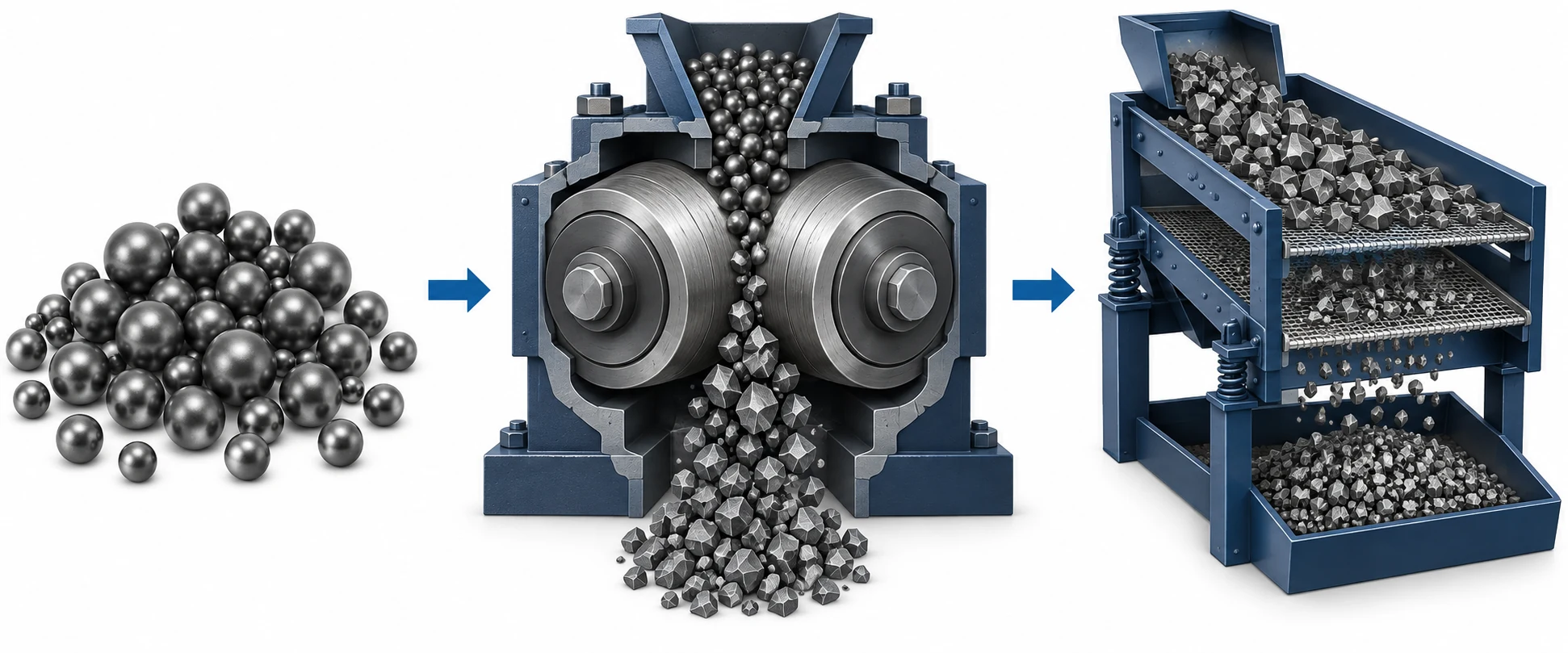
Understanding its production workflow helps explain why grit particles end up with angular geometry.
Manufacturers first produce cast-steel abrasive through controlled steel melting and casting workflows. Once the material solidifies, operators process it to reach target particle dimensions.
For grit production, this base material goes through crushing operations that break apart spherical grains, eliminating the smooth round form typical for steel shot. Output particles come out with defined corners, sharp edges, and irregular outer surfaces.
Individual grit grains do not all look identical. Some carry very sharp cutting edges straight out of production, while others lose part of their aggressiveness after going through repeated impact cycles. This is one key reason brand-new abrasive and well-worn circulating working mix will not deliver identical blasting performance.
Inside running blast equipment, media keeps recirculating continuously. Some grains stay large and retain strong cutting capability, while others gradually fracture into smaller pieces and fine dust particles.
Blasting performance therefore depends not only on specs printed for unused grit, but also on how those grains degrade after hours of continuous production operation.
Why Does Steel Grit's Angular Geometry Create Cutting Power?
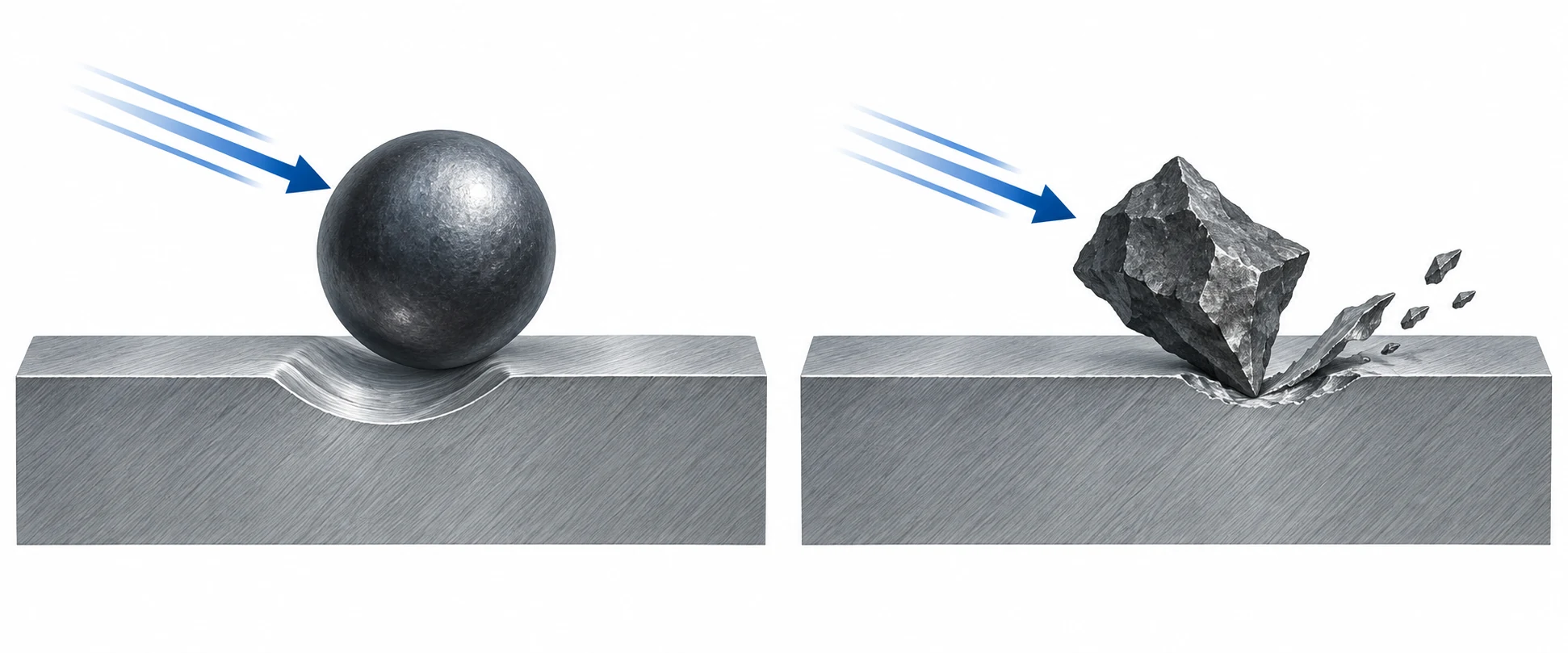
That jagged particle form gives steel grit most of its aggressive stripping capability. Let's imagine two grains hitting a steel plate travelling at matching velocity.
A spherical steel shot touches the workpiece across a rounded contact zone. Energy is released through impact force, and the bead bounces off afterward.
By contrast, angular grit makes contact through sharp corners or edges. This geometry squeezes kinetic energy into a tiny contact spot. Instead of just striking the metal surface, each grit fragment acts like thousands of miniature cutting blades.
This effect can be useful when contaminants stick firmly onto base steel. Heavy compacted mill scale, for example, may respond less effectively to mild impact-based cleaning. Aggressive angular grit can shear and lift those tough deposits much more efficiently. The same logic holds for rust buildup, old coating layers, and casting residuals.
There are unavoidable trade-offs, however. That powerful cutting action will also act on your base workpiece material. If you are blasting thin sheets, soft alloys, delicate components, or parts requiring highly controlled surface texture, excessive cutting force can yield unwanted surface damage.
That explains why abrasive selection should start from your target surface condition, rather than simply ordering the most aggressive grit grade your supplier offers.
How Angular Grain Shape Changes Blasting Behaviour
To grasp steel grit's real-world performance, keep the contrast between impact-based blasting and cutting abrasion front of mind.
Steel shot relies on repeated blunt impacts. Steel grit adds heavy scraping and cutting forces into the process chain, which influences multiple core operational aspects:
Cleaning speed: Angular grit shines when contaminants bond tightly to substrate surfaces. Its sharp edges chip away at deposits instead of only relying on repeated collisions.
Surface anchor profile: As grit abrades tiny amounts of base material, it carves micro peaks and valleys, building a well-defined anchor profile ideal for subsequent coating adhesion.
Media degradation: After countless impacts, angular grit grains gradually lose sharpness. Some particles fracture and split into smaller fragments.
Dust and fine particle buildup: As grains keep wearing down, fines content inside your blast system rises. That makes separator and air-wash unit performance absolutely critical for stable operation.
Working mix characteristics: Circulating abrasive inside production machinery never matches brand-new material from shipping bags. Fresh sharp grit, partially worn grains, and fine debris all circulate together. For production engineers, analyzing this working mix often carries higher priority than inspecting handfuls of unused abrasive samples.
What Contaminants Can Cast Steel Grit Remove?
Operators turn to cast steel grit for jobs calling for forceful mechanical surface treatment. Common real-world applications cover:
- Stripping heavy mill scale layers
- Removing light-to-severe rust corrosion
- Taking off aged, multi-layer protective coatings
- Clearing casting sand and baked-on residuals
- Surface profiling work ahead of coating application
- Blast-cleaning fabricated steel assemblies
- Pre-treatment for large-scale heavy steel structures
- Surface preparation for cast metal components
Final results never hinge solely on grit particle size. Wheel rotational speed, blast angle, component exposure duration, abrasive feed volume, base workpiece condition, separator efficiency and circulating working mix all shape end quality. That is why a grit grade delivering excellent results for one manufacturing plant may underperform completely under another site's operating parameters.
How Steel Grit Generates Anchor Profiles

For most coating projects, removing surface dirt and rust is only half the assignment. Parts also need controlled micro-texture so paint or protective coating can mechanically lock onto metal substrates. Industry professionals refer to this texture as anchor profile or surface profile. For coating-focused selection, see the cast steel shot for surface preparation guide.
Thanks to its angular grains, steel grit builds far more prominent mechanical surface texture than purely impact-driven spherical abrasives. Still, deeper anchor profiles are not always preferable.
Coating technical datasheets define explicit target surface texture ranges. If anchor profile sits too shallow, coating adhesion may be reduced. If profile depth becomes excessive, you will consume extra coating material, and finished surfaces may fail project specification requirements.
Abrasive selection must align directly with coating system requirements. Before you launch full-scale blasting work, confirm required cleanliness grades and anchor profile targets either from coating manufacturers or official project documents. Your abrasive vendor should build recommendations around those defined targets, rather than automatically suggesting the coarsest available grit variant. Review common grade and packing information on the cast steel grit product page.
Does Higher Cutting Aggressiveness Always Equal Better Cleaning Outcomes?
Definitely not. This ranks among the most critical points for every team purchasing steel grit.
Buyers frequently fall into the trap: assuming larger or harder grit always delivers faster cleaning. Actual production scenarios are far less straightforward.
Take one scenario: steel parts covered in thick compacted mill scale running on high-throughput lines. A well-matched angular grit grade can significantly shorten blast cycle times.
Switch to another scenario: parts already relatively clean, with coating specs demanding a carefully limited anchor profile. Deploying overly aggressive grit will erode base workpiece material without bringing any tangible production benefit.
Your priority should be building a stable, repeatable blasting workflow, not chasing maximum possible cutting intensity.
A properly designed production trial needs to answer practical on-site questions:
- How long must components stay within the blast chamber?
- What volume of fresh abrasive gets consumed per batch?
- Can we hit specified cleanliness standards reliably?
- What anchor profile depth is generated on finished parts?
- How much dust and fine waste accumulates during runs?
- Does the circulating working mix stay stable over time?
- Can results remain consistent across successive production batches?
Collecting these practical metrics delivers far more value than vague assessments about whether a grit grade feels "powerful".
Steel Grit vs Steel Shot: When Does This Distinction Matter Most?

Choosing between steel shot and grit mostly comes down to what type of surface interaction your process demands. For a focused comparison of impact cleaning and angular cutting, read steel shot vs steel grit.
Steel shot features spherical grains. Teams pick it for gentle impact treatment, excellent recycling potential, and moderately controlled surface finishing.
Steel grit uses angular fragments. It gets selected when powerful cutting action, heavy-duty contaminant removal, or defined anchor-profile generation are top priorities.
Quick practical comparison reference:
Steel Shot
- Shape: Smooth spherical beads
- Core working mechanism: Impact collision
- Key strengths: Consistent repeated impact performance, good recyclability in suitable closed-loop systems
- Typical use cases: General blast cleaning, mill-scale removal, jobs requiring mild, non-aggressive surface texture
Steel Grit
- Shape: Jagged angular fragments
- Core working mechanism: Combined cutting, scraping plus impact
- Key strengths: Heavy-duty stripping, building distinct anchor profiles
- Typical use cases: Heavy rust removal, aged coating stripping, casting residue cleanup, demanding coating pre-treatment
This table serves only as a starting reference. Real-world machine setup and workpiece geometry can shift expected outcomes. For instance, wheel-blast equipment accelerates abrasive particles in ways air-blast cabinets do not. Identical grit grade will show different behaviour under differing operating conditions.
What Role Do Grit Size and Hardness Play?
Particle shape draws most of people's attention, yet grit size and hardness represent equally critical process variables.
Grit particle size determines how much surface area each grain can act upon and how forceful individual cutting points become. Coarser grit works well for rapidly breaking down thick, stubborn contamination layers. Finer grit fits scenarios needing milder, controlled surface treatment or parts with complex geometry that cannot accommodate large abrasive grains.
Hardness governs particle durability and how grit degrades with repeated impacts. Harder grit retains sharp cutting edges longer, though this trait does not guarantee the lowest overall operating cost.
If your abrasive hardness is mismatched for your workpiece or blast operating parameters, you will see abnormal particle fracture rates, excess fine dust output, and overly aggressive substrate erosion. Hardness should be defined as part of your complete abrasive specification, instead of treated as a standalone marketing selling point.
When placing orders, confirm agreed hardness ranges and official test methodologies with suppliers. Where hardness performance is critical for your workflow, request certificates of analysis so incoming batches can be verified against agreed technical requirements. The cast steel shot and steel grit buyer's guide lists useful specification and supplier-document checkpoints.
Can Steel Grit Be Recycled for Multiple Runs?
Yes. One major advantage of metallic blasting abrasives lies in their compatibility with recovery and separation systems for repeated circulation.
Reusability does not mean individual grit grains stay usable inside the machine forever. During blasting cycles, grit particles undergo continuous changes:
- Sharp cutting edges gradually wear down and turn blunter
- Some grains fracture and split into smaller fragments
- Fine debris and dust keep accumulating within the system
Separator and air-wash units filter out part of this unwanted waste material, while operators top up fresh grit to keep the working mix balanced.
Poorly calibrated separation equipment destabilizes your whole abrasive loop. Too many leftover fines suppress cleaning efficiency and push up dust levels. On the other hand, if functional usable grit gets discarded along with waste streams, your abrasive consumption figures will spike unnecessarily.
Maintaining a stable working mix depends equally on quality incoming abrasive and proper day-to-day machine maintenance.
Compatible Equipment Options for Steel Grit
Steel grit works across multiple industrial blasting platforms, yet equipment configuration directly shapes final performance.
Wheel-blast machines dominate automated mass-production lines. Parts travel through enclosed blast chambers; abrasive gets mechanically accelerated and automatically recirculated.
Air-blast systems rely on compressed air to propel abrasive. They offer superior flexibility for complex geometries, localized spot repair work, and areas hard to reach via fixed wheel-blast patterns.
Whichever system you use, reliable abrasive recovery infrastructure is important. Screens, separators, and air-wash assemblies must be properly sized for your selected grit media. Picking abrasive without factoring in recovery hardware can lead to disappointing production results.
How to Select Suitable Steel Grit for New Workflows
No single grit size-hardness combination works universally for every blasting task. Use these six practical questions to guide your selection process:
- Understand your workpiece: Clarify base material, part thickness, geometric complexity, and whether components are sensitive to aggressive surface attack.
- Define what needs removing: Rust, thick mill scale, old paint layers, and casting residues do not all demand identical blasting parameters.
- Set clear surface-quality targets: Document required cleanliness standards and target anchor-profile depth for coating applications.
- Document your blast equipment: Confirm whether you run wheel-blast or air-blast hardware, and assess the capability of your abrasive recovery setup.
- Narrow down candidate grit size and hardness ranges. Select reasonable baseline parameters; avoid automatically defaulting to the coarsest or hardest available product.
- Determine how you will measure success. Agree evaluation criteria before starting trials: blast cycle duration, abrasive consumption rates, anchor-profile readings, dust generation levels, and final surface condition.
This framework shifts supplier conversations away from simple "what products do you sell" toward "what consistent process outcomes can your grit deliver for my production conditions".
When Should You Conduct Production Trials?
On-site production trials provide useful evidence whenever you switch abrasive type, adjust grit size grades, or change hardness specifications. Trials are also highly recommended for projects with strict coating requirements, or scenarios where abrasive consumption represents a major portion of operating expenditure.
Run trials under stable, unchanged machine settings. Document original equipment parameters, record the state of your existing circulating abrasive, track fresh grit top-up volumes, inspect finished surface cleanliness, take anchor-profile measurements as needed, observe dust and fine particle generation, and check separator and recovery system performance. Compare trial outputs against results achieved with your current abrasive media.
Your trial goal is not merely proving that new grit can clean parts. You need to verify consistent performance alongside acceptable long-term cost efficiency. Short, well-controlled trial work helps prevent costly purchasing errors caused by ill-suited bulk abrasive purchases. To discuss representative parts and measurable acceptance criteria, contact the Promisteel team.
Key Questions for Steel Grit Suppliers Before Bulk Orders
When preparing bulk purchase contracts, procurement teams need more than just product names and unit pricing.
Vendors should supply complete abrasive specifications, available grit grades, hardness ranges, chemical test data where applicable, packaging information, and all relevant quality documentation. For repeat production orders, batch traceability is another critical requirement.
If your supplier references GP, GL or GH hardness labels, clarify exactly what hardness ranges those internal labels correspond to. Never treat those shorthand tags as universal standards replacing formal written technical specifications.
Industry documents such as SAE J444 lay out size specifications for cast shot and grit, and SAE J827 defines performance metrics for high-carbon cast steel shot. These serve as useful references when drafting purchasing documents. Even so, buyers still need to reach explicit agreement with suppliers covering particle size bands, hardness values, test protocols and acceptance criteria for your specific application. Well-defined purchasing specifications beat ordering based purely on product trade names.
Frequent Pitfalls When Purchasing Steel Grit
- Judging value purely by per-ton price: Low quoted material cost does not equal low total blasting cost. Media consumption speed, cleaning throughput, unplanned downtime, and waste disposal expenses exert far larger influence on per-part processing costs.
- Selecting the coarsest or hardest grit without real-world testing: Aggressive cutting media only makes sense when your workpiece and finish requirements genuinely demand that level of force.
- Neglecting recovery-system status: Even premium-grade grit will underperform if separators throw away usable grains or allow excessive fines to keep circulating.
- Over-emphasizing new-abrasive specs while ignoring working-mix management: For continuous production operations, the condition of circulating media carries equal weight to specs printed on product packaging.
FAQ
What is cast steel grit made from?
Cast steel grit is manufactured from cast-steel abrasive material that is crushed and processed into irregular angular particles, then supplied in defined size and hardness ranges.
Why does angular steel grit clean more aggressively?
Its corners and edges concentrate impact into smaller contact areas, adding cutting and scraping action that can help remove tightly bonded scale, rust, and old coatings.
Can cast steel grit be reused?
Yes, in suitable closed-loop wheel-blast or recovery-equipped air-blast systems. Reuse depends on particle breakdown, separator settings, fines removal, and fresh-grit additions.
How should buyers choose steel grit size and hardness?
Start with the workpiece, contamination, machine, required cleanliness, and surface profile. Compare a practical size–hardness range in a controlled production trial instead of selecting the coarsest or hardest grade automatically.
Final Takeaway
Cast steel grit is far more than just broken-up steel shot. Its angular grain geometry redirects abrasive energy onto workpiece surfaces. Rather than relying mainly on blunt impact force, sharp edges deliver powerful cutting and scraping effects.
That makes steel grit a strong candidate for heavy-duty cleaning tasks: thick mill scale, deep rust, aged coating layers, casting residues, and projects requiring defined anchor profiles for coatings.
Even so, maximum cutting aggression is not always your target objective. The ideal abrasive delivers your required surface condition, keeps media consumption stable, holds fine-particle generation within acceptable limits and maintains dependable production performance.
When evaluating competing steel grit suppliers, focus your discussions around these practical points:
- Exact particle size range
- Confirmed hardness band
- Test protocols used for specification verification
- Batch-to-batch consistency
- How this abrasive will behave inside your unique blast equipment
- Most importantly: can the vendor support properly controlled on-site production trials?
Getting these points settled before approving bulk orders turns steel-grit procurement from a simple commodity buy into a deliberate process-control decision.
Compare related round and angular metallic abrasives in the steel shot and steel grit category.
For grade selection or a controlled production trial, contact the Promisteel team.


