
 Español
 Türkçe
 Français
 عربي
 dansk
 한국어
 Deutsch
 Việt Nam
 Italiano
 日本語
 Português


Quick answer
Cast steel shot is made from molten steel and supplied as spherical media; cut wire shot begins as wire cut into segments and may be conditioned to a rounded form. Either may suit certain cleaning operations, but they are not automatically interchangeable, especially in qualified shot-peening processes.
Evaluating a metallic-media change? Send the current media specification, machine information, cleaning or peening requirement, and acceptance criteria.
Request a Technical Review

Technical overview of the two manufacturing routes. Final selection must follow the actual grade, process, and qualification requirements.
Contents
When a factory needs metallic abrasive for blast cleaning, two products may appear surprisingly similar on a purchasing sheet:
Cast steel shot and cut wire shot.
Both are steel-based media.
Both are supplied in controlled particle sizes.
Both can be used in industrial blasting equipment.
And both can appear as small, metallic particles in a product sample.
That similarity can make the purchasing decision look easier than it really is.
The manufacturing route is different. The particle geometry is different. Their behavior during repeated blasting can also be different.
For general cleaning, the two media may overlap in some applications. For shot peening, however, the question becomes much more serious. A change in abrasive media can affect the peening process and therefore should not be treated as a simple product substitution.
So when comparing cast steel shot vs cut wire shot, the useful question is not simply:
"Which one is better?"
It is:
Which media matches the existing process, required surface result, equipment and qualification requirements?
Explore Promisteel's industrial-material supply capabilities from the Promisteel homepage.
What Is Cast Steel Shot?

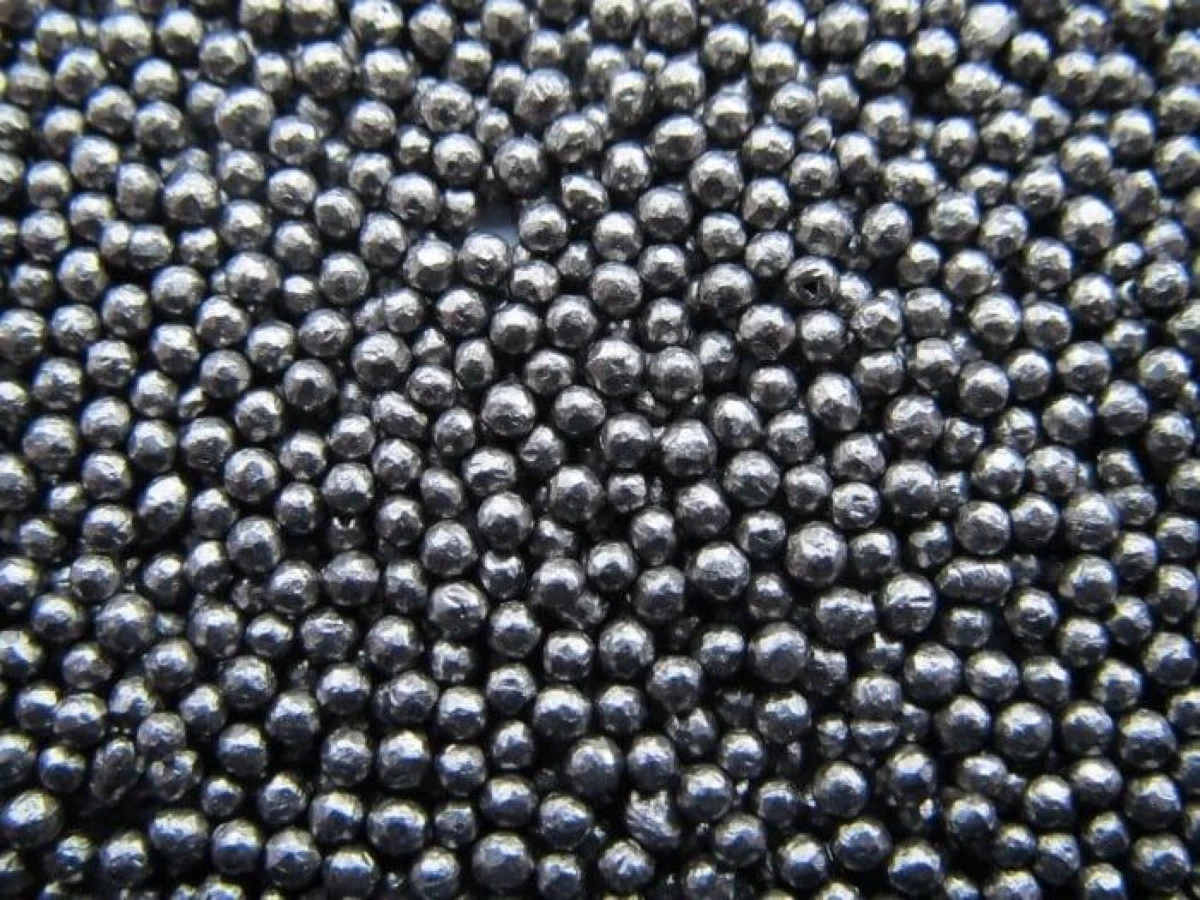
Illustrative spherical steel shot media. Confirm size, hardness, shape, and batch requirements for the actual process.
Cast steel shot is a spherical metallic abrasive produced from molten steel.
The molten metal is converted into particles, which are then processed and heat treated to achieve the required physical properties.
After manufacturing and conditioning, the particles are classified by size and supplied in different hardness grades for different blasting applications.
The most recognizable feature is its shape.
Cast steel shot is round.
That geometry gives it a predominantly impact-based blasting action.
When accelerated toward a workpiece, the spherical particle strikes the surface and rebounds. Repeated impacts loosen contaminants such as mill scale, oxidation, casting residue, and other surface deposits.
This makes cast steel shot common in:
- foundry cleaning
- forging operations
- steel fabrication
- automotive component processing
- general metal cleaning
- descaling
- shot peening
The exact grade still needs to be matched to the application.
A product should not be selected simply because it is labeled "steel shot."
For Promisteel's available round-media specifications, see the cast steel shot product page.
What Is Cut Wire Shot?
Cut wire shot starts with steel wire rather than molten steel droplets.
The wire is cut into small pieces to produce the abrasive particles.
Depending on the manufacturing and finishing process, the particles may be supplied in different forms, such as as-cut or conditioned/rounded shapes.
This is one of the major differences between cut wire shot and cast steel shot.
The basic manufacturing route is:
Steel wire -> cutting -> conditioning if required -> sizing -> final inspection
Because the starting material is wire, particle dimensions can be controlled through the wire diameter and cutting length.
That can provide useful dimensional consistency.
Cut wire shot is used in various blast cleaning and peening applications, particularly where controlled particle geometry and size are important.
But once again, application matters.
A cut wire product should not automatically be considered interchangeable with a cast steel shot simply because both are sold under similar nominal size descriptions.
How Are Cast Steel Shot and Cut Wire Shot Manufactured Differently?
The manufacturing route creates the starting point for their physical differences.
Cast steel shot begins as molten steel.
The material is formed into particles and then heat-treated and conditioned.
Cut wire shot begins as manufactured steel wire.
The wire is cut mechanically into small segments, which may then be conditioned to modify the particle shape.
This distinction matters because particle geometry affects how the media contacts the workpiece.
Think about two objects hitting a steel plate.
A sphere contacts the surface differently from a short cylindrical or conditioned wire segment.
The contact area, impact behavior, and way the particle rebounds are not identical.
This does not automatically make one process superior.
It means the two products should be evaluated as different abrasive technologies, even when their nominal size appears similar.
What Is the Difference in Particle Shape?
Particle shape is probably the easiest difference to see.
Cast steel shot is designed to be spherical.
Cut wire shot starts with a cylindrical piece of wire.
Depending on the conditioning process, the final particle may retain some of its original geometry or become more rounded.
That creates different contact behavior.
A spherical cast shot particle has no cutting edge.
Its main action is repeated impact.
Cut wire particles can have a different contact pattern, particularly when the ends and cylindrical surfaces interact with the workpiece.
For blast cleaning, this may influence:
- cleaning rate
- surface texture
- media movement
- recycling behavior
- particle wear
For peening, the difference becomes even more important because the media is not simply removing contamination.
The abrasive is deliberately interacting with the metal surface to create a controlled mechanical effect.
Is Cut Wire Shot More Consistent in Size?
It can offer strong dimensional control because the particle originates from wire with a defined diameter and is cut to a controlled length.
That is one reason cut wire shot is used in applications where particle geometry and size consistency are important.
However, buyers should distinguish between:
nominal size
and
actual particle size distribution.

Illustrative size samples. A nominal grade does not replace measured particle-size distribution or shape inspection.
A product name alone does not prove how tightly the particles are controlled.
For either cast steel shot or cut wire shot, a serious industrial buyer should ask for the relevant size specification and inspection data.
Depending on the agreed product specification, useful information may include:
- nominal particle size
- size distribution
- shape requirements
- hardness
- chemical composition
- batch identification
- applicable test method
A consistent particle population generally makes process control easier.
That matters even more when the abrasive is being used repeatedly in a production system.
How Does Hardness Compare?
Hardness is another area where buyers sometimes make an overly simple assumption.
It would be tempting to say:
"Cut wire shot is harder."
Or:
"Cast steel shot is harder."
Neither statement is reliable as a general rule.
Both types of steel media can be manufactured in different material grades and hardness ranges.
The correct comparison is between the actual specifications of the two products being evaluated.
For cast steel shot, hardness is commonly discussed using HRC or an agreed hardness classification.
Cut wire shot can also be produced using different steel materials and heat-treatment conditions.
So when comparing two products, ask for the actual hardness requirement and test method.
Do not compare only product names.
A more useful purchasing specification looks something like:
Product -> size -> hardness -> size distribution -> shape requirement -> test method -> batch documentation
That gives the production team something measurable.
Why Does Hardness Matter During Blast Cleaning?
Every abrasive particle experiences repeated mechanical impact during blasting.
If the particle is too soft for the application, it may wear or deform more quickly.
If the particle is appropriately hardened and processed, it may retain its useful characteristics for longer.
But hardness should not be viewed in isolation.
Actual abrasive life also depends on:
- particle size
- material composition
- microstructure
- blast wheel speed
- abrasive flow
- workpiece condition
- machine design
- separator efficiency
- recycling conditions
This is particularly important when comparing cast steel shot and cut wire shot.
A laboratory hardness number does not tell you everything about how a product will behave inside your machine. See the steel shot hardness and blasting performance guide for the hardness-breakdown-fines relationship.
A production trial is still the best way to evaluate actual performance.
Which Is Better for General Blast Cleaning?
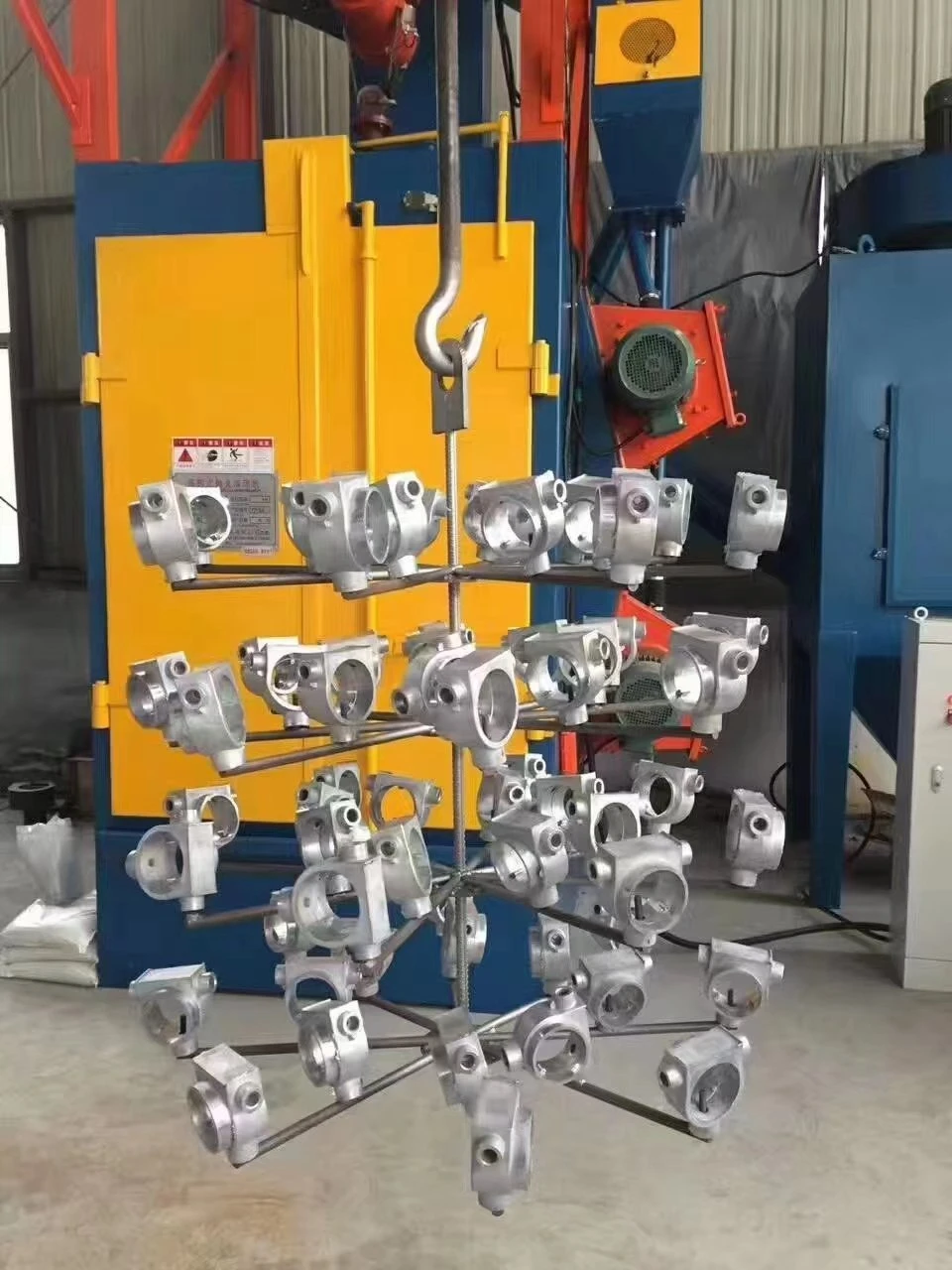
Through-feed wheel-blast equipment illustrates a closed-loop application where recycling behavior and working mix matter.

Hanger equipment illustrates why workpiece geometry and coverage must remain consistent during a media comparison.
There is no universal winner.
For many conventional wheel-blast cleaning operations, cast steel shot is a well-established choice.
Its spherical shape works well in closed-loop abrasive systems, where the media is repeatedly collected, separated and returned to the blast machine. The round steel shot for wheel blasting guide explains the role of rebound, recycling, and working mix.
Typical applications include:
- removing mill scale
- cleaning castings
- removing light oxidation
- cleaning forged components
- preparing metal surfaces for subsequent processing
Cut wire shot can also be effective for blast cleaning, particularly where its controlled particle dimensions or specific shape characteristics fit the process.
The important point is to compare the actual production result, rather than assume that the manufacturing route alone determines performance.
For example, a buyer should compare:
- Cleaning time
- Surface result
- Abrasive consumption
- Working mix stability
- Dust and fines
- Equipment condition
- Production throughput
If both products meet the required result, those numbers provide a much stronger basis for purchasing.
Can Cast Steel Shot and Cut Wire Shot Produce the Same Cleaning Result?
Sometimes they can produce acceptable results in the same general application.
That does not mean they are technically identical.
Abrasive selection should be based on the required result.
Suppose a factory is removing light mill scale from carbon steel components.
The main requirement may be:
- consistent cleaning
- high throughput
- controlled surface appearance
- low abrasive consumption
Both media types might be worth evaluating.
But if the application has a very specific surface requirement, the difference in particle geometry may become more significant.
This is why a production trial is useful.
Instead of asking:
"Can this product theoretically replace our current abrasive?"
ask:
"Can this product produce the same required result under our actual production conditions?"
That is a much safer question.
What About Shot Peening?

Technical diagram: a peening media change must be verified through the media specification, process settings, and verification and approval.
This is where the comparison requires extra caution.
Shot peening is not simply another form of blast cleaning.
The purpose is to create controlled plastic deformation at the surface of a metal component, producing a compressive residual stress layer that can improve fatigue performance in suitable applications.
Because the process is performance-sensitive, the media specification matters.
Particle size, hardness, shape, material condition, and process parameters can all influence the result.
For this reason, cast steel shot and cut wire shot should not be treated as automatically interchangeable in a qualified peening process.
If a manufacturer has already qualified a particular peening media, changing to another type requires technical evaluation and, where applicable, requalification.
This is especially important for components where fatigue performance is critical.
Examples may include:
- automotive springs
- gears
- shafts
- aerospace components
- critical mechanical parts
The question is not whether the new abrasive "looks similar."
The question is whether the finished component still meets the required performance criteria.
Why Is Media Shape So Important in Peening?
During shot peening, the media repeatedly impacts the metal surface.
The particle shape influences how the impact is transferred.
A properly controlled spherical shot produces a different contact condition from a cut wire particle.
If the particle geometry changes, other aspects of the peening process may also need to be reviewed.
These can include:
- coverage
- intensity
- surface condition
- particle velocity
- media flow
- exposure time
Therefore, replacing one media type with another should not be treated as a simple purchasing substitution.
A cheaper abrasive can become very expensive if it changes the finished component's performance and forces the manufacturer to repeat qualification work.
Is Cut Wire Shot Suitable for Peening?
Cut wire shot is used in some peening processes, but suitability depends on the exact product, process, and component requirements.
This distinction is important.
It would be incorrect to say that every cut wire product is suitable for peening.
It would also be incorrect to assume that every cast steel shot can be substituted for a qualified cut wire peening media.
The correct approach is:
Check the required media specification -> compare the candidate product -> run the required qualification -> verify the finished component.
For safety-critical or performance-critical parts, follow the applicable customer, engineering, and process requirements.
The abrasive supplier should provide technical documentation that allows the manufacturer to evaluate the change. The steel abrasive buyer's guide lists practical COA, TDS, SDS, and batch-control questions.
Cast Steel Shot vs. Cut Wire Shot: Practical Comparison
| Feature | Cast steel shot | Cut wire shot |
|---|---|---|
| Starting material | Molten steel | Steel wire |
| Manufacturing route | Particle formation and heat treatment | Wire cutting and conditioning if required |
| Typical shape | Spherical | As-cut cylindrical or conditioned form |
| Size control | Classified by particle size | Wire diameter and cut length |
| Cleaning action | Primarily impact | Depends on geometry and conditioning |
| Closed-loop recycling | Widely used | Product and application dependent |
| General cleaning | Widely used | Used in suitable applications |
| Shot peening | Used under qualified specifications | Used under qualified specifications |
| Direct interchange | Requires evaluation | Requires evaluation |
| Buyer priority | Size, hardness, shape, microstructure and consistency | Size, hardness, geometry, conditioning and consistency |
The table is a starting point, not a universal performance ranking. For a separate comparison of spherical shot and angular grit, read steel shot vs steel grit.
The actual result depends on the specific products and the production system.
What Should Buyers Compare Before Changing Media?
If you are currently using cut wire shot and considering cast steel shot, or the other way around, collect comparable information.
Start with the basic product specification.
1. Manufacturing Route
Understand how the media is produced.
This helps explain differences in particle geometry and physical behavior.
2. Particle Shape
Ask whether the media is spherical, as-cut, conditioned or otherwise specified.
3. Size
Do not compare only the product name.
Review the actual size distribution. Use the cast steel shot size selection guide to structure a size trial around the workpiece and machine.
4. Hardness
Confirm the required hardness range and test method.
5. Chemical Composition
Where relevant, confirm the agreed material composition.
6. Microstructure
For cast steel shot, microstructure can be an important quality consideration.
7. Batch Consistency
Ask how the supplier controls consistency from one shipment to the next.
8. Application History
A supplier should understand whether the media will be used for cleaning, peening or another process.
9. Qualification Requirements
For peening applications, establish whether customer or engineering approval is required before changing media.
Compare the main metallic-abrasive families on the steel shot and steel grit category page.
What Should You Measure During a Cleaning Trial?
A controlled cleaning trial can be relatively simple.
Keep the machine and workpiece conditions as consistent as possible.
Then record:
Blast time
How long does each product take to achieve the required cleaning condition?
Surface appearance
Is the result consistent?
Abrasive consumption
How many kilograms of fresh media are required during the trial?
Working mix
Does the circulating abrasive remain stable?
Fines
Does one product generate noticeably more breakdown material?
Production throughput
How many acceptable parts can be processed during a defined period?
Equipment condition
Are there any noticeable changes in wheel, liner or other wear areas?
The purpose is not to prove that one product is always better.
The purpose is to find out which product fits your particular process.
What Changes When the Application Is Shot Peening?
The trial requirements become much stricter.
For cleaning, visual inspection and production measurements may provide a useful first evaluation.
For peening, the qualification process needs to be based on the applicable engineering or customer requirements.
Depending on the application, the evaluation may involve:
- media specification
- particle size
- hardness
- shape
- machine settings
- intensity
- coverage
- surface condition
- component performance
- process documentation
A peening process should not be changed simply because a replacement abrasive has a similar size.
If the component is safety-critical, the consequences of an unqualified media change can be far greater than the difference in abrasive price.
When Should You Avoid Direct Substitution?
Be particularly careful when:
- the current media is part of a qualified peening process
- the component is fatigue-critical
- the customer has approved a specific media specification
- the abrasive shape is explicitly controlled
- the surface result has a narrow acceptance range
- the process is already highly optimized
- the new media has a different hardness or size distribution
In these situations, treat the new abrasive as a process change, not merely a new supplier.
That mindset can prevent costly mistakes.
A Simple Decision Guide
If your primary objective is general industrial cleaning:
Start by comparing the actual cleaning performance and operating cost of the two media.
If your process depends heavily on closed-loop wheel blasting:
Evaluate recycling behavior, working mix stability, and abrasive consumption.
If particle size consistency is especially important:
Request the actual size distribution rather than relying on the product name.
If hardness is critical:
Confirm the hardness range and test method.
If the application is shot peening:
Do not assume interchangeability. Check the process requirements and qualification procedure before changing media.
If the two products both appear suitable:
Run a controlled production trial before making a bulk purchasing decision.
A Practical Example: Replacing Cut Wire Shot With Cast Steel Shot
Reference before-and-after comparison. Use identical acceptance criteria when testing a replacement metallic abrasive.
Imagine an automotive component manufacturer currently uses cut wire shot in a cleaning operation.
The purchasing team receives a competitive offer for cast steel shot.
The price looks attractive.
Instead of changing the entire production line immediately, the factory runs a controlled trial.
The team keeps the same:
- workpieces
- machine
- blast time
- operating conditions
- acceptance criteria
They then compare:
| Trial metric | Current cut wire shot | Cast steel shot |
|---|---|---|
| Blast time | Baseline | Measured |
| Fresh media consumption | Baseline | Measured |
| Accepted parts | Baseline | Measured |
| Surface result | Baseline | Measured |
| Fines generation | Baseline | Measured |
| Working mix | Baseline | Measured |
| Equipment condition | Baseline | Measured |
If cast steel shot produces an equivalent or better cleaning result with acceptable consumption and stable operation, the factory has evidence for the purchasing decision.
If it does not, the lower quotation price is no longer attractive.
The same logic applies in the opposite direction.
Why a Similar Particle Size Does Not Mean Equivalent Performance
This is one of the most important points for buyers.
Two products may both be described as, for example, a similar nominal size.
That does not mean they will behave identically.
The final behavior is influenced by:
Material + manufacturing route + shape + hardness + size distribution + machine + working conditions
That is why changing abrasive should be treated as a process decision.
The product specification tells you what the abrasive is.
The production trial tells you what it does.
You need both.
What Documents Should You Request From the Supplier?
For an industrial purchase, useful documentation may include:
- Certificate of Analysis (COA)
- product technical data
- particle size distribution
- hardness information
- chemical composition
- batch number
- applicable manufacturing or product specification
- packaging details
For peening applications, ask for whatever additional documentation is required by your engineering or customer qualification procedure.
The supplier should be able to identify the material supplied by batch.
This becomes especially important when a factory runs repeated shipments over several months.
If production performance changes, batch traceability makes the investigation much easier.
Before substituting media in a qualified process, contact the Promisteel team with the current specification and acceptance criteria.
Common Mistakes When Comparing Cast Steel Shot and Cut Wire Shot
Comparing Only Price
A lower price per ton does not automatically mean lower production cost.
Comparing Only Nominal Size
Two products with similar size labels can have different particle geometry and size distributions.
Assuming Hardness Tells the Whole Story
Hardness needs to be considered together with material quality, shape, microstructure, and application.
Treating Peening Media as Interchangeable
This is the most serious mistake to avoid.
A qualified peening process should not be changed without appropriate technical evaluation.
Skipping the Production Trial
Laboratory specifications are useful, but actual machine performance is what matters in production.
Ignoring Batch Consistency
A supplier may provide an excellent first shipment but fail to maintain the same characteristics later.
For continuous industrial production, repeatability matters as much as the initial result.
Cast Steel Shot vs. Cut Wire Shot: Buyer Checklist
Before approving a media change, confirm:
- Current abrasive type
- New abrasive type
- Manufacturing route
- Particle shape
- Nominal size
- Actual size distribution
- Hardness
- Chemical composition
- Microstructure where applicable
- Blast machine type
- Current machine settings
- Cleaning requirement
- Surface acceptance criteria
- Abrasive consumption
- Working mix behavior
- Batch traceability
- COA and technical documentation
- Production trial
- Peening qualification, if applicable
This checklist is especially useful when the purchasing department is considering a supplier change based primarily on price.
FAQ
Can cast steel shot replace cut wire shot?
It may be evaluated for some cleaning operations, but substitution should be confirmed through a controlled production trial. In a qualified peening process, follow the applicable engineering and requalification requirements.
Which media is better for general blast cleaning?
There is no universal winner. Compare cleaning time, accepted output, surface result, consumption, fines and equipment behavior using the actual candidate grades.
Is cut wire shot always more consistent in size?
Wire diameter and cut length can provide strong dimensional control, but the buyer should still verify the actual size distribution, conditioning, and inspection method for the supplied product.
Why is particle shape important in shot peening?
Particle geometry affects how impact is transferred to the surface. A change in media shape can influence intensity, coverage, and surface condition, so it should be reviewed as a process change.
Final Takeaway
The comparison between cast steel shot vs cut wire shot is not simply a question of which steel abrasive is stronger, cheaper or more durable.
The two products begin with different manufacturing routes.
Cast steel shot is formed from molten steel and processed into spherical particles.
Cut wire shot begins with steel wire that is cut into controlled lengths and may be conditioned to modify the particle shape.
Those differences can affect the way the media behaves in a blasting system.
For general cleaning, both can have a place depending on the application.
For shot peening, however, the decision requires considerably more care. A media change can become a process change, and a process change may require qualification before it is accepted for production.
The safest purchasing approach is therefore straightforward:
Compare specifications -> check the application -> run a controlled trial -> measure the production result -> qualify the change where required.
Do not choose between cast steel shot and cut wire shot simply because one quotation is lower.
Choose the product that can deliver the required cleaning or peening result consistently, economically and with the necessary technical approval.
For related grades, standards and packing options, return to the steel shot and steel grit category.
If you are currently using cut wire shot and considering cast steel shot, or if you are evaluating a new steel abrasive supplier, provide the current media specification, machine information and application requirements.
A side-by-side production trial can often answer the question much more reliably than a product catalogue.
Before substituting media in a qualified process, contact the Promisteel team with the current specification and acceptance criteria.
Compare the Process Before Changing the Media
Promisteel can review the current specification, candidate grade, machine, workpiece, acceptance criteria and trial plan before a bulk order or qualified process change.
Contact PromisteelDiscuss on WhatsApp


