
 Español
 Türkçe
 Français
 عربي
عربي  dansk
dansk 한국어
한국어 Deutsch
 Việt Nam
 Italiano
 日本語
日本語 Português

A stable steel shot working mix is the controlled population of new, worn, and smaller reusable particles circulating through a blast machine. Stability depends on new-media quality, blasting conditions, separator and screen performance, regular sampling and a data-based top-up rate, not on filling the machine with 100% new shot.
Is cleaning performance or abrasive consumption becoming unstable? Send your machine, shot specification, top-up records and representative working-mix data.
Request a Technical Review
Contents
A blasting machine can be loaded with high-quality steel shot and still produce inconsistent results.
That sounds strange at first.
If the abrasive specification is correct, why would the cleaning result change?
The answer is often found inside the machine.
In a recirculating blasting system, the steel shot hitting the workpiece is rarely 100% new abrasive. Fresh shot is mixed with particles that have already gone through many blasting cycles. Some particles remain close to their original size. Others have become smaller, worn, or fractured. Fine material is gradually removed through the separation system.
This constantly changing mixture is known as the steel shot working mix.
For a production engineer, the working mix is much more than a technical term.
It can influence cleaning speed, surface consistency, abrasive consumption, dust generation, and the stability of the entire blasting process.
A factory that monitors only how many tons of new steel shot it purchases each month may miss what is actually happening inside the machine.
The better approach is to manage the abrasive that is circulating, not just the abrasive that arrives in new bags or bulk containers.
For the available abrasive specifications and selection routes, review the steel shot and steel grit product category.
What Is a Steel Shot Working Mix?
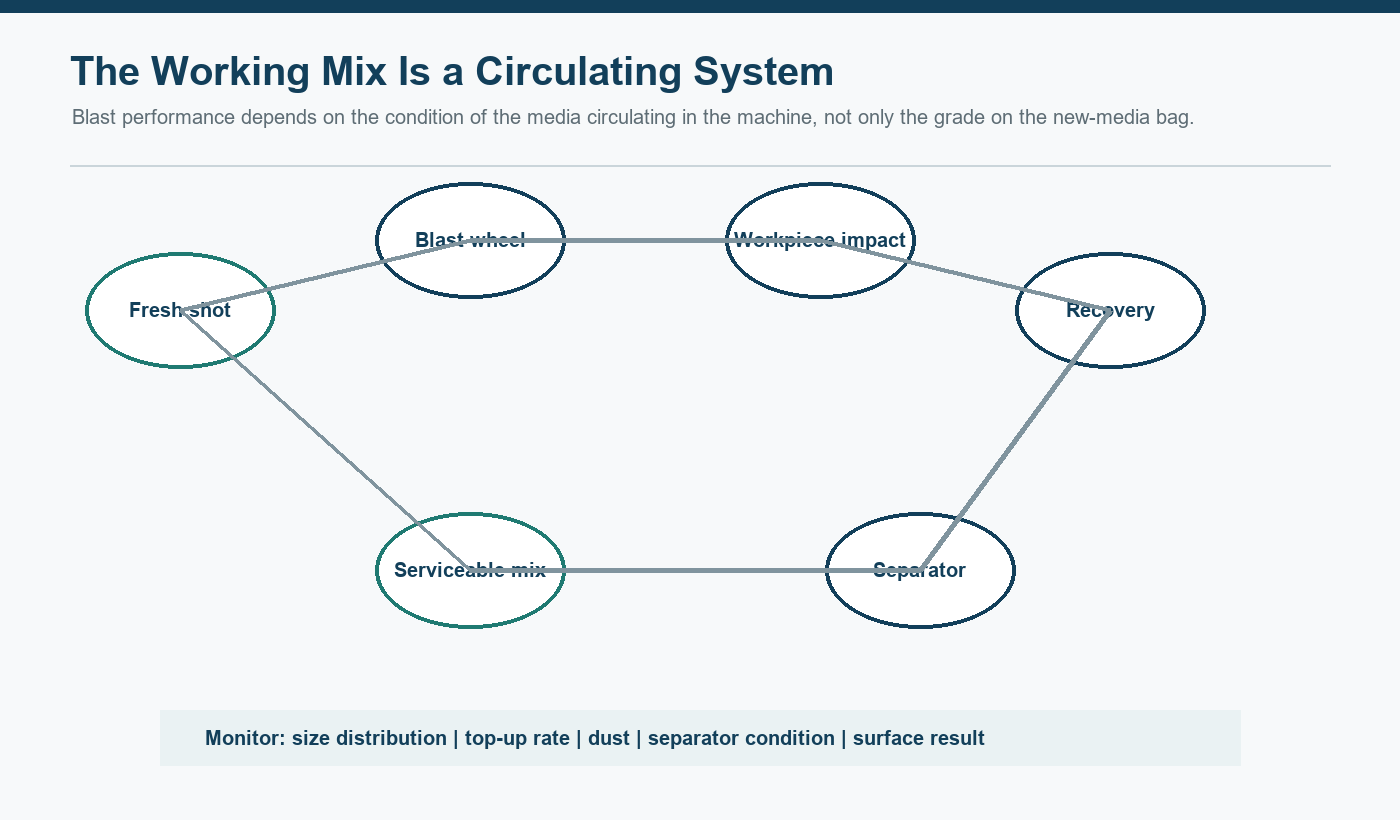
Fresh media enters a recirculating system while reusable particles return and unsuitable fines leave.
A steel shot working mix is the population of abrasive particles circulating through a blast machine during normal operation.
It can contain:
- relatively new steel shot
- partially worn particles
- smaller particles produced by repeated impact
- broken or irregular particles
- fines and dust
- material removed from the workpiece
The exact composition changes continuously.
Every time the machine operates, some fresh media enters the system.
At the same time, existing particles are repeatedly accelerated toward the workpiece and eventually begin to wear or break down.
The separator removes material that is no longer suitable for effective blasting, while usable abrasive returns to the circulation system.
The result is a moving balance.
Fresh media enters -> abrasive is used -> particles break down -> unsuitable material is removed -> usable media returns -> fresh media is added again.
A stable working mix is achieved when this cycle is controlled well enough to deliver consistent blasting performance.
It is not necessary to keep the machine filled with 100% new steel shot.
In fact, doing so in a continuous production environment would usually be wasteful.
The objective is a stable and productive mix, not a constantly fresh one.
Why Is the Working Mix So Important?
Imagine a steel plate processing line that runs the same type of workpiece every day.
The machine settings have not changed.
The operator has not changed the nominal steel shot size.
Yet the surface coming out of the machine gradually becomes less consistent.
The first thing the production team may check is the blast wheel.
That is reasonable.
But the working mix should also be investigated.
If too much of the circulating abrasive has broken down into small particles, the machine may no longer deliver the same effective impact as it did when the mix was healthier.
The consequences can include:
- slower cleaning
- longer blasting cycles
- inconsistent surface appearance
- increased dust
- higher fresh abrasive consumption
- unstable surface profile where applicable
On the other hand, if oversized or unsuitable particles remain in the system because the separation process is poorly adjusted, the mix can also become unbalanced.
The working mix therefore sits between the abrasive specification and the actual production result.
That is why plant engineers should monitor it as part of routine process control.
How Does New Steel Shot Enter the Working Mix?
Fresh steel shot is normally added to compensate for abrasive that has been removed from the system or consumed through breakdown.
This is often called the top-up rate.
The required top-up rate varies from one operation to another.
It depends on factors such as:
- steel shot size
- hardness
- workpiece condition
- blast intensity
- production volume
- machine efficiency
- separator settings
- contamination entering the abrasive circuit
- recycling performance
A factory processing heavily scaled steel plate may have a very different abrasive addition rate from a foundry cleaning smaller castings.
For this reason, there is no useful universal statement such as:
"Add X kilograms of steel shot per ton of steel."
Such a number may be valid for one production line and completely wrong for another.
The more useful approach is to establish a baseline from your own machine.
Record the amount of new media added over a defined production period.
Then compare it with:
- tons of workpieces processed
- machine operating hours
- cleaning cycle time
- working mix condition
- separator discharge
Over time, these records become a useful production benchmark.
What Happens to Steel Shot During Repeated Blasting?
Steel shot is designed to withstand repeated impact, but it does not remain unchanged forever.
During operation, particles repeatedly experience mechanical impact.
Some remain usable for many cycles.
Others gradually become smaller or change shape.
Eventually, particles that are too small or otherwise unsuitable need to be removed from the system.
This is where the separation system becomes important.
The machine is effectively trying to answer one question continuously:
Which abrasive particles are still useful, and which should leave the system?
A well-managed separation process helps maintain that balance.
An ineffective separation process can allow too much unwanted material to circulate.
That means the condition of the working mix is not determined by the steel shot alone.
It is determined by the interaction between:
Abrasive quality + blasting conditions + recycling + separation + top-up
This is also why changing suppliers does not always solve a working-mix problem.
Before attributing instability to a batch, compare its size and hardness documentation with the cast steel shot specification.
The abrasive may be perfectly acceptable while the recycling system is poorly adjusted.
What Does the Separator Do?
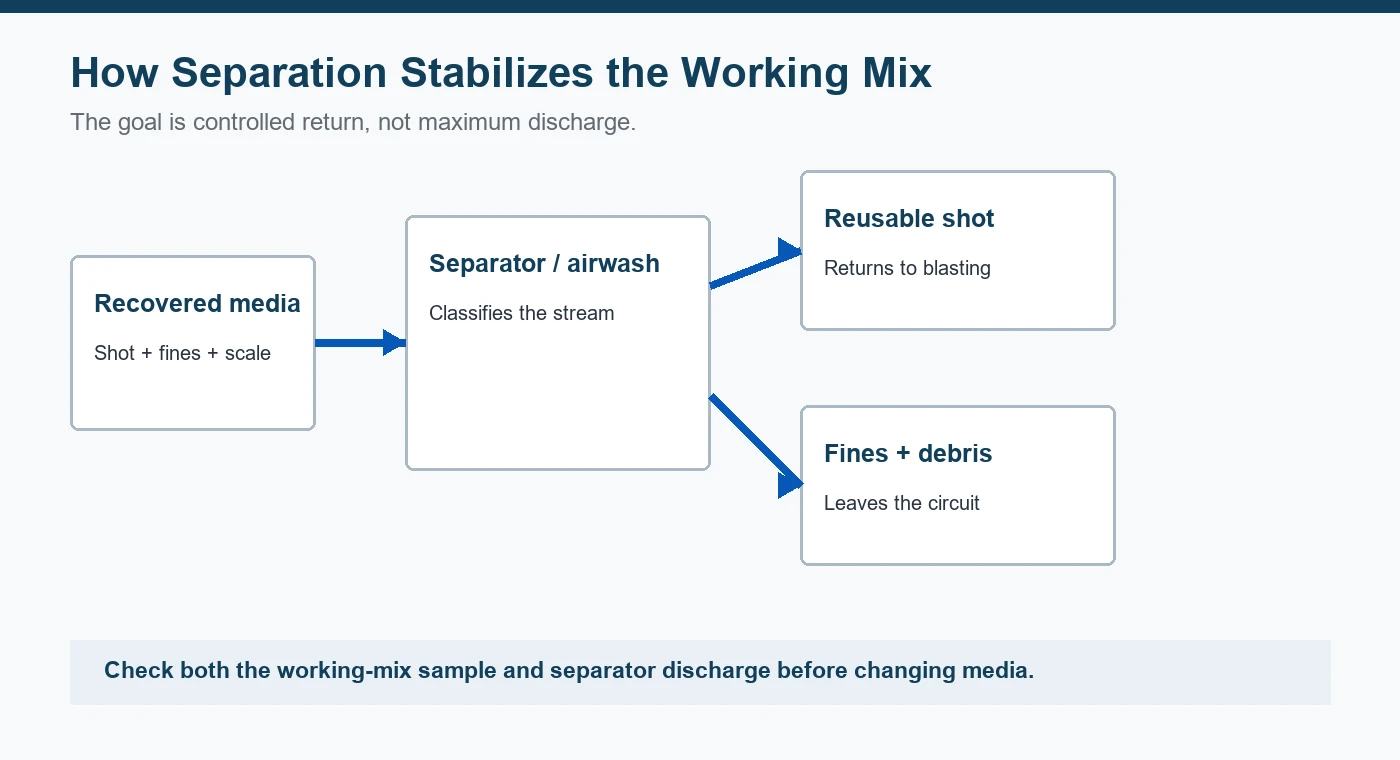
A stable separator returns serviceable shot while removing fines, scale and lightweight debris.
The separator is one of the most important components in a recirculating blast system.
Its job is to separate usable abrasive from unwanted material.
Depending on the machine design, the separation system may remove:
- broken abrasive
- fines
- dust
- scale
- sand
- other contaminants from the workpiece
The usable portion of the abrasive is returned to the blast circuit.
The unwanted fraction is discharged.
The exact design varies between machines, so the separator should be adjusted according to the equipment manufacturer's recommendations and the actual operating condition.
The key point is simple:
The separator controls what stays in the working mix.
If it removes too much usable abrasive, fresh media consumption can increase unnecessarily.
If it removes too little unwanted material, fines and debris can accumulate.
Neither situation is ideal.
What Is Airwash Separation?
Many industrial blasting systems use an airwash or air separation process as part of abrasive cleaning.
The principle is relatively straightforward.
An airflow is used to separate particles according to differences in characteristics such as size, density and aerodynamic behavior.
Lighter unwanted material can be carried away while heavier usable steel shot falls back into the abrasive stream.
The exact airflow and separator design depend on the machine.
This is why airwash adjustment should not be treated as a universal setting.
Too much air can remove usable abrasive together with unwanted fines.
Too little air can allow excessive dust and lightweight debris to remain in circulation.
For production engineers, the important question is not:
"Is the airwash set high or low?"
It is:
"Is the separator producing the required working mix?"
That can be determined by examining the abrasive sample and the separator discharge.
Why Do Screens Matter?
Screens or screening systems can also play an important role in abrasive management, depending on the blasting equipment.
They help control particle size distribution by separating particles according to size.
During repeated blasting, steel shot gradually produces smaller particles.
If these particles remain in the working mix, the size distribution can gradually shift.
That may change the way the abrasive interacts with the workpiece.
A screen that is damaged, incorrectly selected, or poorly maintained may therefore contribute to an unstable abrasive population.
Operators should periodically check:
- screen condition
- blocked openings
- damaged sections
- accumulated debris
- correct installation
- maintenance records
A simple inspection can sometimes explain a change in abrasive performance that initially appears to be a steel shot quality problem.
How Often Should You Sample the Working Mix?
There is no single sampling frequency suitable for every factory.
A high-volume production line operating continuously may need more frequent monitoring than a small blasting cabinet used occasionally.
The appropriate schedule should reflect:
- production volume
- machine type
- abrasive consumption
- sensitivity of the finished surface
- historical stability
- frequency of process changes
For a stable high-volume line, a regular routine sample can help identify changes before they become production problems.
Sampling becomes even more important after:
- changing steel shot suppliers
- changing shot size
- changing hardness
- repairing the separator
- replacing screens
- changing machine settings
- introducing a new workpiece
The purpose of sampling is not to create paperwork.
It is to identify trends.
A single sample may tell you what the working mix looks like today.
A series of samples tells you whether the process is becoming more stable or less stable.
What Should You Look for in a Working Mix Sample?
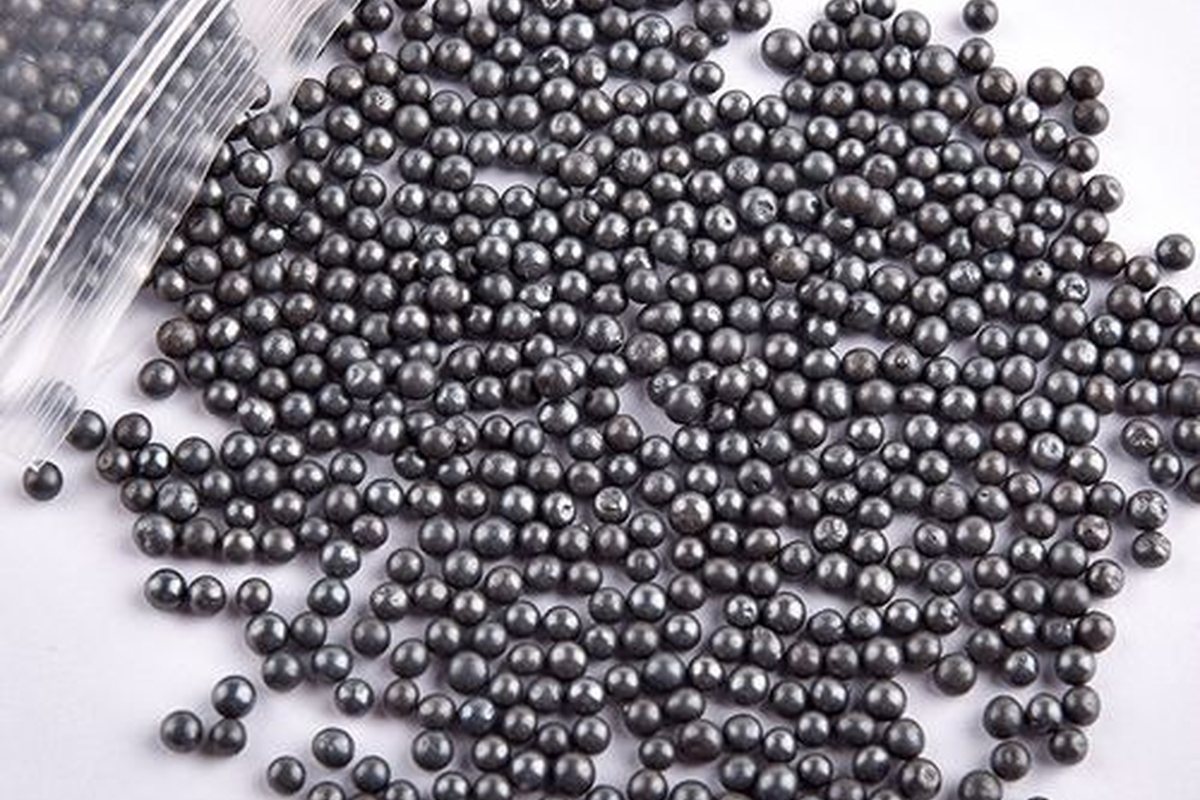
Compare representative samples under consistent lighting and scale to identify changes in size distribution and fines.
If the sample has shifted toward a different size range, use the cast steel shot size selection guide as a supporting reference.
The sample should be evaluated systematically.
Start with the particle size distribution.
Is the mix still within the operating range expected for the machine?
Then look for excessive fines.
A visible increase in very small particles may indicate increased breakdown or inadequate separation.
Also look for:
- unusual particle shapes
- broken shot
- excessive dust
- foreign material
- contamination from the workpiece
If possible, compare the current sample with a previous sample from the same production line.
This comparison is often more useful than judging the material in isolation.
For example:
Sample A: taken after a stable production period.
Sample B: taken after abrasive consumption begins increasing.
If Sample B contains noticeably more fines and broken particles, the production team has a useful starting point for investigation.
How Do You Know If the Working Mix Is Unstable?
An unstable working mix does not always announce itself with one obvious failure.
More often, several smaller changes appear together.
Watch for these signs:
- cleaning takes longer than normal
- the same machine settings produce a different surface
- abrasive top-up increases
- fines in the separator discharge increase
- dust generation changes
- surface profile becomes inconsistent
- operators need to adjust settings more frequently
- new steel shot appears to "disappear" unusually quickly
One sign alone may not prove that the working mix is the problem.
But several signs appearing at the same time deserve investigation.
For example, if abrasive consumption rises while cleaning becomes slower and the working mix contains more fines, simply increasing the fresh shot addition rate may not solve the underlying issue.
The separator, airwash, and screening system should also be checked.
What Happens When There Are Too Many Fines?
Excessive fines are one of the more common working-mix problems.
Very small particles do not provide the same impact behavior as correctly sized steel shot.
If too many fines remain in circulation, they can dilute the effective abrasive population.
Possible results include:
- reduced cleaning efficiency
- longer blasting time
- increased dust
- higher media consumption
- inconsistent surface results
This does not mean every fine particle is a problem.
Some breakdown is normal.
The issue is whether the amount of fines is consistent with the machine's operating requirements.
A properly adjusted separator should continuously remove material that has reached the end of its useful blasting life.
What Happens If Too Much Usable Steel Shot Is Removed?
When angular cutting action is being considered instead of round-shot impact, compare the application with cast steel grit before changing the working mix.
The opposite problem is also possible.
If separation is too aggressive, usable steel shot may be discharged together with unwanted material.
The factory then needs to add more fresh abrasive to maintain the working mix.
The purchasing department may see this as:
"Our steel shot consumption is too high."
But the actual problem could be:
"Our separator is throwing away usable abrasive."
This distinction matters.
Before changing suppliers, check the separator discharge.
If a significant quantity of usable steel shot is being removed, correcting the separation process may reduce consumption without changing the abrasive specification.
That can be a much cheaper solution.
How Should You Control the Top-Up Rate?
The top-up rate should be based on actual production data.
A simple system is to record:
Fresh steel shot added ÷ production volume
For example, a plant can monitor the kilograms of fresh shot added per ton of processed steel.
The exact benchmark will depend on the operation.
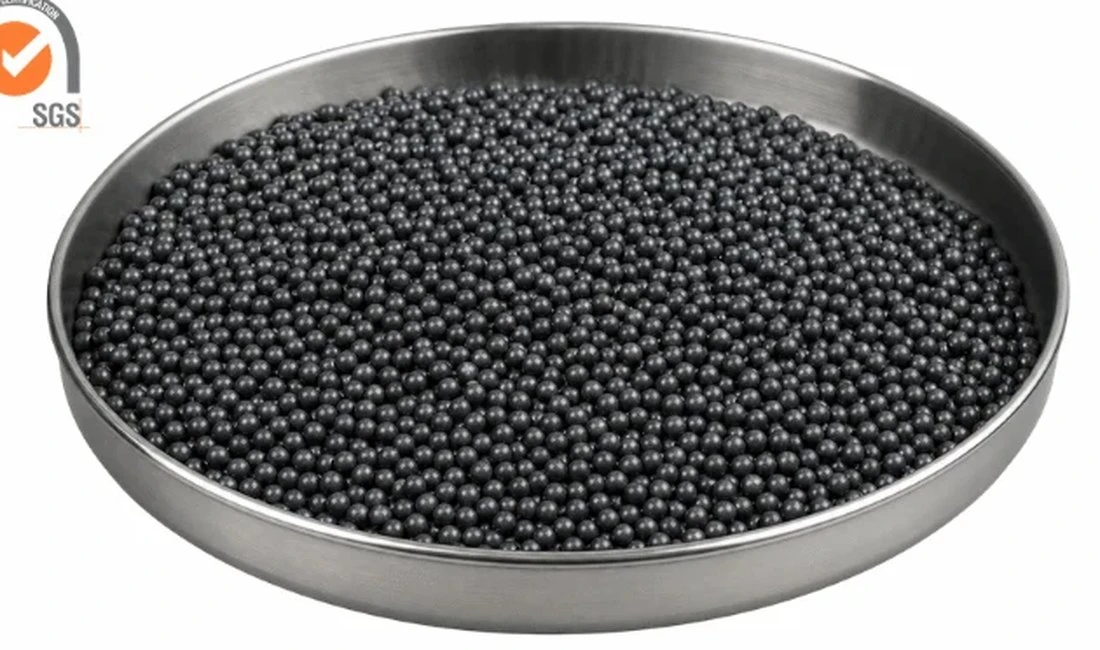
Fresh-shot additions should be tracked against production volume, operating hours, and accepted cleaning results.
The important part is consistency.
If the plant normally operates within a relatively stable range and the figure suddenly increases, investigate the reason.
Possible causes include:
- increased contamination
- higher production intensity
- separator changes
- screen problems
- increased abrasive breakdown
- changes in shot size
- changes in hardness
- blast wheel adjustments
- equipment wear
Do not automatically conclude that the new steel shot is defective.
The production system should be checked as a whole.
Should You Add More New Steel Shot When Cleaning Becomes Slow?
Not always.
This is an easy reaction on the production floor:
"Cleaning is slower. Add more abrasive."
Sometimes it works.
Sometimes it simply increases the amount of abrasive in the machine without fixing the actual problem.
Before increasing the top-up rate, check:
- working mix
- separator
- airwash
- screens
- blast wheel
- abrasive flow
- wheel speed
- workpiece condition
If the mix contains too many fines, adding fresh shot may temporarily improve the result.
But if the separator continues to operate incorrectly, the same problem may return.
A stable process is better than repeatedly correcting an unstable process with additional material.
How Can You Build a Working Mix From New Steel Shot?
When starting a new machine or introducing a new abrasive specification, the working mix needs time to develop.
Fresh steel shot initially represents a much more uniform particle population.
As production continues, the abrasive begins to circulate and gradually develops a mixture of different particle ages and sizes.
During this period, operators should pay close attention to:
- cleaning result
- abrasive consumption
- separator discharge
- fines generation
- surface consistency
The goal is not to rush the process by continuously adding large quantities of fresh abrasive.
Instead, allow the machine's recycling system to establish a stable operating condition while monitoring the results.
The exact procedure should follow the blast machine manufacturer's operating instructions.
What Information Should Be Recorded?
A working-mix management program does not need to be complicated.
A basic production log can include:
Date
Workpiece
Steel shot size
Hardness
Machine operating hours
Production volume
Fresh shot added
Working mix sample result
Separator condition
Screen condition
Cleaning result
Operator observations
Over several weeks, this information becomes valuable.
You can see whether abrasive consumption is stable.
You can identify whether a particular batch of steel shot behaves differently.
You can also connect a change in surface quality with a change in machine operation.
That is much more useful than relying on memory.
A Practical Example: When Abrasive Consumption Suddenly Increases
Consider a steel fabrication plant running an automated wheel blast line.
For several months, the plant has maintained a relatively stable steel shot consumption rate.
Then the monthly consumption increases.
At the same time, operators report that some workpieces require a longer blasting cycle.
The purchasing department assumes the latest batch of steel shot has a shorter service life.
Before changing suppliers, the production engineer checks the system.
The inspection finds that:
- the working mix contains more fines
- the separator airflow has changed
- the screen has accumulated debris
- more usable shot is being discharged than usual
The plant corrects the separation system.
After several production cycles, the working mix becomes more stable and fresh abrasive consumption falls.
In this situation, the problem was not necessarily the steel shot.
It was the abrasive management system.
This is exactly why working-mix control matters.
How Often Should You Check the Separator and Screens?
Inspection frequency should be based on machine design and production conditions.
However, routine maintenance should be part of the blasting process rather than something done only after a problem appears.
Operators should follow the equipment manufacturer's maintenance recommendations and pay attention to changes in:
- separator discharge
- airflow
- screen condition
- dust level
- abrasive consumption
- cleaning performance
A small change in the separation system can eventually affect thousands of kilograms of circulating abrasive.
Early detection is usually easier and cheaper than correcting a heavily unstable working mix later.
What Is a Good Working Mix Management Strategy?
A practical approach can be summarized in seven steps.
Step 1 - Start with the correct new steel shot
Confirm size, hardness, and quality documentation.
Step 2 - Establish a baseline
Record cleaning performance and initial abrasive consumption.
Step 3 - Monitor the working mix
Take samples at a defined frequency appropriate for your production line.
Step 4 - Check the separator
Make sure usable shot is returning while fines and contamination are being removed.
Step 5 - Inspect screens and airwash
Look for blocked screens, excessive discharge or inadequate separation.
Step 6 - Control the top-up rate
Use actual production data rather than adding fresh shot based only on operator intuition.
Step 7 - Investigate changes
When cleaning, consumption or surface quality changes, inspect the complete system before changing the abrasive specification.
This approach turns working-mix management into a repeatable production process.
When Should You Contact Your Steel Shot Supplier?
Your abrasive supplier should be involved when the problem may be related to the material itself.
For example:
- a new supplier is being evaluated
- a new shot size is required
- hardness is being changed
- abrasive breakdown appears unusually high
- particle size distribution is inconsistent
- a new workpiece is being introduced
- the machine has been significantly modified
Useful information to provide includes:
- current shot size
- hardness
- machine type
- blast wheel information
- production volume
- current top-up rate
- working mix sample
- separator condition
- photos of the workpiece
- photos of the blasted surface
The more information the supplier receives, the less likely the recommendation will be based on guesswork.
A supplier can make a more useful recommendation when the inquiry starts from a documented shot size and hardness specification and representative operating data.
Steel Shot Working Mix Checklist
Before assuming that your abrasive is the problem, check:
- Is the new steel shot specification correct?
- Is the working mix within the expected particle size range?
- Are excessive fines accumulating?
- Is the separator working correctly?
- Is the airwash correctly adjusted?
- Are screens clean and undamaged?
- Is usable shot being discharged unnecessarily?
- Has the top-up rate changed?
- Has the workpiece condition changed?
- Has blast wheel performance changed?
- Has abrasive flow changed?
- Has machine maintenance been completed?
- Are working-mix samples being taken regularly?
This checklist can help production teams avoid making an expensive purchasing decision before checking the equipment.
Final Takeaway
A stable steel shot working mix is one of the foundations of consistent blasting performance.
The new abrasive you purchase is only the starting point.
Once the machine begins operating, the abrasive becomes part of a continuously changing system. Particles are recycled, worn, separated and replaced.
That means production performance depends on more than the specification printed on the steel shot bag.
The key relationship is:
New Media -> Repeated Blasting -> Breakdown -> Separation -> Working Mix -> Top-Up -> Stable Production
If the balance is maintained, the machine can deliver consistent cleaning while controlling abrasive consumption.
If the balance becomes unstable, the first symptoms may appear as slower cleaning, rising consumption, more fines, or inconsistent surface results.
The solution is not always "buy better steel shot."
Sometimes the right solution is to adjust the separator, inspect the screens, correct the airwash, or review the top-up rate.
For this reason, plant engineers and abrasive suppliers should look at the whole blasting system, not just the abrasive itself.
If you are experiencing unstable cleaning results or unexpectedly high steel shot consumption, provide your current abrasive specification, machine information, and working-mix data before changing the product.
For a broader purchasing comparison of round and angular metallic abrasives, read the cast steel shot and steel grit buyer's guide.
A controlled working mix can make the difference between a blasting line that simply runs and one that runs consistently, predictably and economically.
Frequently Asked Questions
What is a steel shot working mix?
It is the changing population of relatively new, partially worn, smaller and sometimes fractured particles circulating through a blast machine. A controlled mix includes reusable abrasive while the separator removes unsuitable fines, dust and contamination.
How often should a working mix be sampled?
There is no universal interval. Set the frequency according to production volume, machine type, consumption history and surface sensitivity, and sample again after changes to shot size, hardness, supplier, separator, screens, machine settings or workpiece type.
Why can excessive fines slow blast cleaning?
Very small particles do not deliver the same impact behavior as correctly sized steel shot. When fines become excessive, they can dilute the effective abrasive population, increase dust, and contribute to longer cycles or inconsistent results.
Can adding fresh steel shot fix slow cleaning?
Sometimes it gives a temporary improvement, but it will not correct a separator, airwash, screen, wheel or flow problem. Inspect the complete circulating system before increasing the top-up rate.
How can separator settings affect abrasive consumption?
An overly aggressive separator can discharge reusable shot and force higher fresh-media additions. An ineffective separator can leave excessive fines and debris in circulation. The discharge and representative working-mix sample should be evaluated together.
What data should be sent to a steel shot supplier?
Provide the shot size and hardness, machine and wheel information, production volume, current top-up rate, working-mix sample, separator and screen condition, plus photographs of the workpiece and blasted surface
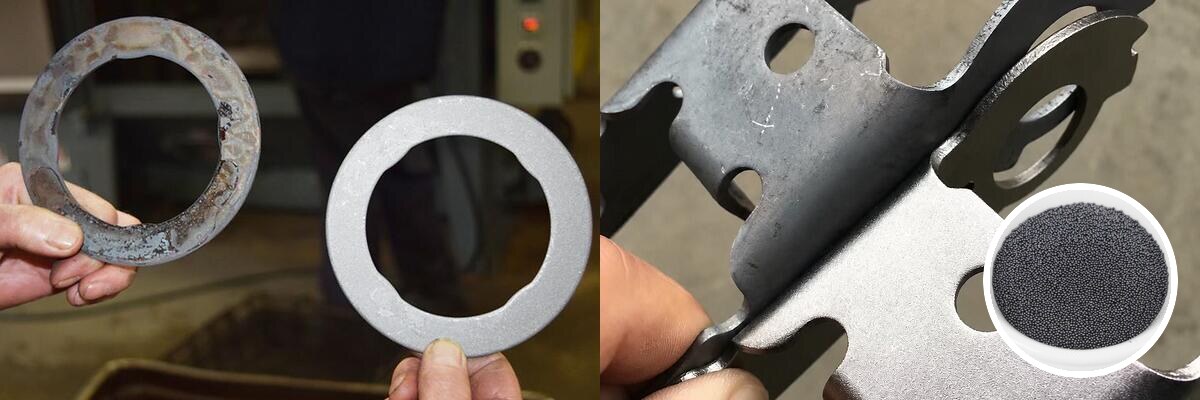
Incoming steel shot should be verified by specification, then evaluated as part of the complete recirculating process.
Review the Working Mix Before Changing the Abrasive
Share the current shot size and hardness, machine type, production volume, fresh-media additions, separator condition and representative samples. Promisteel can help identify a practical trial and purchasing route.
Contact PromisteelDiscuss on WhatsApp


